Tag: Mindset

  • Enjoyment v’s Perfection; Release the Pressure!

    [fusebox_track_player url=”https://dts.podtrac.com/redirect.mp3/pdcn.co/e/traffic.libsyn.com/dailystridespodcast/1353_Enjoyment_vs_Perfection_Release_the_Pressure.mp3″ title=”Enjoyment V’s Pressure; Release the Pressure!” social_linkedin=”true” social_pinterest=”true” social_email=”true” ]

    Have you been allowing your goal of ‘doing things right’ to suck the joy and fun out of horse riding for you? Maybe you’ve been wanting to get back into riding after a long break, but you stop yourself because things are not 100% perfect. There’s a time and a place for perfection. Every single moment that you’re interacting with your horse is NOT that time!

    Today, I want to encourage you to let go of perfection. Release the pressure you’re putting on yourself and your horse for everything to be amazing. And just be present and enjoy the moment – warts and all! 

    Have you ever watched children playing and noticed how much pure fun they usually have? They are not worried about ‘playing the correct way’ or ‘doing it the right way’. They are simply there, at the moment, enjoying it as it all unfolds before them.

    Here’s how to begin approaching your riding and interactions with your horse the same way…

    Perfection Leaves Little Room for Fun!

    Years ago, I worked at a yard exercising horses. One of those horses was, in my opinion, really special. I absolutely adored working with him and riding him. After about a year, that same horse came up for sale. I was delighted and immediately made a plan and bought him. And then everything changed…

    Within a week I was falling off more than staying on! Things that were simple before felt impossible. Until I gave up! I admitted defeat, made the decision to sell him, and just stopped trying. And like magic – things were amazing again!

    You can work on improving yourself – AND have fun while doing it. So can your horse. If frustration, disappointment, or even avoidance make up a big part of your riding – you need to learn to release perfection. 

    Back then, I had been trying too hard with my new horse. I had placed so much emphasis on making everything perfect and right, that it was actually ruining everything!  Now, I’m not telling you this to say ‘give up’, but to show you how perfection can really and truly ruin so much in your riding.

    The Rider You ‘Used to Be’

    Another way this shows up for many riders who have been at this for a while is comparisonitis. These riders are comparing their current self with the version of themselves that used to ride 20 or 30 years ago. You’re not that person now. And this applies even if ‘that person’ was you only 3 months ago.

    You have to understand that the level of progress you make now is what’s possible for the rider you are now. Does this mean you must accept this as the be-all end-all going forward? No – you can definitely improve. But that will take a strategic approach, consistency, and time.

    You can only be as good as you are right now. This version of you. And if you want to be better, pinpoint things you can do to begin improving – and remember to give this version of you, right now, grace in the moment. 

    What Do You Enjoy?

    So there’s the comparison between past you and present you. And then there’s the trap of comparing yourself to others. Usually strangers. Who are willing to post their ‘highlights’ on social media for the world to see. Watching other riders, if you do it long enough, will almost always leave you feeling ‘less than’. Trying to reach that perceived standard of ‘perfection’.

    Keep in mind that every rider has their own journey. And it’s all of your experiences in life that makes up your riding style (not just equestrian experiences). This goes for other riders as well. So there is no way to compare. 

    So rather than trying to squeeze yourself into a style (think of it like an outfit) that belongs to someone else, find your own. What do you enjoy? Yes, you can try on different things that you see others doing or using. And if you like them, you will then blend that specific element into the rest of your style. The key here is to enjoy it all. Like what YOU do and are.

    And rather than it all being ‘perfect’, start looking for little things that feel good. Small pieces of the ride or interaction that you’re proud of. And focus on repeating those more often when you’re working with your horse

    What Is Success for You?

    Recently I was working with a rider online and I could see that frustration was creeping into her work with her horse. She was definitely aiming for some form of perfection. This was a horse she had recently purchased from someone she knew. After the lesson (our virtual private lesson – more information on that HERE), we got more into the nitty gritty of what was going on.

    It seems that she was trying to ride to ‘be like’ the horse’s previous owner. This owner was more experienced, about 6 inches taller, rode 6/7 days a week, and had a full-time trainer… It was like chalk and cheese! And there was no way that my rider was going to ‘win’ using the points she was comparing herself to! The perfection she was aiming for was just not realistic for her.

    So we worked on figuring out what a great ride would look like for her – at this exact point in her training and riding journey with this exact horse. We bantered around a few different versions until she eventually identified something that she both enjoyed and felt excited about doing. 

    Now, when she rides, she first spends time visualizing what’s possible for her at the place she is right now in her riding. And she works towards that in her ride. I can see both she and her horse enjoy themselves a lot more with this approach!

    Enjoyment v’s Perfection

    Another way to enjoy more about your riding is to become aware of the marker or measurement you’re using when working with your horse. Unfortunately, as adults, we can train ourselves to judge how ‘good’ something is by how much we achieve by doing the thing. And, in riding, this often revolves around competitions.

    At the beginning I mentioned how children love playing because they love playing. There’s no ‘winning’ or ‘result’. They are simply enjoying the moment. It is absolutely okay to ride because you love riding. 

    Yes, you can work on improving your relationship with your horse, but this should be because you want to develop the bond or partnership more. Not because you think you ‘should’. Or to win some competition (official or in your head).

    If you have been struggling with perfection in your riding, I challenge you to have at least one ‘pressure-free ride’ each week. The goal is simply to enjoy being with your horse and to remain present throughout the session.

    Enjoyment; How Did ‘WE’ Feel Today?

    As you move through this week with your horse, try to notice where you are being a little hard and rigid with yourself or your horse. When you notice excessive tension creeping in; stop what you’re doing. Notice how it feels in your body and then try to work back and find the thought that triggered it.

    Once you’ve discovered this thought (which is probably on repeat a lot in your head), challenge yourself to come up with something different to think…

    “Did I do that as well as Barbara does when she rides?” can become “How did that feel for me?”. Or if you find yourself thinking “Why can’t I do this now – I could do this 7 years ago!”, stop and turn it into “That’s interesting; I wonder how I can approach this differently?”. Or even “Do I have to do this at all?”…

    Spend 30 days prioritizing developing your bond or partnership with your horse over achieving perfection in what you’re doing. You can still work on the thing – but you’re approaching it through a different filter. 

    5 Prompts for Your Riding Journal

    If this is something you find yourself doing over and over again; use any of these 5 prompts and begin working on enjoying your rides and your time more with your horse.

          1. “What unrealistic expectations am I placing on myself as a rider, and how can I adjust them?”
          2. “If I took away all expectations and pressure, what would my ideal ride feel like?”
          3. “What are three ways I can measure success in my riding that don’t involve performance or outcomes?”
          4. “What would a joyful, pressure-free ride look like for me?”
          5. “What fears or worries come up when I think about my riding, and how can I reframe them into something more positive?”

    Happy Riding
    Lorna

    More on This Topic:-

    Online Training to Help Your Riding

    Connect with Lorna online:-

  • Has Tension Been Holding You Back in Your Riding?

    [fusebox_track_player url=”https://dts.podtrac.com/redirect.mp3/pdcn.co/e/traffic.libsyn.com/dailystridespodcast/1352-Has_Tension_Been_Holding_You_Back_in_Your_Riding.mp3″ title=”Has Tension Been Holding You Back in Your Riding?” social_linkedin=”true” social_pinterest=”true” social_email=”true” ]

    As riders, we can often have a very negative association with tension. Yet, without it, neither you nor your horse would remain upright! Take away the tension and both of you will go limp and become a ‘dead weight’ immediately. So, instead of seeing tension as the enemy – it’s key to begin reshaping your understanding and your ‘practice’ of tension. You must begin managing your tension.

    Tension is absolutely 100% essential for both you and your horse. It’s the presence of too much or excessive tension that causes the issues… 

    Tension management is often called relaxation when it is related to horses and riding. And, just like tension, many riders don’t really understand the concept of relaxation as it pertains to riding and training horses. I don’t want to go too deep into relaxation today (there is a previous post and episode on that HERE).

    What’s important to understand about tension and relaxation is that it’s not just about the horse. This principle is equally as important for the rider to understand and develop throughout their own body. 

    In this episode of the Daily Strides Podcast, I will help you to begin developing more tension management throughout your body by beginning with creating ‘calm’ for both you and your horse. You will do this through your own actions and thoughts while working with your horse.

    What Is Rider Tension?

    As I mentioned, it’s what keeps you upright in the saddle! It is 100% essential in order for you to get on and stay on. It’s when the tension levels get too high that riders begin to see problems show up. This becomes especially obvious in your hands, shoulders, seat, and jaw!

    And when your level of tension becomes excessive, your horse can feel it too… Both physically because you are probably blocking through your body. And also emotionally!

    Many horses, when they feel the rider’s level of tension increase, simply mirror this back to the rider. There are lots of reasons why this is true. What’s important is that you begin to see the correlation between the tension in your body and your horse’s tension.  In horses, excessive tension can show up as anxiety, ‘rushing’, ‘pulling’, ‘bracing’, choppy steps, hollow back, and lack of focus on the job at hand.

    Resetting Your Tension Level

    Imagine the difference you would experience if you could quickly identify excessive tension through your body; and then take active steps that allow it to dissipate quickly and gently. Learning how to do this is essential for all riders.

    And while many riders can lower their tension levels while in the saddle, if this has been ongoing, you’re actually better off practicing managing your tension from the ground

    There’s less to distract you, less risk of things going sideways, and space to keep the focus on you while you reset. I’ve always noticed that one of the worst things to say to someone who is feeling tense, anxious, or over-excited is to ‘calm down’! What I’ve found works best is to gently bring awareness to how it actually feels in the body. Becoming aware of how your physical body actually feels at that point in time…

    Finding Your Neutral…

    I’m going to suggest a slightly different approach to ‘resetting’ your tension levels. Especially if they have a habit of going sky-high at the slightest inkling of something changing! Start on the ground. Close to your horse. If being right beside your horse increases your tension, step back. Go outside of the paddock, stable, or pen.

    Find the place where you really do feel relaxed in your body while standing up. Not tired or slumped. Alert, focused, and ready to interact with your horse – while maintaining the rhythm and flow of your movements and breath. 

    Then just take a moment or 5 and notice how this feels in your body. Are your shoulders still ‘high’ and tense? If so, intentionally drop them down. How about your jaw? I personally find myself holding excessive tension there; maybe you’re the same? If so, simply relax the muscles. And do this throughout your whole body. Anything that is ‘too much’ for what you are doing at that moment (standing close to your horse), open up and relax. Then pause a moment and feel how this is different from when you initially started.

    Let Your Horse Be Your Mirror

    Once you have found neutral, begin to intentionally interact with your horse. As you do this, look for responses or signals from your horse. They will probably be very subtle – but they will be there. As you become more intentional with your interactions, your horse’s signals will become more obvious. This is how we communicate with our horses.

    By paying attention here, you can use your horses responses to see where excessive tension might be building again through your body. Check in with your physical self frequently – and then look for how your horse mirrors this. 

    As riders, we can become so caught up in ‘doing things right’ or things being a certain way, that we miss the small subtle telltale signs that can guide us. As you move closer and closer to your horse, pay attention to how your body feels – and how your horse is responding. You may even notice that you begin mirroring each other’s breath rate, etc.

    Practice on the Ground…

    Once you have your ‘neutral’, your goal is to begin seeing this as the norm in your riding. Being able to mount up and work your horse with the exact right level of tension for the activity you’re doing at that exact moment. Tension levels fluctuate all of the time. They’re up and down. The problems show up when they get stuck on ‘high’!

    As you physically interact with your horse on the ground, begin thinking about being in the saddle. Again, notice how your body physically feels in this moment – and then imagine that same feeling in the saddle. This may be difficult initially, especially if you have been running on ‘high’ for longer than a few days!

    Every time, as you imagine yourself in the saddle, you physically feel your body becoming tight or stiff, intentionally relax or soften that part. Try including an intentional exhale as you do this as well. 

    As you practice this more and more, from the ground, you will see patterns begin to show up. Maybe it’s your jaw. Or your wrists. Perhaps your lower back or core becomes tight and stiff. Chances are that what you are feeling as you imagine riding (even though you’re on the ground) are the same feelings that are happening when you’re in the saddle. Knowing where your body holds excess tension will allow you to become faster at releasing it when it shows up.

    Grounding Before Each Ride

    If you have been struggling with excessive tension for a while, I strongly suggest investing time in learning to reset this while on the ground. 5 minutes spent grounding yourself and your horse before you mount up can work wonders in developing the connection between you both. It also gives you time to really become intentional about the type of energy you want to carry into the ride itself.

    And when you know how your body responds to too much tension, you can identify it more quickly – and let it go before it becomes an issue.

    When you begin working in true relaxation and flow, your horse will positively respond to that. Reducing the tension in your body will have an immediate knock-on on effect on your horse. And this will help you both to feel and develop a more positive connection with each other.

    The Energy Connection

    There are so many different ways and exercises you can use to help develop a more positive energetic connection with your horse. If you’re keen to find out more, join me for this free online training where I will give you exact exercises you can use to develop this with your horse.

    You can register for free for The Energy Connection Webinar HERE

    And, until then, take the time to ‘feel’ into your body. It will guide you as to where you are holding onto too much. Your intention will help you to release it – for both you and your horse.

    Happy Riding
    Lorna

    More on This Topic:-

    Online Training to Help Your Riding

    Connect with Lorna online:-

  • What is Stopping You From Riding More? Part 2

    What is Stopping You From Riding More? Part 2

    [fusebox_track_player url=”https://op3.dev/e/traffic.libsyn.com/dailystridespodcast/1313_Whats_Stopping_You_From_Riding_More_Part_2.mp3″ title=”What’s Stopping You From Riding More – Part 2″ social_linkedin=”true” social_pinterest=”true” social_email=”true” ]
    So many riders ‘say’ they want to ride more.  But making it happen is an entirely different matter altogether.  Identifying why you are not riding more is key to overcoming this.  And by ‘identifying’ I mean going deeper than those initial reasons or excuses that simply scratch the surface.
    This is Part 2 of exploring this topic for you and your riding. If you have not already, make sure you go back HERE and listen to Part 1, which is focused more on external factors.  In today’s episode, we will dive into more specific internal factors that may be causing you to complain that you’re just not riding anymore…

     1. Wrong Horse & Rider Combination

    This can be a tough one to admit to.  And then, once you have admitted it, taking action can feel mentally and emotionally uncomfortable for many riders. I think we often become conditioned to believe that if we create a partnership with a specific horse, that partnership must last forever.  We have all come across the term ‘forever horse’.
    However, if we think about relationships, partnerships, and friendships that we have with other people in our lives, we will see that only the rare few will truly last a lifetime. The majority will work for a period of time until either one of the people or the circumstance changes.  And we are, for the most part, okay with that happening.
    Often intentionally allowing a particular relationship to change and breakdown is a good thing as it creates space for someone new and more aligned with present-day you to enter the picture.
    If you have become aware of a lack of alignment between yourself and your horse, and it’s begun to prevent you from getting into the saddle and riding, maybe it’s time to reassess the partnership.
    This does not have to always mean ‘selling’ your horse. However, by acknowledging this and then actively looking for more suitable partners for both of you, things can begin to move forward for both of you again. Both in the training and simply riding as well.

     2. Lack of Confidence

    When new riders join the Daily Strides Podcast Online Community, I ask them a few simple questions – just so that I can get the lay of the land and where they are at in their riding. One of the questions is about naming the biggest challenge currently in their riding.  Hands down, ‘lack of confidence’ is the biggest issue.  And while I sometimes feel that this is more of a symptom pointing to the above point, about ‘wrong horse and rider combination’.  I also see that it can also have its roots elsewhere…
    In the previous episode, Why Are You Not Riding – Part 1, I touched on facilities often being a factor.  I mentioned the challenge of having arenas that are too large or too small.  And if your horse is at a boarding yard or barn, often the majority of riders who will be at the farm will suit the arena.
    When we are talking about the arenas being too large and open for you to feel confident and safe, the constant presence of riders who are further along in their riding journey can begin to erode your confidence.
    Acknowledging that you are struggling with confidence is a key step.  From there, begin looking at how you can better support yourself and your horse to overcome this and move forward in your riding.

     3. Boredom or Repetative

    This is the reason I initially started Strides for Success and, specifically, Daily Strides Premium.  I was seeing and hearing from riders who simply had no idea how to keep things interesting day in and day out with their horses. Having a coach or trainer in the arena working with you will 100% keep things interesting.  However, the vast majority of riders do not have access to this – and especially every single time they mount up!
       Which opens the door to a whole host of other challenges and problems down the road!
    This is where planning becomes so essential in your day-to-day riding.  When you have a goal that inspires you and you then take the time to step it out, ride by ride, it will help to keep you both motivated and inspired.  And you and your horse will learn things along the way as well. If this is something you’re struggling with, make sure you check out Daily Strides Premium.

     4. Lack of Progress – Hit a Plateau

    There is always this wonderful sense of achievement when you reach a point in your riding that you have been working towards for some time.  Maybe it’s clean canter transitions.  Or riding for 5km on the trail without anyone else accompanying you.  However, once you and your horse settle into this ‘new normal’, the novelty will soon begin to wear off… And, again, boredom can set in!
    Plateaus in your progress and training are great in the short term.  It allows you both to rest a little, regroup, and ‘calibrate’ the new training or achievement into the rest of your skills and communication.
    The problems start when you become a little too comfortable and stay there, on the plateau, for too long… And, for the most part, this is because you are not willing to change, let go of, or begin something different or new. 
    In order for you to begin ‘climbing’ again, you will have to choose something to work on and change. And accept that as you are working on this, the ‘climb’ will often be uncomfortable.  But you can rest again when you reach the new plateau…

     5. Nothing to Work Towards

    This leads me to the final reason I think riders are not riding when they say that they want to.  They have absolutely nothing to work towards! If you have found yourself thinking “I don’t know what to do”, or “It all feels the same, every ride”, of course you are not going to bother pushing on through and getting out there into the saddle.  Why would you?! There is nothing at all to motivate or inspire you.
    I think riders can often fall into the trap of thinking that goals or outcomes in riding must be competition-related.  And, maybe not having any desire to compete, they then feel a little flat when it comes to actually creating a goal for their riding…
    Goals can be so, so much more.  They can have to do with building and developing trust.  Riding with friends.  Going on holidays with your horse to participate in riding trails, attending a clinic, or taking part in a riding workshop. A goal can be groundwork-related or lunging-related.  It can also be long-line related.
    The sky is the limit when it comes to finding something that you and your horse can get excited about and then begin to work towards.
    If you need help making riding a reoccurring activity in your life again, make sure you check out Returning to Riding; a way that we can work together to get you back in the saddle and back on track to enjoy horse riding again.
    Happy Riding
    Lorna

    Get Going in Your Riding:-

    Daily Strides Premium is back! The first and original audio horse riding lessons you can use to improve your riding, train your horse, keep things interesting, have fun… Even if you don’t have a trainer or coach

    Connect with Lorna online:-

  • Getting Back in the Saddle After a Fall

    Getting Back in the Saddle After a Fall

    [fusebox_track_player url=”https://op3.dev/e/traffic.libsyn.com/dailystridespodcast/1301_Getting_Back_in_the_Saddle_after_a_Fall.mp3″ title=”Getting Back in the Saddle After a FAll” social_linkedin=”true” social_pinterest=”true” social_email=”true” ]

    As riders, we all know that falls are part and parcel of the whole riding experience. However, getting back in the saddle after a fall can be a sticking point for many riders. This can be due to fear, a lack of understanding, or just the realization that falls can and will happen!

    In this episode of the Daily Strides Podcast, I will lay out short actionable steps you can take to get you back in the saddle after a fall from your horse.

    Why Did You Fall?

    Understanding why you fell in the first place is usually pretty important. And it can also be a moment of truth for many riders. Especially those who want to lay the blame squarely at their horse’s hooves! Now, let’s be honest, sometimes it can be something that the horse did that caused the fall, such as tripping or losing balance.  However, even then, there are usually ways that you can improve your chances of staying on.

    Identifying the reasons for the fall, both internal and external, will allow you to begin to make changes so that the chances of you coming off again are less.

    If the reason was more external, such as a bag blowing in the wind and spooking your horse, you can begin to make changes to lessen the chances of this happening again.  Not riding on a windy day.  Cleaning up around the arena or riding space.  Riding a different route, etc.

    And you can work on increasing your own balance, posture, position, suppleness, independent aids, and response when in the saddle as well. All of these will help increase your chances of staying on next time.

    Groundwork is Your Friend

    Before getting back in the saddle after a fall it can be helpful to spend time working with your horse on the ground. Especially if you are experiencing anxiety about mounting up again.  Groom, lead, and engage in groundwork exercises to rebuild trust and establish a strong connection with your horse.

    Following a groundwork plan will allow you to increase your confidence in your own abilities and in your horse as well.

    And, if done correctly, will set the two of you up for better communication and aids when you do eventually mount up again.  Make sure you check out my Groundwork for Riding Program where we go deep into all of this. From here, when you are ready to get back in the saddle again, there are a few key considerations and steps.

    Select the Right Horse

    Choose a calm, well-trained, and reliable horse for your first few rides back. A horse with a willing and gentle temperament; and a history of being safe for riders! This can play such an important role in boosting your confidence.  Now, I get that you might be limited here by location, however, if necessary, maybe research a riding school that can really give you this type of horse for your first time back in the saddle.

    I also think having a ‘helper’ on the ground can lower your stress levels all around in this situation.  When you have someone who is considerate, knowledgeable, and trustworthy, it can boost your confidence a little more.

    This helper doesn’t necessarily have to be a ‘horsey person’.  Just someone who is willing to be there for you, keep the conversation flowing and borrow you a little of their more relaxed feelings when you need them.

    Short & Sweet

    For your first time back in the saddle, keep it short and sweet.  3 to 5 minutes is perfect.  Enough time for you to get on, feel the discomfort, and then also feel it dissipate a little.  This is important when we think of changing your current ‘go to’ feeling of anxiety or fear.

    From there, begin making each ride a little longer until you have built up to 15 or 20 minutes riding time.  This is long enough to begin ‘working’, but not so long that you end up exhausted (mentally or physically). 

    I also think that it is really important to be consistent with your riding.  The more of a rhythm you can create with how often you are getting back into the saddle, the more positive momentum you will create.  Even if it’s just a couple of minutes at a time.

    Get Back to Basics

    Once you can begin to actually mount up without feeling paralyzed by anxiety, I would strongly suggest getting back to the basics of your riding. Focus on really developing and correcting your seat, position, and posture.  From here, your aids and timing your aids will be important to creating better communication with your horse.

    A big part of building confidence as a rider is to believe in your own abilities when it comes to your riding.  How well you can effectively communicate with your horse is a big part of this.

    By getting all of your basics working for you (so being correct) and then putting them onto autopilot, you will begin to feel more and more at ease in the saddle.  And soon, getting back on after a fall will no longer be a worry for you. Because, I think this is important to keep in mind, you will most likely fall again in the future.  It really is just part and parcel of riding horses.

    Returning to Riding

    Remember that rebuilding confidence after a fall takes time and patience. And every rider’s journey is unique.  It’s important to listen to your body and emotions.  Don’t simply disregard your fears as being ‘stupid or silly’.  You feel that way for a reason.

    Understanding why you feel that way will have a far longer-lasting effect on your overall success with getting back into the saddle.  

    And, if at any point you feel overwhelmed or unsafe, it’s okay to take a step back.  Find the place you feel comfortable and begin again from there.  I realize that telling you to get ‘professional help’ in the form of a trainer or instructor is also correct.  However, I also know that so many riders simply cannot do this due to location or time challenges.

    You can get back in the saddle after a fall.  It is definitely do-able.  The question is, are you willing to invest the time and feel all of the uncomfortable feelings to make it a reality for you?  I hope so! 

    If you would like some step-by-step help and training with this, make sure you check out Returning to Riding.

    Happy Riding

    Lorna

    Back in the Saddle After a Fall

  • I Don’t Have Enough Time to Ride…

    I Don’t Have Enough Time to Ride…

    [fusebox_track_player url=”https://op3.dev/e/traffic.libsyn.com/dailystridespodcast/1279_I_Dont_Have_Enough_Time_to_Ride.mp3″ title=”The ‘I Don’t Have Enough Time to Ride" Experiment ” social_linkedin=”true” social_pinterest=”true” social_email=”true” tweet_text=”Step by step on how to find more time to ride your horse” hashtag=”equestrian #horsepodcast” twitter_username=”strides_success” ]

    A few months ago, I really felt the burden of guilt on my soul…  And during that time, my ‘whine’ was fairly constant; “I don’t have time to ride!’ Now, it is not lost on me the fact that I created all of this guilt myself. You see, whenever I was doing one thing, I was feeling like I ‘should’ have been doing something else.

    So, when I was with ‘The Boys’ (my children) I felt guilty because I ‘should‘ have been riding. And when I was at the stables and in the saddle, I felt guilty because I wasn’t ‘with‘ the children.  When I was working, I seemed to be continually thinking “I need to ride today”.  And, then when I was riding I berated myself over my lack of planning to bring a tripod, phone, and mic with me to create some videos for work.

    Why is it that, as riders, we can often feel so guilty about riding – or about not riding? And why do so many of us struggle with finding ‘enough’ time to ride? 

    Making a Decision

    So, in order to get past all of this – and quite frankly stop whining – I decided to tackle the mindset issue I’d created for myself. And this all began with making a decision. For me, the question really boiled down to “do I want to ride? Or not?” Now, obviously, there’s no right or wrong answer here… It simply comes down to making a decision based on my longer-term goals and vision. I also committed that I wouldn’t make this decision based on what I felt I ‘should’ do based on the circumstances at the time.

    Once I was truly able to decide whether or not I want to actually ride that particular week, I was then able to begin crafting a week that supported that decision, whatever I choose to do. 

    Also, once I made the decision, I made a commitment to myself to stick with it.  Meaning that if I choose “Yes, I do want to ride this week”, I was 100% committed to making this one of the top priorities for my week.  And, similarly, if I chose “No, I don’t want to ride this week, ” I was equally as committed to that.

    This meant that I didn’t revisit the decision over and over again, second-guessing myself at every available opportunity. 

    How Often Will I Ride?

    So, doing all of that, at this particular time in my life, I decided that most certainly “Yes; I do want to ride this week”. Phew, one thing off my mind and done with.  Now, this is where the real work began.  And I say ‘work’ because in order to make this a pleasant experience, I believe that there must be a little planning involved here. And a lot of discipline!

    The first thing to do was to figure out how important or how much of a priority my riding will be on this week.  My schedule is created with the most important things first… So, is riding my horse one of those things?

    For me, mealtime with the boys and Dion is a top priority. Also, some ‘quiet time’ in the mornings before everything else starts.  I have also recently committed to devoting more time to walking and hiking again. So, this is something I pencil in first in my schedule.

    Once all of my ‘top priorities’ are in, I then think about my other responsibilities and commitments.  It is easy to say that horse riding will be a top priority. However, if you have responsibilities at work that must be done at a certain time on certain days; I strongly suggest getting those on the calendar first. Otherwise, you will begin to feel that guilt creeping into your riding time again.

    So, for the sake of this little ‘experiment’, I committed to creating enough time to ride on 4 days that particular week. 

    I ideally would have liked 5… However, the season of my life at that point was (and still is) one where things can change at the drop of a hat (hello 2 young children, 2 businesses, and 2 farms; I’m looking at you!). 4 days felt (and usually still feels) manageable, a little bit of a stretch, but doable for me that week.

    What Will I Do?

    Okay, so once I had 4 days chosen and penciled into my schedule for the coming week, I had to go a little deeper.  You see, there is a temptation to think that, at this point, the job has been done.  Nope, this is only the halfway point.

    In order for the week to mean something for me and my horse, I needed to have an idea of what we would be working on. 

    At that particular point in time, the weeks leading up to ‘my new week’ had been focused on creating a more established rhythm in the trot.  The particular horse I was planning on working with is 5-gaited.  And while she only ever displays the normal walk, trot, and canter in the field.  She can begin to ‘triple’ when she becomes unbalanced while being ridden.  At that point, we were also working on increasing the responsiveness to the seat aids.  She had been used in the riding school for some time and quite a few things need some tuning up again!

    Knowing what I wanted to work on for the week, I was then able to choose 4 simple exercises that either directly addressed the topics, or complimented them. 

    I chose a mixture of ground pole exercises and also included some lateral work to help establish and maintain the rhythm.  And, I also began tracking how each session went, so I could create some feedback for myself going forward.

    Applying Discipline…

    Now, for me, this is the final ‘commitment’ I had to make to myself.  Being disciplined enough to honestly assess if something is truly a reason or an excuse! Let me explain.  So, I’ve mentioned that things are busy.  They are now, and they were then.  I am pretty sure you are in the same boat, right?  And when things are busy, I often find that other things can ‘crop up’.  Unexpected things.

    Part of having enough time to ride involves honestly assessing these ‘things’ and deciding if they are more important than the commitment you have already made to yourself and your horse. 

    Obviously, there are certain things like someone becoming ill and needing to be taken to a doctor, vet, or, hospital.  I say vet because often it can be our pets that need support and assistance as well. However, an invitation to go for coffee and a chat? Hmmm… That would fall under ‘practice more discipline and say no’ for me!  What I decided to do was to actually list the things that, if they showed up, I was okay with changing my riding schedule for.  Sick children and sick animals are just two of those things.  I have a few more, I’m sure you will too.

    By thinking about and planning for my acceptable ‘reasons’ beforehand, it makes it easier to say yes or no during the week.  Especially when I may be feeling tired, lazy, or uninspired – and the ‘excuse’ to not ride is a tempting one!

    Additional Commitments

    Finally, in order to make this a more enjoyable experience (especially when I was feeling tired and under pressure), I created a few little extras for myself.  Sort of like extra ‘clauses’ to help seal the deal! I know, it seems odd.  However, I also know myself and I know what is most likely to crop up for me on any given week…

     1. I am not allowed to moan or complain about ‘not having enough time to ride’.

    I allow myself to question how I can move, rearrange, barter, or reschedule different things in order to create time. Especially if I feel that the schedule I created at the start of the week is not working out as planned.

    However, there is absolutely no room for complaining or thinking negatively about the time that I have committed to my riding.  There is enough time to ride!   That feels good :)

     2. I have choosen a groundwork exercise to use, if necessary, in 15 minutes or less

    You know as well as I do all about ‘best-laid plans’ and how things can tend to go sideways very easily! So, in order to be prepared for this, I usually know exactly what I will work on with my horse if I do find myself within 20 minutes or so.  For me, it usually is based around lunging over ground poles or working on lateral work in hand on the ground.

    This way, even if time does feel a little ‘tight’ and restrictive, I can still get some quality work done with my horse.  Work that will move us along.  I am all about ‘creating stepping stones’ :)

     3. Informing my VIPs of my decisions (and asking for support if necessary)

    Finally, even though it’s only me and my horse when we are working together… This impacts the rest of my family.   I feel that it is important to inform all my VIPs about any decisions and/or commitments that, potentially, impact them.  This is a way to work around any potential conflicts that might show up before they actually do.  And also, a great way to keep accountable!

    In order for me to create enough time to ride and for it to be sustainable, I must make sure that I don’t create resentment toward my riding.  Either from me or my close family.  If horse riding is to remain fun and exciting, it must also work with my top priorities. And, again, for me, this is my family.

    Join me on the Journey…

    So, all of that being said, if creating enough time to ride is something you have also felt challenged by, use this template to help you. You can download a free worksheet I’ve created for you to help you make the decisions and plan the rides HERE

    For more ‘behind the scenes’ of what I am doing throughout each week, join me inside of Connection. Oh, and you will also get audio horse riding lessons to work on with your horse. Trust me, having something specific to practice (with step-by-step guidance) is half the battle :)

    You can also reach out to me on the socials by posting in our FB Group HERE, on Instagram HERE, and on the Strides for Success FB Page HERE.  I would love to hear what your decision is and what you’re doing to keep on track…

    Happy Riding
    Lorna

    Additional Resources:-

  • Horse Riding as a Parent – How to Make It Work

    Horse Riding as a Parent – How to Make It Work

    [fusebox_track_player url=”https://op3.dev/e/traffic.libsyn.com/dailystridespodcast/1278_Horse_Riding_as_a_Parent_Making_it_Work_for_You.mp3″ title=”Horse Riding as a Parent – Making it Work” social_linkedin=”true” social_pinterest=”true” social_email=”true” tweet_text=”Blending horse riding and parenting… This might help you :)” hashtag=”horseriding #parenting #equestrianpodcast” twitter_username=”strides_success” ]

    Can I tell you something funny?  Years ago, before I had children, I was one of ‘those’ people. You know the ones that say “when I have children, I will have them at the stables with me all the time because nothing will change”.  I usually followed it up with something offhand like “they will fit in with my schedule”.  Ha, ha, ha!! Oh, how naive it was back then!

    If you are trying to juggle horse riding and parenting, you will know all too well that they can often clash. The time, focus, and attention that is necessary to really improve as a rider can often leave us feeling like we’re stealing time from our children!  Or that our children are stealing valuable ‘riding time’ from us!

    Finding time to devote to your riding when you are a parent can truly be a challenge

    However, by setting a few healthy boundaries, becoming more disciplined with your time, and a lot of luck, it can be done 🙂

    Horse riding as a Parent

    Before I had my children, I had this wonderful story in my head of how things would be if I became a mother someday… This generally involved lots of laughter, riding together in nature, peace and tranquillity, and little people who were very capable from the get-go. I know, if you have small children, trust me we are laughing together other now!

    For me, the biggest challenge has been merging the consistency required for horse riding as a parent with the responsibilities of being an actual parent!

    I have found that no matter how well I plan or try to cover all of my bases with regards to ‘what might happen’, children are wonderful at creating new scenarios that I never even considered up to that point!

    Couple this with them wanting to accompany me to the stables ALL OF THE TIME, and then help them work with their ponies… Time spent in the saddle really does begin to take a knock. And this is not even mentioning being able to focus and physically ‘ride’ after a couple of hours of broken sleep. Or squeezing rides in between meals, car drives, and all the other wonderful things that life with children introduces!

    However, after speaking with other brave souls who are committed to horse riding as a parent, and blending their advice with what I have found to work, I have become a lot more successful in making this happen.

    1. Be Flexible – and Expect the Unexpected!

    This has probably been the most useful advice for me as I continue to navigate the whole horse riding as a parent journey. You see, I would find myself feeling more frustrated than compassionate when unexpected things showed up.

    By shifting my focus to appreciating the days when the plan worked, I found I was much more relaxed when faced with the days that it didn’t!

    I realize that gratitude is a word that has been bandied around a little too much over the past few years. However, noticing and appreciating the days that I was able to ride really did help me shift my mindset.

    Being grateful for the days I got to ride also helped me to be more focused, disciplined, and intentional with my time in the saddle as well

    2. Have a Plan for Your Rides

    Once I got over the frustration of not being able to stick to my plan, I began to plan a little differently. And I would highly suggest this way of doing things if you have a schedule that may also change suddenly.

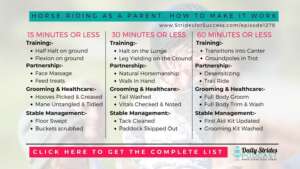
    I began to keep a list of things that I wanted to work on or do during my ‘riding time’. There were 3 ‘groups’ of topics depending on how much time I found myself at the yard

    You see, once I began to truly embrace horse riding as a parent, I realized that there was value in the smaller pockets of time in my life. 10 minutes alone took on a whole new meaning for me! So, I began to plan accordingly!

    My list had things I could do in 15, 30, or 1 hour or less. Each of those groups had riding, groundwork, and stable management items on them

    By doing this, I found I always had something meaningful to do, even if my plan changed at the drop of a hat. It also allowed me to make the absolute most of the time I did have with my horses. Get a list of 80+ Topics to do with your horse HERE

    1278 - Horse Riding as a Parent

    3. Get Support & Set Boundaries

    Support can be a tricky one, especially when young children are involved. It can be as simple as asking a grandparent to watch the children one afternoon a week, to paying a babysitter. Support can also come from your partner or the child’s other parent.

    What I suggest doing is creating a list of all the ways you can free up some pockets of time for yourself to ride your horse, from the easiest to maybe some less ideal or likely situations. Then begin asking…

    I also found that making my horse riding a ‘non-negotiable’ really worked for me. Seeing it as an important appointment that I couldn’t just cancel on a whim. This helped me to prioritize a little better, which often meant creating stronger boundaries.

    You can create boundaries for both yourself and those around you. And keep in mind, your boundaries will only be as effective as how well you decide on them, communicate them, and enforce them…

    4. Involve Your Children

    This might not always go to plan, especially if you have this perfect picture in your head as I had before children! However, if you are realistic and patient, this can really be worth your while. Be realistic with your expectations of each visit to the yard with your children. They will most likely want it to be all about them and their pony, so allow for that.

    Plan activities that you can do together so you can spark curiosity in your child. Think about things that are safe and also a little mentally or physically challenging for them

    Remember, this won’t be the day that you will get a huge amount of focused, uninterrupted riding time in! However, it might just be a stepping stone for your child to begin becoming an independent equestrian in their own right.

    It’s also worth remembering that as your child grows, they will have their own opinions, likes, methods, and beliefs about horse riding – and they might not always line up with yours!

    Try not to crush their enthusiasm by dictating the terms of their relationship with their horse. Rather see your role as a guide. At the end of the day, they are on their own journey as a rider. Encourage rather than cut down and stifle.

    5. Be Patient… This Will Also Change

    My final piece of advice is to simply be patient.  And, most of the time, accept the situation you find yourself in. Horse riding as a parent can either be one of the things that will propel your riding and your development forward. Or see you being endlessly frustrated and annoyed with your current circumstances.

    Be honest with yourself; some days your responsibilities as a parent will mean that you won’t get to do what you wanted to with your horse

    And that is okay… I like to think of my life as a series of seasons. Different areas are in different seasons at any one time. And this means that when I’m experiencing summer and growth in one area, there will be winter and hibernation in another.

    By getting truly clear on your priorities, and your values, and then creating goals that align with those, you can make horse riding as a parent work for you and your family.

    Happy Riding

    Lorna

    More on this Topic

    More Training & Support