Tag: natural aids

  • Using Artificial Aids when Training Your Horse

    Using Artificial Aids when Training Your Horse

    [fusebox_track_player url=”https://op3.dev/e/traffic.libsyn.com/dailystridespodcast/1299_Using_Artificial_Aids_For_Good_in_Your_Riding.mp3″ title=”Using Artificial Aids when Training Your Horse” social_linkedin=”true” social_pinterest=”true” social_email=”true” ]
    I think it’s safe to say that all equestrians use artificial aids when working with and communicating with their horses at some point.  And yet, for some reason, many riders see many of these things as being ‘bad’.  However, for the most part, this is simply not true; especially if they are used correctly.
    If you use a saddle, a bridle, a head collar, a leadrope, a stable, an arena, a round pen, etc. etc. etc. when working with or training your horse, you are using artificial aids.
    And when they are used correctly, they can really be a help when explaining things to your horse and also helping your horse to develop strength through his body.  However, the keyword in that sentence is ‘correctly’…

    What is an Artificial

    The easiest way to think about artificial aids is anything that is not attached to you.  It’s not part of your body or who you are! If it’s part of you, it’s a natural aid. So artificial aids are equipment, fences, etc.
    And artificial aids, when used correctly, clarify, strengthen, or ‘back up’ your natural aids.
    They help your horse to understand what you’re saying and what you expect from him when you say it.  And this is a key part of the conversation… In order for your aids to be effective, your horse must understand your aids.
    It is when we are being a little ‘lazy’ without natural aids and depend too much on our artificial aids that we run into trouble.  This is where your artificial aids can start to become too ‘strong’ or downright incorrect when it comes to training your horse.

    Lead with Your Natural Aids

    One of the key factors when using artificial aids is to ensure that you are always leading or offering your natural aids first.  It is only when they are ignored, responded to incorrectly, too weak, or misunderstood, that you can then, maybe, introduce the artificial aid.
    In fact, the goal as a rider should be to develop your natural aids, and your horse’s understanding so that you no longer need the artificial aids to assist. 
    And yes, while many riders will never reach this point in their conversation with their horses, it does help to keep the ‘why’ you are using artificial aids in perspective when you are training and riding.
    Artificial aids are simply a tool to help you become more effective when using your natural aids.

    Using Artificial Aids

    There are many aids that are not natural and all can be used in different ways in order to clarify, back up, or strengthen your natural aids.  A few of the most common and basic examples are:-
    • Whip (crop, pointer!)
    • Spurs
    • Bit
    • Groundpoles
    • Lunge Line
    • Lunge Whip
    • Boundary of Arena
    There are so many more, but these are the ones that the riders I work with most commonly use. And, again, when used correctly, there is nothing wrong with these aids.
    When the rider is thoughtful, responsible, and compassionate each one of these aids can make a huge difference in how well the horse understands what is being asked.
    Make sure you listen to this episode of the Daily Strides Podcast where I go further into how you can begin using these sorts of aids in your riding that will help develop your natural aids.
    Happy Riding
    Lorna

    List of Resources on This Topic:-

    Join Our Online Community of Equestrians

  • Correctly Applying Your Weight Aids

    Correctly Applying Your Weight Aids

    When we begin riding, we are generally told about this almost magical ability that we have to communicate with our horse, known as the weight aids.   However, it soon becomes apparent that we have to master many other aspects of riding before we can hope to use our weight to communicate with our horse…

    Unfortunately for many of us, this takes too much time to achieve, so instead we begin happily throwing our weight around in the saddle and then getting upset when our horse does something completely different to what we ‘asked’.

    [smart_track_player url=”https://op3.dev/e/traffic.libsyn.com/dailystridespodcast/516-Learning-to-Correctly-Apply-Your-Weight-Aids.mp3 Feedback” title=”Learning to Correctly Apply Your Weight Aids” social_linkedin=”true” social_pinterest=”true” social_email=”true” tweet_text=”Learning to Correctly Apply Your Weight Aids in the Saddle” hashtag=”horseriding #equestrian” twitter_username=”strides_success” ]

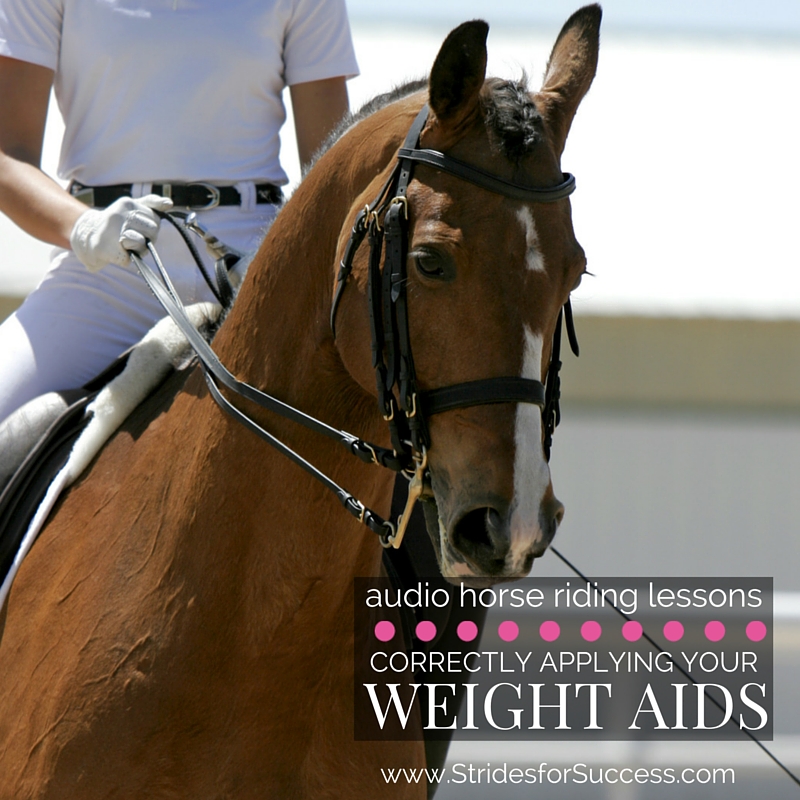
    So first and foremost, what are your weight aids?  The term ‘weight aids’ refers to where and how you are using your core to distribute your weight in the saddle.  Your weight aids are controlled with subtle movements which shift the pressure and weight of the seat bones in a way that communicates a certain instruction to your horse.

    You use your weight aids in all aspects of riding, from slowing down or stopping, to asking for more energy or moving forward.  Weight aids are an important part of transitions, bending, turning and even just riding a straight line.  Learning how to control your weight aid is a vital and essential part of good riding.

    It is only when we learn to develop a truly independent seat that those aids really can become useful to both us and our horse

    An independent seat is when you can move your legs or other parts of your body without affecting your overall balance & position in the saddle.  An independent seat is also something that is really earned by spending consistent time in the saddle, riding correctly and practicing correct movements and sound techniques.   A rider also needs a certain level of fitness and body awareness, so as to be able to use their muscles, and therefore shift their weight, as desired or required.

    If we do not first cultivate that independent seat, our weight aids can often work against us and our horse.  They can also when applied incorrectly, whether due to lack of knowledge or lack of control, contradict the other aids being applied which leads to our horse not performing as we think he should.

    Applying Your Weight Aids

    Many riders think that they are applying their weight aids correctly, however something as simple as not sitting straight in the saddle is enough to change the application and meaning of a particular movement.  Often riders will sit to one side, or favour one side of their body, when in the saddle and the problem then begins to compound when they begin shifting their weight around, giving a total different feeling to their horse than what the rider thinks they are asking

    Another way that the weight aids can begin to work against the rider if not correctly understood and applied is that often riders get a little ‘over enthusiastic’ in the application of the aid.  So rather than that subtle shift we mentioned in the beginning, they either begin ‘shoving’ or ‘pushing’ their horse, or they begin leaning…  Never Lean!  We can also incorrectly apply the weight aids, particularly when turning, by lifting our outside seatbone off the saddle…

    Keep in mind that both seat bones must remain seated if you want to give a correct and easily understood weight aid!

    The final issue I want to warn you of before we carry on is incorrect timing of the aid.  As with all things riding related, the weight aid being given will only be as good as the preparation leading up to it and the timing of it.  No matter how well-balanced, or finely tuned your seat may be, if you apply the aid at a moment when your horse physically cannot respond to it, the aid will never get anywhere near the result you desire.

    It is when you can combine a true independent seat with correctly applied subtle weight aids & a perfect sense of timing you will begin to master what we call ‘feel’ in the saddle

    To get an idea of just how subtle your weight aids and the ways you affect them are, I suggest beginning off your horse.  Find a firm surface you can sit on, and gently put a hand under each of your seat bones.  Feel how just applying a little more tension to the different muscles in your core, affects the distribution of the weight applied by your seat bones on your hands.

    Move your body as you would when in the saddle performing a half halt; feel how your seat bones would ‘block’ a river of energy that would flow underneath you through your horse’s back when you are in the saddle.  However, then begin to see how, my making slight adjustments,  you can soften that aid or smooth it out.

    Once you can begin feeling these subtle differences, try it with how you would move when you ask your horse to move forward, whether it be to transition up a gait, or within a gait.  Again, imagine the river of energy flowing underneath you and how, when applied correctly, your weight aids will ‘open’ and allow that energy to flow a little more.

    Of course, when you apply your weight aids you are not necessarily ‘blocking’ or ‘allowing’, just rather suggesting this to your horse, who with time, will understand and make adjustments as required

    Once you have a good feeling and understanding of the ’cause and effect’ of your body movements out of the saddle, then you can begin experimenting in the saddle.  Unfortunately however, many riders will experience that their horse is not all that attentive to their weight aids initially.  This is usually due to the fact that the rider has been guilty of literally ‘throwing their weight about’ in the saddle!

    However, all is not lost and you can begin to re-school or retrain your horse to your newly acquired subtle weight aids.  To do this you will have to be consistent and mindful of where you are sitting in the saddle and also that each movement or change is set in motion by applying the correct, subtle, weight aid first.   Your horse will, given time, begin to associate that particular weight aid with that instruction and soon, begin responding to the weight aid when it is applied.

    Really effective communication with your horse through your weight aids will take time and patience, however is really worthwhile in the end.

    Happy Riding

    Lorna

    Applying Your Weight Aids