Tag: suppleness

  • Adjusting the Length of Your Horse’s Stride for Jumping

    Adjusting the Length of Your Horse’s Stride for Jumping

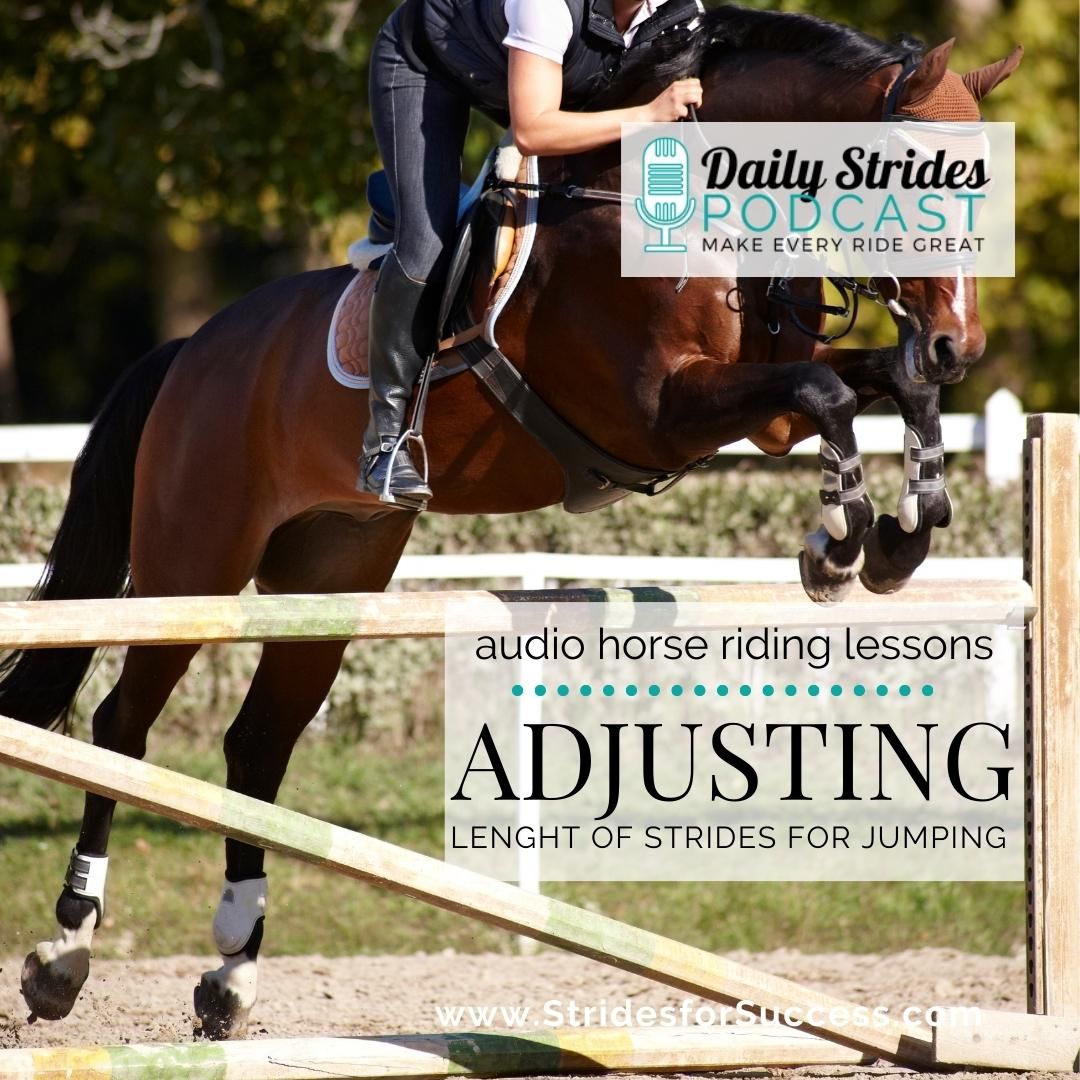
    If you enjoy jumping with your horse, riding that clear round is all important. Luckily there are a few key areas you can work on in your training that will help you to begin seeing more of them.  Adjusting the length of your horse’s strides is just one of those. And it’s also a pretty useful exercise for all horses and riders, jumping or not.
    If you can begin to intentionally help your horse to have either a shorter or a longer stride, it gives you both flexibility and adjustability in your riding
    In this episode of the Daily Strides Podcast, I want to help you to begin to understand just how versatile this exercise is to have in your toolkit when it comes to riding your horse.

    Predicting Your Horses ‘Arrival’ Point

    Like anything, if you can more accurately predict the outcome of something, you can begin to make changes or preparations for how it will be.  Jumping is no different.  When you can begin to ‘see’ the point your horse will actually take off from the fence, from a distance away, you can make decisions based on that.
    In fact, being able to see a ‘point’ for something to happen further on down the line is useful regardless of what you’re doing with your horse.
    And when jumping, remember, that all horses are different.  So when we think about jumping tracks the distances, however well planned, won’t suit all horses.  However, if you can accurately predict where your horse will be 5 or 6 strides from now, and then make adjustments to those 5 or 6 strides; well it won’t really matter, will it?

    Before Adjusting the Length of Your Horse’s Strides

    Like most things, there are a couple of prerequisites that riders and horses will have to develop before they begin adding this to their training program. The first of these, I feel, is the ability to see and then ride a line.  This is often one of those ‘easier said than done’ things.
    And while many riders might be able to ‘see’ the line; riding it is a whole other story!
    Another important element to both understand and effectively ride is the half halt.  Having control over your aids to clearly communicate this to your horse is key to it working for you.  Whether that is to balance, rebalance, correct, or just focus attention and energy.
    Adjusting the length of your horse’s strides is not pulling their mouth or kicking on; it is harnessing the energy to make changes to your horse’s way of going.

    Understanding Impulsion

    Whether you’re shortening or lengthening, maintaining the desired level of impulsion is key to effectively jumping the actual jump!  Pulling too much and slowing things down in a misguided attempt to shorten will not work.  Sure, you might fit more strides in between here and there.  But when you do get ‘there’ your horse won’t be ready to actually jump the jump.  Which, is the whole point of the process.
    Similarly, kicking on and chasing your horse to lengthen will result in your horse flattening and becoming heavy on the forehand; again not a great way to meet a jump!
    Impulsion needs you to really have the correct level of tension present inside of the container that makes up you and your horse.  This tension (relaxation) combined with the actual energy needed (forwardness) and a good and consistent rhythm will help maintain impulsion.  And, when working correctly, impulsion leads to straightness. Another key element when jumping those clear rounds.

    Seeing a Stride

    This is a skill that, as a rider, needs to be developed in order to really get the benefits of adjusting the length of your horse’s strides. After all, it makes little sense adjusting them if you’ve no idea where you really want to be at take-off!
    Seeing a stride simply means that you can accurately predict where your horse will be in a specific number of strides time. 
    It’s being able to say, “in 5 strides from now, all being equal to what we’re doing now, we will be ‘there’.”  And based on where ‘there’ is, you can then decide if adjustments need to be made to the actual length of the strides.  Changing the length of the stride will prevent chipping in or standing off the jump. Neither of these are ideal for clear rounds!
    If ‘there’ is too close or too far away from the ideal take-off point of the jump, you have now 5 strides available to adjust that point.  And this is often the difference between a pole staying up or coming down.

    Counting Yourself Down

    Start learning how to see your stride by playing a game with yourself over a single pole on the ground.  Canter back and forth over the pole and see if you can accurately and correctly predict the point where you will have 3 strides left to go before ‘jumping’ the pole.
    Accountability is key here; say out loud 3, 2, 1, jump. If you get 3, 2, jump or 3, 2, 1, 1, 1, jump – clearly there’s an issue!
    Once you have eventually mastered this skill, you can begin to make it a little more difficult.  Begin predicting where 5 strides between you and the pole will be.  Again, count yourself down.  Counting yourself ‘up’ (1,2,3,4,5) won’t work as you can just keep counting!  I also find that riders who initially count in their heads also struggle!  Their brain wants them to be right, so they can tend to tell themselves porkies!
    When you can accurately predict the point where your horse will fit 5 or even 7 strides in between you and the pole, this is where you can start to see where adjustments should be made. And, this is where you can begin working on making those small adjustments over every stride to result in a big difference.

    Shortening Your Strides

    If you can take 2 inches off each of your 5 strides, it means you can change the ‘take-off point’ by 10 inches.  That is nearly a foot or 30 centimeters.  And that is just shortening by the smallest of margins, 2 inches or 5 centimeters.
    Imagine when you and your horse develop this skill; you can shorten strides by 10 inches per stride (or more).  This will truly give you the flexibility you need to meet each jump at the right place each time.  So that your horse has the best possible chance of clearing the jump.
    Shortening is not slowing your horse down.  It is not pulling his mouth or throwing an ‘anchor’ behind you in the sand! 
    True shortening will allow you to maintain the energy, rhythm, suppleness, impulsion, contact, and straightness in order to reach the jump in the best possible place to clear it from. Sometimes, when we shorten, your horse might not initially have enough strength in his body to maintain the above; this is where your aids will act like boundaries to help your horse.
    Shortening the strides also requires that you maintain a lightness in both how you are riding and your horse’s way of going.  Light and bouncy; not heavy and ‘stuck in the mud’.

    Lengthening the Strides

    So many riders think lengthening and speed are related.  I have honestly watched people and said silent prayers in my head that they get from A to B in one piece!  It can be nerve-wracking watching a rider who has confused rushing or chasing with lengthening.
    To effectively lengthen the stride, you must maintain the energy, the tension, the contact, the forwardness, and – maybe most importantly – the impulsion.
    Chasing your horse on to the point where all of the energy falls out the front door is not lengthening.  In fact, it is just downright dangerous as your horse will find it very difficult to find the ‘lift off’ gear and get his shoulders over the jump!
    As you ask for your horse to lengthen, make sure you’re not getting ahead of or in front of the movement.  If you are leaning your weight in any way on your horse’s shoulders or withers, you make jumping the jump so much more difficult for the horse.  Sit up and remember to ride!

    Adjusting the Length of Your Horse’s Stride

    My big piece of advice when you are beginning to work with adjusting the length of your horse’s stride is to start small.  A couple of inches either way are either longer or shorter.  Being able to have this level of adjustability in your horse can change so much when it comes to your training in general.
    Remember, you are simply ‘asking’ your horse to lengthen or shorten; you’re not doing the work yourself! Don’t lie back and don’t throw your body forward.
    And, as I said at the beginning, this type of suppleness and adjustability through your horse is not just for jumping. You can and will use this in all day-to-day riding.  And it’s a great exercise to work on with your horse as well.
    Happy Riding
    Lorna

    Resources:-

  • How Flexion can Transform Your Riding

    How Flexion can Transform Your Riding

    [fusebox_track_player url=”https://op3.dev/e/traffic.libsyn.com/dailystridespodcast/1248_How_Flexion_Can_Transform_Your_Riding.mp3″ title=”How Flexion Can Transform Training for You and Your Horse” social_linkedin=”true” social_pinterest=”true” social_email=”true” tweet_text=”Check out this episode on Flexion while riding your horse… ” hashtag=”equestrianpodcast” twitter_username=”strides_success” ]

    I find it a little mind-boggling how, the longer we spend developing ourselves as riders, the more we need to unlearn. Especially when it comes to those first one or two initial horse riding lessons!

    Using your hands and arms to ‘steer’ the horse is one of those things. And, flexion is often one of the best concepts to help riders become clearer on this. And more open to other possibilities when it comes to their aids, their riding, and steering their horse.

    Flexion versus Bending

    Flexion is bending. In the truest definition of the word, it is often attributed to the bending of a limb; an arm or leg. And when we are talking horses, this can also be true. Many vets will do a flexion test to assess soundness.

    However, flexion when riding is a little more subtle. instead of it being a bend, it is more like a suggestion towards a bend…

    I often describe it to my younger riders as being like the indicator lights on a car (also called blinkers, or turn signals). The point is that the indicator merely suggests to other drivers that you’re about to go a certain way, but they don’t actually steer the car.

    I feel that ‘bending’ while riding is more about the channel of the energy. Where the energy flows as the horse and rider move together.

    When Do We Use Flexion

    As I said, flexion can often suggest or indicate to your horse other things. So, for example, if you were preparing to track to the left, you could ask for a slight flexion to the left first. Or if you were preparing to ask for canter on the right lead, you could ask for flexion to the right first.

    When I’m in the saddle, I like to think of flexion as being a very subtle ‘nod’ in the right direction. Like a little prompt or cue for your horse to follow.

    Flexion is also how we determine ‘outside and inside’ when it comes to our aids. Flexion to the right will result in your right side becoming your inside. And therefore your left side becomes your outside.

    So rather than using your position in the arena to determine inside and outside aids, the flexion of the horse will dictate what’s what 🙂

    [convertkit form=3477209]

    Flexion for Suppleness

    Finally, flexion can be introduced to your daily riding work in order to increase suppleness throughout your horse’s body. And I think this is the key defining element when it comes to really understanding flexion and its true meaning when we are working, training, and developing horses.

    As riders, we can use slight but very intentional flexion as a tool to help develop suppleness and increase elasticity throughout our horse’s bodies

    This brings me to go a little deeper into the word ‘slight’. I’ve already mentioned that bending is more of a way to channel the energy through a turn, on a circle, or around a corner.

    Flexion, when riding, is often far more subtle than bending, and can be achieved anywhere in the ride; riding on the straight or through a bend

    True Suppleness = Flow & Ease

    And what makes flexion so important is that, for many horses, this slight shift in how they carry themselves can allow new pathways to open. Both in how they ‘think’ they can work. And in how their body actually can work.

    Flexion is often the key to softening something that has become hard or rigid – and this is because true flexion allows the energy to continue to flow

    So in instances where a true bend is difficult for the horse and rhythm or relaxation is lost, flexion can be a great introduction to the whole ‘idea’.  This is while still moving forward in relaxation and rhythm. A good example of this is introducing shoulder-fore before riding true shoulder-in.

    Also, because flexion is ‘slight’ and merely an indicator, the horse learns to continue to move forward until another aid or another question is asked

    By working on developing true flexion, even the slightest incline towards it, the horse will begin to create new ways of using his body.  And continuing to implement previous training principles.

    Start on the Ground

    So, like so many things to do with horses, the best place to begin your work with flexion is on the ground. Beside, not on, your horse. I will do a follow-up training on this which you can get delivered to your phone by ENTERING YOUR DETAILS HERE.

    Begin Implementing Flexion into Your Riding

    From here, you can begin to work on this principle with your horse using a simple technique that I will talk about in a step-by-step audio training. This training will be delivered a day after the first one for groundwork. Make sure you DOWNLOAD THE FREE TRAINING HERE

    This is a key concept that can literally transform both you and your horse.  From being hollow and wooden to becoming more ‘loosey goosey’, supple, and ‘able’ in your work together.

    Happy Riding
    Lorna

    Get Support & Guidance in Your Riding

    More on this Topic

  • Warming Up Decisions for Your Unique Situation with Your Horse

    Warming Up Decisions for Your Unique Situation with Your Horse

    [fusebox_track_player url=”https://op3.dev/e/traffic.libsyn.com/secure/dailystridespodcast/1222_Warming_Up_Decisions_for_Your_Unique_Situation.mp3″ title=”Warming Up Decisions for You and Your Horse” social_linkedin=”true” social_pinterest=”true” social_email=”true” tweet_text=”Getting intentional with your warming up can change your horse and you…” hashtag=”equestrian #horsepodcast” twitter_username=”strides_success” ]

    How could becoming more intentional and creative with your warming up transform your riding? After all, it is something that you do every time you ride, right?!

    If you were to do one thing this month that has the potential to ripple into all the months hereafter where your riding is concerned; becoming intentional about your warming up might just be the thing. 

    This episode of the Daily Strides Podcast has been plucked from a week of lessons from Daily Strides Premium called “Increasing Suppleness with Your Warm-Up & Cool Down”. The full week of lessons are available right now when you join Connection

    Creating a Routine

    One of the great things about becoming intentional with your warm-ups is how much you learn about yourself and your horse. You will begin to see patterns regarding what works and what does not.

    You will also begin to instinctively know what to do when things are not going to plan in order to settle and refocus you and your horse. 

    This is particularly useful if you are traveling to a different barn, show grounds, an overnight trail, or competition. By knowing what works to produce a specific outcome, you can begin using your warm-ups to produce better results throughout the ride itself.

    Your warming up routine can help you and your horse get into the ‘zone’ for where you want to go. It helps align your mindsets…

    Decide on How Long it Will Be

    Many riders are surprised when they realize that there are no ‘rules’ regarding how long they must warm up.  I think that the idea of having a specific amount of minutes is reassuring and makes the ‘doing’ a little easier!

    Being rigid with the amount of time you spend warming up tends to diminish the positive effects of the warm-up! When you’re focused on the clock, you’re not focused on the quality and relevance of what you are doing…

    Instead, I recommend using the desired outcome for the schooling session as a whole to help you decide what will best help to prepare you and your horse.  The more intentional you become about your warming up supporting the work, the better your warm-ups will become.

    What Gait Will Help You Both

    When we learn to ride, we do things in succession.  The gaits in the warm-up are one of these things.  Walk, then trot, and on the canter. No deviation from that path!  However, as you become more experienced, I think that it’s okay to ‘stray’ a little…

    There are no rules that say you must walk for a certain period of time.  Followed by trotting for a similar time.  And only then can you canter! 

    There are horses out there who do better if canter is introduced before the trot.  Not a huge amount of canter.  And after quite a bit of walking where different questions have been asked.  It is a possibility. The important part is to be responsible and think of what’s best for your horse and his physical health and well-being.

    When it comes to creating a warm-up that works for you and your horse, be open to trying new things. And doing things a little differently. 

    Tailoring It for Your Horse

    Many riders will try to ‘force’ relaxation while riding the initial warm-up.  Obviously, you cannot force relaxation! I mention this because, for many horses, stretching and suppleness are something they must work on throughout the ride.

    For some horses, expecting ‘long and low’, or ‘stretching down’ in the first 20 minutes of the ride is asking too big of a question. 

    This can be due to past training, old habits, or conformation – a high head carriage.  There, of course, are other reasons as well.  What I want to encourage you to do is to find what works for your horse, and start there. Drop all other expectations.

    Warming Up Yourself

    Finally, it is important to consider yourself in the bigger picture.  Horse riding is a team sport after all – you and your horse.  Jumping on and then slouching around in the saddle for 15 minutes is not exactly a warm-up!

    Begin seeing your grooming and tacking up as part of your warming up routine – for you and your horse. 

    Use this time to set the rhythm and tone for the upcoming conversation in the saddle.  Get your blood pumping and flowing by really being intentional with your actions, your movement, and your breathwork.

    Your team – you and your horse – must work together and what leads up to you mounting up can make all the difference.

    Happy Riding

    Lorna

    Increasing Suppleness with Your Warm-Up & Cool Down

    This episode is the first of 5 guided audio horse riding lessons that are available for you to use while riding with your horse.  The other 4 lessons, the guided riding lessons, are available inside of the Connection Member’s Area.

    Join Connection today to get these lessons and so many others to help you make the most of your riding.

    Guided audio horse riding lessons, weekly bonus live training, personal accountability, monthly challenges, and so much more… And all of your training is available on a private podcast feed so you can listen while you are with your horse :)

    Find out all the details and join today HERE

    Additional Resources for Equestrians

  • [Training Scale Series] Part 5 – Developing True Straightness

    [Training Scale Series] Part 5 – Developing True Straightness

    [fusebox_track_player url=”https://op3.dev/e/traffic.libsyn.com/secure/dailystridespodcast/1209.Straightness_in_Your_Horse_and_Your_Riding.mp3″ title=”Straightness in Horse And Rider” social_linkedin=”true” social_pinterest=”true” social_email=”true” tweet_text=”Straightness is more than just riding in a straight line with your horse…” hashtag=”equestrianpodcast” twitter_username=”stridesforsuccess” ]

    When I was first starting out as a rider, I thought that straightness was a simple and easy concept. I remember the first time someone told me that one of the hardest things to do on a horse was to ride a straight line.  I didn’t believe them!  However, turns out they might just have been right…

    This is part 5 in a series I have created about the Training Scale.  We have previously covered rhythm, suppleness, contact, and impulsion. Straightness is the fifth ‘step’ on the ladder or scale.

    Keep in mind that whenever you are working on the lower steps of the scale,  you are doing so with an eye on the top steps. And when working on the top steps, you are doing so through the filters of the lower steps of the scale.

    What is Straightness?

    It’s a bit of a trick question; the simple answer is ‘when I ride a straight line’, right?  Well, yes… And part of straightness is definitely being able to ride and work on a straight line.  But what about riding a straight line through a bend?

    Straightness is less about actually being ‘straight’ and more about the developed strength to be very specific about where you are travelling at any given point.  And the tracks you’re travelling on… 

    Imagine riding in a freshly harrowed sand arena with your horse.  As you ride, you will be able to clearly see your horse’s hoofprints in the sand. Once you have walked, trotted, and cantered a few lines and circles, you halt and have a look over the arena.  If you have been truly ‘straight’ through each movement, there will be parallel train tracks created by your horse’s feet, wherever you rode in the arena.

    Your horse’s back left foot will have followed in the same track as his front left foot.  And, similarly, his back right foot will do the same with the front right foot. 

    This is regardless of if you are traveling on a straight line, let’s say A to C. Or if you are riding a circle, loop, serpentine, or simply through the corner.  The only place this won’t apply is if you asked for some lateral work with your horse.  And yet, lateral work also requires a level of straightness, in the flow of the energy.

    Straightness is Like a Train

    Another way to think of straightness is to imagine a train.  When it goes around a corner or a bend, the tracks remain parallel to each other all the way through that turn.

    Regardless of how many carriages the train has, wherever the front carriage of the train travels, the back carriage will follow in the exact same place. If the back carriage swings out, or if the front carriage turns short the train will lack straightness and derail.  Your horse is the same.

    If you take the picture of yourself and your horse’s tracks in the freshly harrowed sand arena and superimpose the train tracks, you will have a good idea of what straightness is.

    What Causes Crookedness?

    What makes straightness confusing is figuring out if any crookedness is begin caused by the rider or the horse.  It’s a little like the chicken and the egg. Which came first and is influencing the other!  In order to achieve true straightness, it must be developed and strengthened in both horse and rider.

    If you are noticing that there is any crookedness present through your horse, I am going to strongly suggest assessing yourself first. 

    Keep in mind that crookedness can come from both lopsidedness and a lack of strength.  This is true for horses and riders.  I personally find that yoga is a great way to identify any lack of symmetry and strength in my body.  It also shines a light on areas of tightness, stiffness, or tension.  A lack of suppleness.

    If there is any lack of movement or flow through your own body, suppleness, it will show up in your horse, particularly when bigger questions are asked. 

    Strengthening Your Horse

    Developing symmetry and strength is key to correctly train your horse. Horses are very similar to us in that they usually have a dominant side.  This is just like how you may favour your right side if you are right handed. You may notice when you do a certain set of exercises with your horse, it is going to be a lot easier for him on one side, or the other.

    Easier being that he can continue to maintain relaxation, rhythm, suppleness, and contact throughout the movement.

    When we notice a weakness, there is a tendency to ‘double down’ on the ‘bad’ side. Unfortunately, this rarely works or helps in the long term.  Imagine if someone kept making you do something you find difficult, you definitely wouldn’t enjoy doing it! You might even become a little ‘sour’😉

    It is far better to ‘sprinkle’ the difficult things through the ride.  Mix the ‘bigger questions’ up with things your horse enjoys and finds easy.  This way your horse will continue to enjoy his work as well.

    Knowing your horse’s dominant side is important when you begin to work towards true straightness.  It allows you to become clear on any potential pitfalls that might show up, and how you can create a program to suit your horse’s individual needs.

    Spotting Weaknesses in Your Horse

    Sometimes, weaknesses are very obvious and easy to spot. It could be that your horse falls in on a circle.  Or he might swing his hindquarters out. You might also feel or see a ‘bulge’.  This can feel like he is pushing against or bracing against you or your aids.  There may also be resistance to questions.   All of this works against true straightness.

    If we go back a few steps and look at how, by working on suppleness, we begin letting energy flow, we can often see how this leads to straightness.  If your horse is not truly straight, you will feel an unequal thrust, which will result in crookedness or ‘buckling’.  This affects the overall balance and performance of the horse.

    Once the energy is flowing, we then begin to funnel it into a channel.  When we are intentional about where we want it to go, noticing any that is going elsewhere becomes easier!

    Start the next time you ride your horse by becoming more mindful about the simple basics. Perhaps go from a walk to a halt, and notice whether he is truly straight? Or if there is perhaps a ‘bulge’, a shift of energy, or even an actual shift of the horse’s body.

    Notice all of the seemingly little things. And then use what you find out to create a plan to begin developing true, equal, strength in your horse. This will lead to straightness.

    Happy Riding
    Lorna

    More, More, More… To Help You :)

  • A Map for Progress in Your Riding

    A Map for Progress in Your Riding

    Having a map often simplifies the journey.  It helps plan a clear route from A to B.  Riding is a journey.  And so many riders want a map or a plan to follow for progress in their riding.
    [smart_track_player url=”http://traffic.libsyn.com/dailystridespodcast/1121-A-Map-For-Progress-In-Your-Riding.mp3″ title=”A Map for Progress in Your Riding” social_linkedin=”true” social_pinterest=”true” social_email=”true” tweet_text=”Hit a plateau in your riding? You need a map…” hashtag=”equestrian #horseriding” twitter_username=”strides_success” ]
    Well, hold your horses!  What if I was to tell you that there is a map available for equestrians.  Oh yes, and it is loosely called the training scale or the traditional training scale.  So many riders discount this because they think that they have to be riding at a certain level in order to use it.  Or that the training scale is only for riders of a certain discipline, usually dressage.
    Many riders also believe that the training scale is only for the horse.  And a certain ‘type’ of a horse at that. This couldn’t be further from the truth.
    Horse riding is a team sport.  Your horse’s long term success depends on your abilities in the saddle.  Improve your riding skills and you will have improved conversations with your horse.  It is as simple as that.

    What is the training scale and how can you use it as a map in your riding?

    The training scale is a basic system many trainers use when working with horses.  There are certain principles or ‘steps’ which, when followed, ensure that the horse and rider have the mental, emotional and physical ability to progress in their training and riding.
    What often happens is that, without even being aware of the training scale, you are working on some of the principles.  However, when one piece is ‘missing’ or weak, you’ll find that progress stalls.  This is where so many horses and riders then become stuck. 
    Understanding what the training scale is and how you can begin using it today will help you with this.  It means you will clearly see what’s missing or needs work.  Which will inevitably lead to fewer gaps in your training.  Fewer gaps mean that momentum can really begin working for you where your training and progress are concerned.
    By following the principles, step by step, you can really make sure you have a full education in riding.  You can also ensure that your horse is being correctly developed, so he will have the physical and mental abilities necessary to progress in his training.

    Training Scale Foundation:- Relaxation

    Relaxation.  It is a big concept for so many riders.  And the fact that is has nothing to do with ‘doing nothing’ is what confuses so many!  Relaxation should rather be called ‘tension management’.  This is what you must do in order to fully understand and implement relaxation.  Manage your tension in the saddle.
    When you try something new in your riding, often relaxation is the foundational piece that needs attention again.  All new principles must be worked through from the perspective of relaxation.  Can you manage your tension levels as you move up and down through the gears or gaits?  How about if you switch from moving straight to moving laterally?  Or if you decide to pop a fence or jump?
    Different tension is needed for different tasks or work when riding.  Relaxation is your ability to manage your tension, so that it appears smooth throughout the ride. 

    Training Scale Step 1:- Rhythm

    Relaxation is the foundation.  This means that rhythm is the first actual ‘step’ on the ladder or scale.  Rhythm with horses, in my opinion, is that your horse is as close as possible when being ridden to how he naturally moves, in the field alone.
    I believe that your natural rhythm is how you feel when you are ‘doing you’.  When you are doing something you love to do that you find easy to do.  The thing that makes 3 hours feel like 3 minutes.  
    The trick is to work on bringing that same feeling across to the saddle with you. That same openness, flow, and energy.  Your natural rhythm.  This will take time to develop, however it is essential to make progress in your riding.

    Training Scale Step 2:- Suppleness

    The loosey gooseyness that is essential for both horse and rider.  I believe that in most cases where riders are ‘stuck’ are due to a lack of suppleness.  This is often seen when the contact is an issue.  It is a lack of suppleness from the rider that is causing the block through the horse’s energy.

    Suppleness is a mental, emotional and physical development.  It is the ability to move and flow, while still remain strong and true. 

    I am going to ask you to really consider this if you are having issues with, for example, contact with your horse.  If it is ‘fleeting’, you have it for a stride or 4 only to lose it again, take a look at your suppleness. Working on this has the potential to really and truly get you unstuck – without having to actually do anything ‘different’ in the saddle.

    Training Scale Step 3:- Contact & Connection

    Ah, the part everyone wants.  The holy grail; ‘on the bit’.  However, this cannot be correctly or consistency achieved if the other parts we have mentioned are not strong and active in both horse and rider.   I often think of contact as being the step of the training scale where both horse and rider ‘graduate’.
    It is where the horse begins to take responsibility for their own actions and way of going.  it is also where the rider must be confident enough to allow the horse to do this. 
    Contact is a little like a contract that both horse and rider are entering into.  I am agreeing to trust you if you meet me halfway.  This is why sawing, pulling, pushing and shoving will not produce correct contact.  The steps we spoke about before are the only way to actually achieving true, lasting contact in the ride.

    The Traditional Training Scale – Steps 4 to 6

    I have created a free mini-course for you where I go into detail far more detail about the training scale.  I really feel that if you can understand these basic principles, it will move your riding forward.  Even the most basic of conversations with your horse has these things woven through it.
    You can find the 5 Days to Clarity HERE.  I hope that you take the 5 to 10 minutes each day to give it a look or listen and really and truly move things forward in your riding.
    Happy Riding
    Lorna
    Other Resources to Help You in Your Riding:-
  • The Basics when Working a Young or Green Horse

    The Basics when Working a Young or Green Horse

    The Basics when Working a Young or Green Horse

    The opportunity to work with a young or green horse comes with great responsibility. You have the potential to place a lasting imprint on this horses riding career; and his opinion of being ridden in general.

    [smart_track_player url=”https://op3.dev/e/traffic.libsyn.com/dailystridespodcast/1109-The-Basics-When-Working-a-Green-or-Young-Horse.mp3″ title=”The Basics when Working a Young or Green Horse” social_linkedin=”true” social_pinterest=”true” social_email=”true” tweet_text=”Are you starting on your journey with a young or green horse? Here are a few helpful ideas…” hashtag=”equestrian #horseriding” twitter_username=”strides_success” ]

    In order to produce a well rounded riding horse, there are a few basic principles that you should pay attention to. Things that, when your horse understands and develops in each element, will lay a solid foundation for him going forwards.

    1. Forwardness

    It seems so basic that it is not even worth mentioning, however you would be surprised how many riders fail to develop this simple yet absolutely vital principle in their young horse from the beginning.

    So often I see riders on young horses and they are just not going anywhere. They may be physically moving forward, but really, there is no energy there. No ‘sense of purpose’.

    Forwardness is not just physical; as in moving. It is also mental. The ability to think forward is vital to your horses successful development.

    Riding a horse who has to be reminded to move forward every . single . stride . is exhausting. Having to continuously encourage your horse to show up is not ideal. However, when your horse learns how to ‘think forward’, the whole feeling of the ride changes.

    2. Relaxation

    When working with a young or green horse, relaxation is so important to begin establishing early in their training. I feel that there are two different types of relaxation when it comes to working with a young or green horse.

    The first is how we think about relaxation ourselves. We are ‘chilled’. There is no anxiety present. He is ‘carefree’ regarding what he is doing. This can often seem to cause issues when we work on being relaxed while moving forwards.

    With horses, there is always a balance that needs to be found. In this case it is the balance between moving forwards and also remaining relaxed.

    The second is relaxation that forms part of the actual training scale. A better name for this type of relaxation is ‘tension management. Excess tension does not have to show up as anxiety. It often shows up in the horses back. Almost like a stiffness.

    Your job is to make sure that as the horse is moving forwards, the tension is being managed. Especially through the horses back, in order to connect the energy from back to front.

    3. Rhythm

    All horses have a natural rhythm. The true aim of the game when it comes to riding is for your horse to display his ‘natural rhythm’ with us on his back, while remaining in perfect balance. No easy feat!

    Becoming aware of the rhythm is the key to helping your young horse develop his natural rhythm while you are in the saddle.

    A great way to do this is by correctly lunging your horse. It allows him to begin really ‘working’, but also learning how to balance himself; without a rider to worry about as well.

    Your horse has to develop. This will take time, as all development does. It is important to allow your horse the time he needs to develop correctly. In doing so, he will become more confident in his abilities.

    I believe that rhythm and confidence are related. As confidence grows, the rhythm becomes stronger, or less fragile.

    4. Suppleness

    Many riders think that suppleness is all about doing carrot stretches with horses. I don’t. Yes, stretching helps, that is without a doubt. However, suppleness is more about your horses ability to use his body while his body is moving. It is an active ability. As opposed to a stationary one.

    Obviously, suppleness is a physical aspect of your horses development. However, suppleness is also a mental element.

    It is the ability to shift and change mentally to the challenges as they present themselves. To remain confident when working through a challenge. Being able to course correct in order to move forwards again.

    5. Contact

    Contact is where things really begin to get serious when training a green horse. This is the first part of the journey where you ask the horse to take some responsibility.

    Contact is almost like an unwritten agreement between horse & rider that you are both willing to show up. You are ready and committed to participating and contributing to the conversation.

    In order for true contact to be present, all of the other elements must be developed to varying degrees first. It is the culmination of the other training elements. Unfortunately many riders try to establishing a contact too soon with their young or green horse.

    Allowing Your Green Horse Time

    Time is the final element that must be considered when training or working with a young horse. The horse needs time to develop, both physically, mentally and emotionally.

    Following a loose training program consistently over time will produce a solid young horse who someone will enjoy for years to come.

    Happy Riding

    Lorna