Tag: training your horse

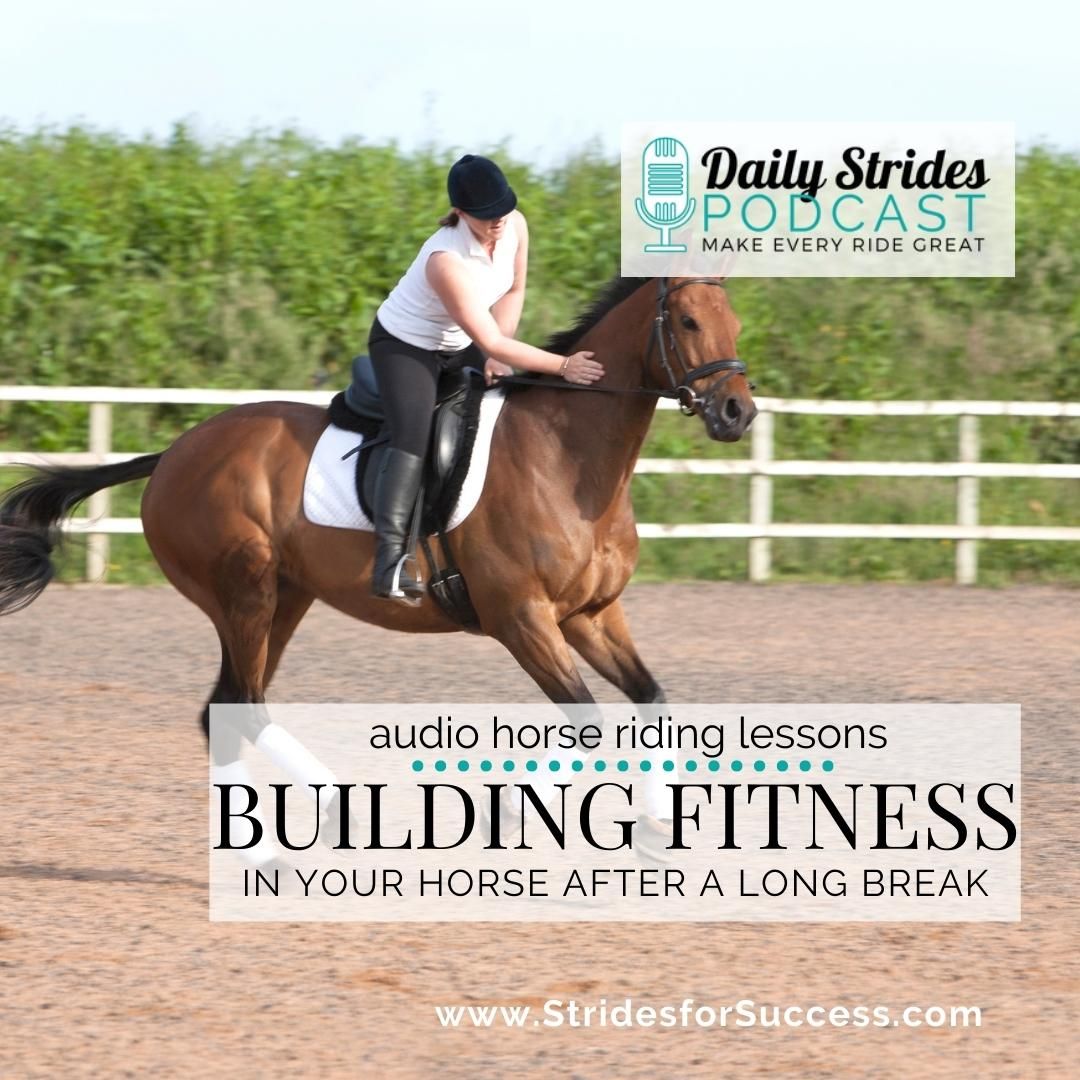
  • Building Your Horses Fitness (coming back to work after a long break)

    Building Your Horses Fitness (coming back to work after a long break)

    [fusebox_track_player url=”https://op3.dev/e/traffic.libsyn.com/dailystridespodcast/1295_Building_Your_Horses_Fitness_After_a_Long_Break.mp3″ title=”Bringing Your Horse Back into Work After a Long Break” social_linkedin=”true” social_pinterest=”true” social_email=”true” ]

    Whether your horse has been on a hiatus due to injury, winter hibernation, or life’s seasons, bringing them back into work can feel so exciting.  And yet, it can also feel a little overwhelming for many riders.  In this episode of the Daily Strides Podcast, we’ll explore how you can successfully build your horse’s fitness and bring them back to work after a long break.

     1. Slow & Steady Wins the Race

    Now, there is always a temptation to simply ‘dive in’ and start riding.  Full speed ahead!  But… As you know, this is not in your horse’s best interest, especially long term when we are talking about soundness, training, and longevity.

    Patience is one of your best friends here and while thinking about what you used to do with your horse when he was fit before can be inspiring, it is vital that you give him the time and the opportunity to get to that point again in his work and training.

    Start slow with lots of road work and walking initially.  This steady work will help to increase his stamina to prevent injuries.  An initial 6-week ‘build up’ period can be useful to create and follow.  

     2. Incorporate Groundwork into Your Plan

    Groundwork is a fantastic tool to build your horse’s fitness, especially if he’s coming back to work after a long break for a few reasons.  Firstly, it helps to strengthen the bond between both of you and establish the partnership again. This is important to build confidence in yourself and each other again.

    The second reason is that you can begin to ‘fine-tune’ your aids.  It’s a little like setting up the expectation for your horse, to help him better understand what is expected and allowed when working together.  After a longer break, your horse might not be as responsive as he once was to your aids.  Groundwork can be a great way of helping to reestablish the ‘rules’ for both of you.

    And then of course, there is the third reason groundwork is great when coming back into work; it helps to increase suppleness, flexibility, balance, and overall strength.  As with everything else, slow and steady initially.  

     3. The First 3 Weeks

    Start with short and focused sessions of 20 minutes with your horse. This is great news for riders as you can be more consistent with your riding work if the sessions are short and sweet.   Many riders fail to realize the time commitment involved with bringing a horse back to work. And this can lead to a more hit-and-miss approach to their training sessions!

    Begin your riding sessions with short, easy hacks on roads or lanes if possible.  Hard and flat surfaces are best for the initial rides, hence the idea of road work being helpful for the first 2 to 3 weeks. Spend most of the time in the walk at the beginning.  20 minutes and then building up to 30, and 45 minutes of active walking.  From there, you can begin to add some trotting into your work.  Short and steady work sprinkled in through the walking.

    Focus on building their confidence and trust in you as their rider. You can also begin introducing some gentle supplying work here as well to keep the rides interesting for both of you. 

    There is a full 6-week plan for doing this ready and waiting for you inside of Connection. The plan is complete with 5 simple suppling exercises that you can ride with your horse when on the roads. To get access, simply join today and search for June 2023 :)

    Building Your Horses Fitness - Connection; The Online Membership for Equestrians Working Alone without a Trainer or Coach

     4. The Second 3 Weeks

    It’s important to continuously tweak your plan to your horse’s particular needs.  Your horse will give you feedback; allow this to guide your actions.  If they seem uncomfortable or stressed, take a step back and reassess your approach.

    Be attuned to their needs and preferences. This applies both physically, mentally, and emotionally. 

    The second 3 weeks are when you can begin to add some variety to your training.  Incorporate some different methods into your training program such as hill work, pole exercises, and transitions to keep your horse engaged and prevent boredom.  This will also help him to begin developing true strength, as well as stamina.

     5. Be Responsible

    Every horse is different.  How long it takes your horse to safely come back to work will depend on you and your horse’s unique circumstances.

    Building your horse’s fitness requires you to pay attention and make adjustments as you go. 

    Remember to celebrate your horse’s progress, no matter how small. Each step toward full recovery and fitness is a milestone worth acknowledging. Positive reinforcement creates a happy and confident horse and a strong partnership going forward.

    Happy Riding

    Lorna

    Related Topics & Resources:-

    Building Your Horses Fitness - Connection; The Online Membership for Equestrians Training Alone without a Trainer or Coach

    Join Our Online Community of Equestrians

  • Time or Money; Which is a Better Investment for You and Your Horse?

    Time or Money; Which is a Better Investment for You and Your Horse?

    [fusebox_track_player url=”https://op3.dev/e/traffic.libsyn.com/dailystridespodcast/1289_Time_or_Money_Which_is_the_better_Investment_for_You_and_Your_Horse.mp3″ title=”Time or Money; Which is a Better Investment for You and Your Horse?” social_linkedin=”true” social_pinterest=”true” social_email=”true” ]
    Your time or your money; it’s an age-old toss-up!  For the most part, most things can be improved, strengthened, corrected, or achieved when we invest either time or money towards it. And, for the most part, you can excel in the progression if you are able to invest both.  And training your horse is no different.
    And while many will argue that training a horse requires both time and money, for many riders it’s possible, or necessary, to offset one with the other.  It will simply depend on your unique situation.
    Like everything else, there are pros and cons to consider with each approach.  In this episode, I want to help you understand which choice may be better for you.  Investing your time or investing your money when it comes to training your horse.

    Investing Your Time: The Pros

    Training your horse when you can input a significant amount of time offers several advantages.  For many riders, the investment of their time will be the obvious choice based on their current circumstances.  However, there are many ‘hard-to-overlook’ advantages to this approach – whatever the reason for your choice to take this route.

     1. Developing the Bond:-

    Spending time with your horse during the training process can strengthen the bond between you. Building a foundation of trust and understanding is crucial for successful training and a harmonious partnership. So by you taking your own time when it comes to training, it allows you both to really develop that strong foundation that will stand for you.  Especially when working through any challenges that show up.  And, when working with horses, let’s be honest, the challenges will almost always show up!

     2. Unique & Personal Approach:-

    When you invest your own time in training your horse, you have the freedom to tailor the training sessions to suit your horse’s individual needs. This personalized approach allows you to experiment with different techniques and adapt to your horse’s unique temperament.  It also allows you to tailor the training program to suit your individual schedule and needs.  You get to choose what to work on, and when to work on it when it comes to your horse and your training program.

     3. Developing Your Skills:-

    The opportunity to work so closely and so consistently with your own horse will inevitably enhance your own riding and horsemanship skills.  The awareness that is an essential part of showing up as a ‘trainer’ for your horse will allow you to begin to tweak or improve your approach to different things. And with your horse providing feedback all the way, you can really develop your feel for riding and training.

    Investing Your Time; The Cons

    Now, let’s be clear… While there are many advantages to investing your own time into training your own horse, there are also a few drawbacks.

     1. Lack of Knowledge

    Experts are experts for a reason.  They have developed their expertise over time and through experience.  When you are choosing to invest your time to train your own horse, it can be difficult to identify, and later correct, any mistakes or training issues.  This also goes for behavioral issues. Training without an experienced trainer or coach may limit your progress and prevent you from reaching your full potential as a rider.  And this can also result in limiting your horse’s career or progress long term as well.

     2. Time Constraints:

    Yes, we have said that you are choosing the time over money scenario here.  However, so many riders fail to actually realize how much time it takes when working with and training a horse.  It requires a significant investment of time, and this may not be feasible for everyone.  Remember, you will be doing this while also juggling other commitments such as work, family, or studies.  Being consistent with your approach is essential with this method and many riders find it really difficult to dedicate sufficient time for effective training.

    Investing Your Money: The Pros

    When we are using the term ‘investing your money’ in relation to training your horse, this usually means that you will invest in professional training at a professional barn or yard.  This, obviously, can have many advantages over the ‘time’ investment.

     1. Expert Guidance

    You are now enlisting the help of a qualified or experienced trainer or coach who is doing this on a daily basis.  Their experience and expertise will allow you to avoid many of the pitfalls or potential challenges along the way.  Going this route also means that you get to ‘tap into’ their valuable ‘knowledge & experience bank’.  This is especially useful when it comes to correcting mistakes, and ensures your horse is introduced to effective, practical, and proven training techniques from the start.

     2. Time Efficiency

    When you hire someone who has successfully achieved a specific outcome numerous times before, it can be a little like taking a little-known but much faster ‘shortcut’.  They can help accelerate your horse’s progress at a rate that would be pretty difficult for you to match doing this for the first time.  And they can also, usually, overcome challenges more quickly as well.

     3. Safety & Confidence

    Professional equestrian trainers and coaches are equipped to handle difficult situations as they occur.  This means that both your horse’s safety and your own safety are maximized during the training process.  Couple this with the fact that most riders feel more confident when they have a trainer in the arena with them; you will usually ‘ride better’ in their presence. This is especially useful when working with a young, green, or challenging horse.

    Investing Your Money: The Cons

    And just like before, this too has its downsides.  Here are a few considerations when it comes to investing your money, rather than your time when training your horse.

     1. Financial Constraints

    Yep, it’s the whole time versus money thing again.  In order for you to save on time, you will almost definitely have to invest your money.  Remember, professional horse training can be expensive and costly.  This is especially true if you are on a limited budget.  Before you commit to this route it is really important to assess your current financial situation and determine whether the, often high, expense aligns with your current resources and priorities.

     2. Lack of Independence

    While a professional trainer or coach might be able to move your horse’s training along, can you then realistically continue to do this when your horse comes ‘home’ or back to you? Relying on a trainer means you may become dependent on their availability. There may be scheduling conflicts while the initial training is ongoing.
    And then the potential need for ongoing support might require adjustments to your training plans in the future…  Basically, it is difficult to really and truly learn how to figure things out for yourself when paying a professional to do the work for you.

    Time or Money; Which Will Suit You Best?

    I honestly believe that there is no real right or wrong answer to this challenge.  At the end of the day, it is a personal choice that will usually be dependent on personal circumstances.  Both approaches have their benefits and limitations.
    Investing your time allows for a deeper bond, more time and schedule flexibility, and faster development and growth of your abilities as a rider and trainer. However, this can often be countered by a lack of expertise and other commitments in your already busy life.
    On the other hand, investing money in your horse’s training introduces expert guidance, a ‘fast track’ time efficiency, and added safety and confidence. You can literally borrow it from them in the arena initially.  But it comes with often great financial considerations and, ultimately, a level of dependency on the trainer in the long term.
    For many riders, a blend of both is the way to truly make this work for them.  A balance that aligns with your goals, resources, and circumstances is key.
    Whether you choose to invest your time, your money, or a combination of both, the most important thing is to prioritize your horse’s well-being, your enjoyment, and the ultimate long-term partnership that will result from working with your horse.
    Happy Riding
    Lorna

    Seeking Founding Riders…

    If you are considering training your horse at home or alone (boarding at a barn, but don’t have a regular coach or trainer), make sure you check out the details of my upcoming brand-new program.

    I’m looking for a limited number of riders to work in-depth with me and my team as we go through this program for the first time.  Get on the waitlist to be the first to find out all of the information… We start in early September. Get All the Details HERE (no obligation to join the program, just be the first to know all of the details :) )

    More Training On This:-

  • Horse Riding Skills You Must Develop to Successfully Train Your Horse

    Horse Riding Skills You Must Develop to Successfully Train Your Horse

    [fusebox_track_player url=”https://op3.dev/e/traffic.libsyn.com/secure/dailystridespodcast/1216_Riding_Skills_You_Must_Develop_to_Successfully_Train_Your_Horse.mp3″ title=”Riding Skills You Must Develop in Order to Successfully Train Your Horse” social_linkedin=”true” social_pinterest=”true” social_email=”true” tweet_text=”Worried you’re not a good enough rider to train your horse? Think again…” hashtag=”horsepodcast” twitter_username=”strides_success” ]

    Many riders have a desire to school and develop their own horse. Yet, a lot of these riders don’t actually know what horse riding skills they need in order to make this a reality.  The fact of the matter is that you are always training your horse. Every single interaction.

    Through your actions, intentional or not, you are always communicating to your horse.  Telling him about what is allowed and what is not.  What is ‘acceptable’ and what needs to change. 

    However, if your horse riding skills are not consistently improving and developing, it stands to reason that this will eventually impact your horse.  Riders are often the cause of the plateau many horses reach in their training. Their own lack of development becomes their horse’s glass ceiling.

    So, in order to maintain the horse riding skills necessary to help your horse develop, you must revisit, upgrade, and develop certain skills regularly. 

     1.  Understanding ‘Why’ – The Nitty Gritty

    For many riders, when they initially learn to canter, they know ‘what’ to do.  Outside leg back makes up a big part of this ‘what’.  However, the vast majority of these riders don’t really know ‘why’.  When they learn why they put their outside leg back to ask for the canter, they also begin to understand the sequence of events.  Which leads to them learning about timing the aids for the canter.  The next obvious step is to begin using the more subtle aids to ask the same question; weight and seat.

    And all of these progressions become possible when the rider is interested in finding out ‘why’ in the first place.  

    Doing things for the sake of doing things won’t help you to improve your riding.  In order to consistently develop the necessary horse riding skills to develop and train your horse, you must go deeper into growing your knowledge first.

     2. Develop Your Actual Horse Riding Skills

    Just like your knowledge of ‘why’ you are doing things needs to grow, so too does the actual horse riding skills to do it! Knowing something conceptually and actually taking action and doing it is different.  Developing your aids is an ongoing, never-ending process.  There is always more that can be done to improve coordination, timing, and the balance of aids.

    It helps to try and ride more advanced horses every now and then.  This is especially true if you are working on training a young or green horse.  The more advanced horses will help to keep your riding skills ‘tuned up’. 

    Many riders experience a deterioration of their overall riding skills when they only ride a young or green horse.  Horses can truly invite you to ride badly! Part of your responsibility when training your horse is to ensure your skills are improving.  Not remaining ‘so-so’ or, even worse, deteriorating.

     3. Create a Feedback Loop

    Reviewing your progress is absolutely essential when you’re working on developing your horse.  This is one of those horse riding skills that many riders fail to see the value in.  And this is such a pity, as this is truly the only way to really begin identifying what is working and what’s not.

    A feedback loop can be something as basic as a riding journal.  Or it can be taking regular videos of your riding and reviewing them. 

    Working alone with your horse can often feel lonely and confusing.  You may find that you’re not quite sure of what to do.  Or what not to do, or stop doing.  It is for this reason that I suggest all riders begin having regular reviews in their riding.  It allows you to see things from a different perspective.

    If you are training your horse alone, you need to begin playing the role of trainer.  Trainers give feedback. 

     4. Be Intentional with Your Riding Plan

    Whenever you begin learning something, there will be a system in place to help you.  Honestly, think back to the last 3 things you learned.  Whether it was gaining a diploma or degree, cooking a meal for the first time, or assembling a piece of furniture…  There was a system created to help you achieve your goal.  Curriculum, recipes, and instructions are all systems.

    It stands to reason that if you are teaching your horse new things, you will also need a system in place in order to get consistent results. 

    Winging it might get you there every now and again.  But I’m going to assume here that you want more than just now and again.  You want to consistently move forward with your horse and his training. Taking time each week to review your goals is important.

    So too is creating a plan for each upcoming interaction that will help him to consistently learn new things and feel confident in doing more while being ridden.

     5. Your Suppleness

    Lack of suppleness in the rider is one of the biggest roadblocks to a horse’s development and training.  Suppleness is both physical and mental.  A rider who physically blocks their horse’s energy from flowing will also hamper any progress in his training.  All of your horse riding skills will require you to regularly upgrade your suppleness.

    Suppleness also is about how you think of both yourself as a rider and of your horse.  Mental suppleness means that you can overcome challenges while remaining calm and focused. It is a skill that must be developed! 

    It is important to regularly notice what you are telling. yourself.  The internal conversation.  Noticing where you are becoming ‘stuck’ in your thinking will allow you to consciously develop your mental suppleness.  This is one of the absolutely essential horse riding skills you will need to successfully train your own horse.

    Successfully Training Your Own Horse

    One of the most rewarding and fulfilling things you can do as a rider develops a horse.  Bring it on.  However, it is also one of the most challenging things to do.  You will question if you are good enough and able more times than you will want to!

    By consistently upgrading, developing, and learning your horse riding skills, it is possible.


    Additional Resources:-