Tag: Weight Aids

  • Improve Your Riding Skills Today With This Simple Exercise…

    Improve Your Riding Skills Today With This Simple Exercise…

    [fusebox_track_player url=”https://op3.dev/e/traffic.libsyn.com/dailystridespodcast/1246_Improve_Your_Riding_Skills_Today_With_One_Simple_Exercise.mp3″ title=”Improve Your Riding Today with One Simple Exercise” social_linkedin=”true” social_pinterest=”true” social_email=”true” tweet_text=”Try this the next time you ride your horse…” hashtag=”audiohorseridinglessons” twitter_username=”strides_success” ]

    Can changing one thing really help you to improve your riding? I think so, and the great news is that regardless of how well you ride, you can begin to implement this the very next time you’re in the saddle.

    This exercise is suitable for you to ride in walk, trot, and canter. It is also something you can use for lateral work and even grids and jumping.

    Begin by Assessing How ‘Straight’ You Are

    Your posture and position are important when you ride. When they are working for you, they allow a clearer use of your aids. So, first and foremost check both and make any corrections.  Take note of what you are having to correct here as well; chances are that the parts which are not working for you have become a habit and will need diligent, consistent attention if they are to work for you and support you.

    Also, assess how ‘equal’ or ‘symmetrical’ you are as you ride. Ideally, you will want to have an equal amount of your body on the left side of the horse as is on the right.

    Any tilting, leaning, collapsing, or crookedness will cause you to incorrectly use your weight aids. And this has the potential to confuse the whole conversation with your horse!

    Your Aids Are the Banks of a River

    From here, begin seeing your aids as being like the banks of a river. The more consistent, symmetrical, and effective they are, the easier it will become to keep the water in the river.

    Notice in particular what happens when you ask something different. Maybe a transition, or a half halt. It could be riding around a bend or riding in a circle. It is easy enough to keep things equal and symmetrical when riding on the straight and doing one thing. It can become a whole different ball game when you add something different to the mix.

    Developing your different aids, independently of each other, will improve your riding.

    Again, take note of areas where you drop something (maybe a hand). Or where you grip with something (like an inside leg?).  Maybe where your seat migrates to somewhere it shouldn’t (hello corners, we’re speaking specifically about you here!).

    Put ‘Water’ Into the River (Energy)

    Once you are pretty aware of your straightness, your symmetry, and your use of all your aids, begin experimenting with putting more ‘water’ into your river. Basically, put more energy into the container that is created by you and your horse.

    When you ask for ‘more’, what notice what happens to that energy… Is there somewhere in particular where it leaks out? Maybe an outside shoulder for example. Or, is the energy simply flowing out too fast; maybe it’s all running out of the front end?

    When you create more energy and actively look for the weak points in your ‘river banks’, you can begin to identify where to focus your development and work in your riding.

    Keep Energy Flowing & Inside of the Banks

    Finally, the goal of all of this is to be consistent with allowing the energy to flow inside of the banks you have created using your aids. Notice if your seat is blocking the flow of energy? Or if your inside hand and arm are blocking your horse from ‘stepping into’ the energy more.

    Once you are aware of the energy contained and channeled by your aids, you can begin to experiment with this energy to produce different results.

    You can ask for your horse to restrict the flow momentarily with the half halt. Also, you can ask for the flow to take a different course or track through turning and bends. And, you can ask for lateral work, lengthening, shortening, half halts, transitions, and everything else in between.

    If you start, today, working on this concept every time you’re in the saddle, you can have a huge positive input on how you ride.

    And to how your horse ‘goes’ as well.

    Happy Riding
    Lorna

    Get Support & Guidance in Your Riding

    More, More, More… To Help You :)

  • Timing Your Transition into Canter

    Timing Your Transition into Canter

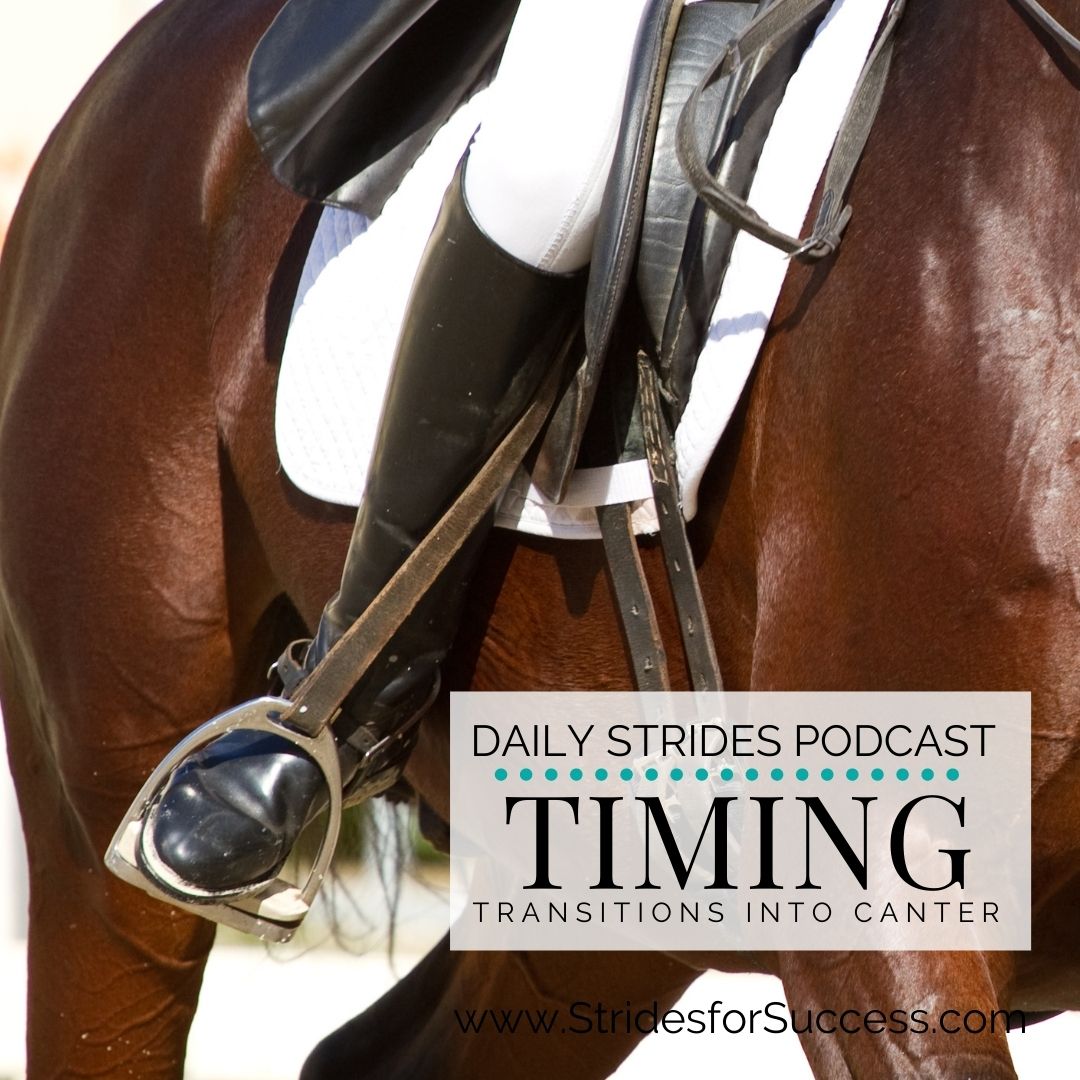
    Timing is something we all understand.  When it is working for us, it feels good.  If it’s a little off, things tend to feel rushed or stressed. I think our horses feel the same mixed bag of emotions and tension when the timing is off.  In fact, bad timing often is the very thing that causes a ‘hop, skip, and jump’ into the canter.

    So, if timing the ask of your canter transitions is so important, why can it often feel so hard?!  And why, is it that what so many people say is ‘easy’ to feel, seems like a mystery to most riders?

    Excess Tension

    The first suggestion I am going to give you when it comes to timing your canter aids is to give your physical body a quick scan.  There is one reoccurring theme I see with novice riders, the world over when it comes to the canter.  Really; this one issue really trips so many riders up!

    When they begin to think about canter, they allow excess tension to creep into their body as they overthink the upcoming transition. 

    It can be subtle or it can be more obvious, depending on the situation and the rider.  However, it is very often there and present.  My suggestion for you when beginning to prepare your transition into the canter is to pay attention to your body.

    Tension is neither good nor bad.  It just is.  And, in fact, it is essential to keep you upright on the horse!  It is when there is too much tension present for the task at hand, that the challenges show up.

    One way to tell if this is happening to you is when your horse seems to either understand English (so when someone tells you to canter, he changes what he’s doing). Or if he seems to read your mind. It’s probably neither.  He’s simply responding to you…

    Feeling the Movement

    From here, begin working on identifying what you are feeling.  It’s all well and good to say ‘my horse is walking’ or ‘my horse is trotting’.  However, you need to begin going a little deeper.  You need to know what is moving when and where underneath you.  And, preferably, without having to look or glance.  Pure feel.

    Start with the rhythm.  Identify the beat.  Then begin imagining in your mind the sequence of hoof falls that make that beat in the gait you are in.  Apply this to your horse.

    Regardless of where you are in your riding journey, you will be able to either feel or hear the hoofbeats of your horse.  Especially in the walk. Feel into that 1,2,3,4, 1,2,3,4, 1,2,3,4…  Do the same in the trot.  Don’t overthink it.  Just simply allow it to happen and be mindful of it.  ‘Oh, there’s the 1’.  Or ‘interesting, that was different between the 2, and 3, than the previous stride’.

    If you are not completely sure of the sequence of your horse’s feet as he walks or trots, learn!  Make it your mission to understand each gait, so you can begin merging the rhythm to what is happening underneath you.

    Noticing the Swing

    From here, I suggest starting to develop your seat by noticing that there is both a ‘forwards and back’ movement happening in the walk and trot and, also, lifting and lowering.

    Notice how, when in the walk, as your left seat bone slides forward, it also lowers a little.  And, as this is happening, your right seat bone will be sliding back and it will be lifted slightly higher.

    Often, when explaining or teaching the transition into the canter, instructors will talk about a scoop of your seat.  This is setting things up for the scoop.  And it is one of the keys to knowing ‘when’ to ask for the transition into the canter.

    Your Horses Barrel

    Okay, this is where you can begin seeing little signals from your horse that this is the right place to ask.  Pay attention to your horse’s barrel as he walks.  As your left seat bone slides forward and dips down, his barrel will swing to the right.

    Now, let’s pretend that you are on the left rein, so moving around the arena anticlockwise.  If you were to ask for a canter, we can assume you will ask for the left lead, right?  So, your aids for the transition itself will include your inside leg being ‘on’ and your outside leg playing ‘tag’ and sliding back to ask for the transition… Okay?

    Well, notice how, when your horse is standing on his outside hind leg (your outside seatbone will be sliding back, and up and over it), his barrel literally pushes into your outside leg.  It ‘prompts’ it to take action. 

    Now, obviously, your horse is not doing this on purpose.  He is simply making space for the inside back leg to move into as it travels forward.  However, if you have done your homework, you will know that to ‘strike’ the canter, he will start with his outside back leg.  So it makes sense to ask when this is on the ground and ready to ‘push off’ into the canter.

    Another way you can look at this, is from the scoop persepective.  If your outside seatbone is travelling backand is higher, it makes sense that your inside seatbone is travelling foward and is… Lower.  Which helps with that ‘scoop’ aid. 

    Transition into Canter From Trot

    I always suggest that riders, if possible, work on perfecting their timing for the transition into canter using the walk to canter.  There is time for them to really settle into it and be mindful and present to all of it.  However, I also know that, at some point, you will want to begin practicing the transition from trot to canter.  This is a little different and, in my opinion, requires a little more coordination and feel.

    One of the best ways of getting clear about what is moving when underneath you as you trot is to pay attention to your diagonals.

    Rise and fall with the shoulder by the wall is how the saying goes.  And because your horse moves his legs in diagonal pairs when he trots, once you know what his outside shoulder is doing, you automatically know that his inside hind leg is doing the same thing.

    Which allows you to figure out where his outside hind leg is at any given time in the stride.  You can tell this, again, by understanding how your horse moves.

    From here, simply apply your aids at the time when your horse will find it easiest to take action on them.

    Happy Riding
    Lorna

    Additional Links to Help You:-

  • Weight Aids & using them with Intention & Focus

    Weight Aids & using them with Intention & Focus

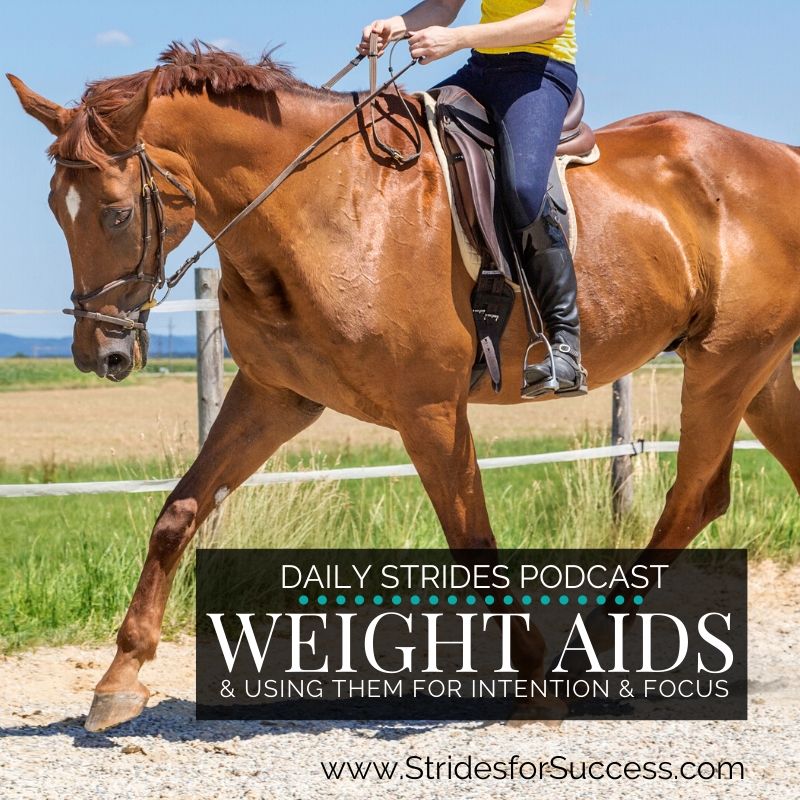
    Weight aids are often overlooked and underused by many riders.  I want to help you begin to see how powerful your weight aids have the potential to be in your riding.  I also want to use your weight aids to see demonstrate how power intention and focus have on your goals as well.
    Less is more where your weight aids are concerned.  Unfortunately, many riders seem to throw everything they have behind a weigh aid when they think they should apply one.  All this serves to do is unbalance both horse and rider.
    [smart_track_player url=”http://traffic.libsyn.com/dailystridespodcast/1126-Weight-Aids-Intention-and-Focus.mp3″ title=”Weight Aids and Using them with Intention and Focus” social_linkedin=”true” social_pinterest=”true” social_email=”true” tweet_text=”I’m going to challenge you here; I want you to see the connection between how you approach your weight aids in the saddle & how you approach your goals…” hashtag=”Equestrian” twitter_username=”Strides_Success” ]
    Your goals are similar.  If you put all your focus and attention on a single goal, you will soon find that life, in general, will become unbalanced.  And this can go against how many of us feel when we set goals.  We get all caught up in the initial enthusiasm of the potential outcome, often to our own detriment.

    Finding Balance

    Balance means that you have a center point where you feel happy.  As everything is moving and you are moving with it, you will make continuous small adjustments to make sure that you return to ‘balanced’ all the time.  Small little ‘course corrects’ that helps everything work together.
    In riding, I call this the ‘balance of aids’.  Yes, there may be a ‘leading aid’, however, all the other aids have supporting roles in order to keep the balance.
    Life is the same.  If you choose a single goal and decide to just focus all of your intention and energy on it, the rest of your life will suffer.  It may be able to sustain for a while, but sooner or later, things will begin to show the strain of this unbalance.

    How Most Riders Apply Their Weight Aids

    Next time you’re in the saddle I want you to do a little experiment…  I want you to ‘weight your inside seat bone’.  This is something most riders will have heard and tried to do at least once or twice in the saddle before.  What usually happens is riders go about weighting that inside seat bone with great gusto!  They literally throw everything they have onto the one seat bone.
    The result is that the now completely disregarded and ignored ’ non-weighted’ seat bone is just that – bearing absolutely no weight at all.
    In fact, I have seen where the ‘unweighted’ side of the riders ‘bum’ has daylight between it and the saddle…  This is definitely not a ‘balance’ of aids.  It is applying too much focus and directing too much attention at one aid.  Resulting in all the others being ignored – until they can’t be ignored anymore…
    The lack of balance caused by this overweighting of the seat bone also usually results in the rider twisting their body in order to remain upright and in the saddle.  They have lost alignment.  Their body will, automatically and without conscious thought, work at keeping them in the saddle and off the ground!

    Versus How You Can Apply Your Weight Aids…

    Okay, once you have experienced the thrown everything bar the kitchen sink approach to your weight aids, I want you to now try the opposite.  Sit back up straight in your seat.  Make sure there is an equal amount of your body either side of the center of the saddle; meaning you’re not crooked or leaning.
    Become aware of how your seat is in contact with your horse.
    Use this to shift your awareness to your core. Pay attention to how, if you engage your core, you can begin having a subtle, but real, effect over your seat bones. Bring your attention to your shoulders and hips.  Keep them aligned and focused on where you are going.  You can also think about your legs and heels.  Feel how the weight is distributed.
    Invest some time playing with how, by engaging specific areas of your body in a conscious, yet subtle way, you can weight your seat bones while still allowing the rest of your aids to play their roles.

    Approach Your Goals the Same Way

    Enthusiasm is great and will often help you gain momentum on specific goals, especially more difficult ones.  However, just focusing on one thing for any prolonged period of time will enviably result in you ignoring or neglecting other areas of your life.  I see this happen with many riders; particularly when the new year rolls around.
    Riders create goals that demand too much of their time, attention and resources if they are to be achieved when and where they want them to be
    This ‘lopsided’ approach ends up in the riders being unable to maintain their focus for any real length of time.  And this is where riders complain that they are not able to ‘make progress’ or ‘reach their riding goals’.  It is important that the goals you are setting are goals that both support and will be supported by the rest of your life. Your current lifestyle, resources, and schedule.
    The key to creating successful goals as a rider is to choose your equestrian goals so that they work with the rest of your life.  Rather than compete with the rest of your life…

    Go Find a Swing to Practice On…

    Here at Strides for Success and on the Daily Strides Podcast, I devote a lot of time helping riders to understand how to channel energy in the saddle.  How to direct the energy they are creating with their horse in a way that gives them the outcome they desire.  It is a pretty basic element of riding and one that must be refined if you are to make progress with your horse.
    Your weight aids are a great way you can begin to more effectively ‘channel’ the energy you and your horse are creating when you ride.
    I would love it if, sometime in the next 24 to 48 hours, you can go sit and ‘play’ on a swing.  A real-life ‘seat with two ropes tied out of something high’ swing. Notice how, first of all, you don’t actually need to ever put your feet on the ground to get you going, stopping or just swinging.  Your body, and more importantly, your weight, can do all of that if used effectively and correctly.
    Also notice how, if you ‘weight’ one of your seat bones, you can twist the swing.  The twist can be a little or a lot depending on how much weight you’re throwing on that seat bone and when you are doing it.  Once you have noticed all of this and you experience firsthand how powerful your weight and focus can be, begin ‘playing’.  Engage your core.  Make the movements more subtle.  Work with energy.  Then work against it.

    Take This Knowledge Back With You In the Saddle

    All of this can also be achieved by you in the saddle.  You just have to first believe it and then actively begin practicing and working on it.   When you’re on the swing, pay attention to how you are using your body to make those changes happen.  What muscles you are engaging in and in what sequence and combinations.
    Play and experiment with how much change you can have over the swing and the energy by just mindfully using your intention and your weight.
    Then do the same thing the next time you are in the saddle.  Play with your intention.  Experiment with your weight.  Notice how your horse responds and look for ways you can refine things with each ride.  Also, keep in mind that if you have been ‘throwing your weight around’ up to this point, your horse might just ignore those more subtle requests initially from you.  He simply won’t know he is supposed to pay attention to them. This is, again, where your balance of aids is so important.
    Use your other aids to tell your horse that the conversation has changed and that you are now focusing on being a little more responsible where your weight aids are concerned!

    Responsible Goal Setting for Your Riding

    My goal with this episode is to show you how, sometimes, being a little too enthusiastic with our riding goals is actually the reason we fail to achieve them.  I want you to think about your weight aids and how less is more.  Apply this same approach to your riding goals and see what happens.
    Maybe you can ‘stretch’ the timeline a little further.  Or it might look like setting a goal of riding 3 days a week, rather than 5.  It could even be a goal for spending one day a week just enjoying your horse’s company.
    Whatever your goals are for the coming year and beyond with your horse, I hope that this will help you to set ones that you enjoy working towards as well.
    Happy Riding
    Lorna

    Resources to help you with this topic

  • Weight Aids & Seat Bones for Turning & Bending

    Weight Aids & Seat Bones for Turning & Bending

    The bend is approaching and you begin preparing both you and your horse to ride straight and accurately through the turn. However, as you ‘shift’ your seat bones into ‘position’ your horse begins, well, almost side stepping… The further you get through the turn, the further your horse is from the path you had planned; in fact, he has derailed altogether from the ideal ‘train tracks’ you had intended to stay on as you rounded the bend.

    As riders we learn early on about how important our weight distribution is to our horses way of going. We learn about positioning our seat bones, so we can indicate to our horses what exactly the next movement should be. We also learn that our weight aids are fundamental to all aspects of successful communication with our horses in the saddle.

    [smart_track_player url=”https://op3.dev/e/traffic.libsyn.com/dailystridespodcast/591-Weight-Aids-and-Seat-Bones-in-Relation-to-Turning.mp3″ title=”Weight Aids and Seat Bones for Bending and Turning” social_linkedin=”true” social_pinterest=”true” social_email=”true” tweet_text=”Weight Aids and Seat Bones for Bending and Turning Your Horse” hashtag=”Podcast #equestrian #horse” twitter_username=”strides_success” ]

    What we don’t learn is awareness of how the other parts of our body directly or indirectly affect how and where our weight aids are applied with our horse. There is also not a lot of time spent on figuring out how loud or how quiet we can communicate with our horses through our weight aids. In fact, most riders seem to think that a ‘one size fits all’ approach is sufficient regardless of the circumstances, situation or horse involved.

    Learning to correctly feel and then master your weight aids in the saddle is key to developing good feel as a rider. Those subtle shifts and movements, which happen when you direct your muscles to move, rather than your actual weight or bones themselves. This is very much apparent when turning your horse and that is what I want to focus on today.

    So let’s begin with focusing on how your carry yourself in the saddle. Many riders make the mistake of going a little too overboard when told to ‘relax’ through their body.

    Relaxation is key to good riding, however the level of relaxation is also important to consider; particularly when it comes to how it affects your weight aids and seat bones in the saddle when riding

    Ideally you want your muscles to ‘carry’ you in the saddle, enough that your hips and seat are free to move with your horse and follow the motion. Following when riding is a little like following when dancing. The dancer that is following must remain in control of their body, walking that fine line between too relaxed or ‘slack’ and too tense or ‘rigid’. All the while they are looking for cues from their partner and then taking the responsibility on themselves to respond to those cues in the agreed manner.

    Riding is the same. Following does not mean you slouch in the saddle, looking like you have had one too many before you mounted. It rather means you carry your upper body, so your hips and seat are then willing and able to follow the horse’s motion as he crosses the ground.
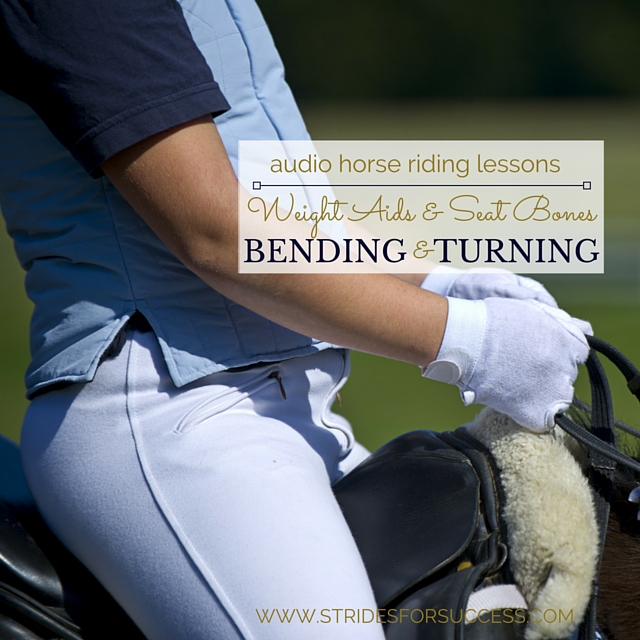
    Bending and Turning Your Horse Using Your Weight Aids and Seat Bones

    Think about it, your hips and seat bones can not possibly be free to perform a full range of motions if your upper body is heavy and slouching on top of it. Many riders mistake this for ‘shoulders back’, which is unfortunate as this only serves to increase the excess tension and therefore rigidness in the body, rather than simply carrying yourself, through your ribcage and positioning your body in the best possible place from which to begin asking your horse to turn using your weight aids.

    Once you are sure that you are indeed carrying yourself and, as a result, correctly following your horse wiht your seat, you can then begin looking at how subtle changes in different areas of your body will affect your weight aids and therefore what you communicate to your horse through your seat.

    So to begin with, let’s focus on the half halt.  One of the reasons we apply the half halt is to bring your horse’s attention back to you and let him know something is coming up.

    In fact, you can almost think of your half halt as being a big flashing arrow, directing your horse’s focus to your seat so he can begin to get further directions on what to do next

    Not using your half halt will probably result in your horse’s attention being elsewhere and therefore, any subtle movements with your seat to communicate with your horse will have a good chance of being ignored.

    That being said, it is also worth noting that applying the half halt and then following it up with an incorrect, overly exaggerated or heavy use of the seat and weight aids is just as ineffective as not using the half halt at all.  Think of your half halt as the opening part of the sentence which will then, in turn, lead up to the actual question you wish to ask your horse.   Become clear on what you want to ask, before you draw your horse’s attention to your seat to begin with!

    Once you have his attention, think about what you want of your horse as he rounds the bend.  Ideally, your horse’s spine should replicate the arc of the bend or circle.

    Your horse’s spine will stay on the arc all the way through, from his poll or ears to his tail or dock.  Similarly, your spine will too stay centered over your horses, not leaning one way or the other, not twisting and not collapsing to either the inside or outside.

    His hips will travel along parallel either side along this arc, however his inside hip will come slightly forward or ahead of his outside hip.  Your hips or seat bones will be in this same position.  Then look at the shoulders; again, they should remain parallel to the central arc or track as he moves along (like train tracks), however the outside shoulder will have to move a little more forward in order to do so and, therefore, so must your shoulders.

    It seems like an awful lot to remember, and when starting out, it is!  I have found it easier for some riders to rather remember where their legs should be through the turn.  Because your legs are connected to your hips, by moving them into the desired position, your seat bones will generally follow suit and automatically also ‘slot’ into position.  However, as you become used to the inside and outside being dictated by your horse, regardless of where you are in the arena, you can begin rather making the subtle shifts with your seat bones, and then allowing your legs to follow suit.

    So back to how we can use our muscles, either for good or bad, to influence our weight in the saddle.  Find a hard chair or stool and sit down with a hand under each of your seat bones.  Now, begin by moving your shoulders, the right one forwards the left one back and then vice versa.  Notice how a very small movement of only an inch or so, will change how the pressure being exerted on your hands from your seat bones feels.  Similarly, think about ‘weighting’ one of your seat bones.  Many riders will literally ‘bear down’ on that particular seat bone, shifting their upper body to do so.  However, feel that when this happens, your seat bones actually begin ‘sliding’ towards the opposite side.

    Now, rather think of ‘weighting’ that seat body through a combination of elongating the muscles on that side of your torso, and sending a tiny bit more weight or pressure to the heel of that leg.  Notice the subtle change in the pressure being applied on your hand.  It only takes small but precise adjustments with your muscles to ‘weight’ the seat bone.  The more you can learn to control your muscles, the clearer your communication will become with your horse.

    Very often riders use their weight aids in the wrong way; namely leaning with the upper body while will result in their seat shooting to the outside

    The result is that your horse will move completely differently to how you had planned, because he is trying to remain balanced and, literally, stay underneath you.  If you find this happening a lot, go back to making sure you are symmetrical, balanced and straight in the saddle and, once you are sure of that , begin insisting on it from your horse also. Always think about your own body and what you are communicating with your horse while riding  through the corner.

    I really think that being a little ‘picky’ or obsessive about riding in the correct position will help you to make sure that your body is in the best possible place to apply the correct aids for any given movement or direction.  It will take concentration and consistent effort on your part initially, but as your ‘feel’ increases, you will find that merely thinking about it will result in your body shifting slightly in the saddle – and the more consistent you are with always riding in the correct way, the more effective your horse will be at reading the small, subtle changes in your weight and position.

    Happy Riding

    Lorna

    I have written another blog post on applying your weight aids HERE >>

    Get to know your core muscles better which will give you more control over them by joining the FREE 30 Day Rider Fitness Challenge…
  • Correctly Applying Your Weight Aids

    Correctly Applying Your Weight Aids

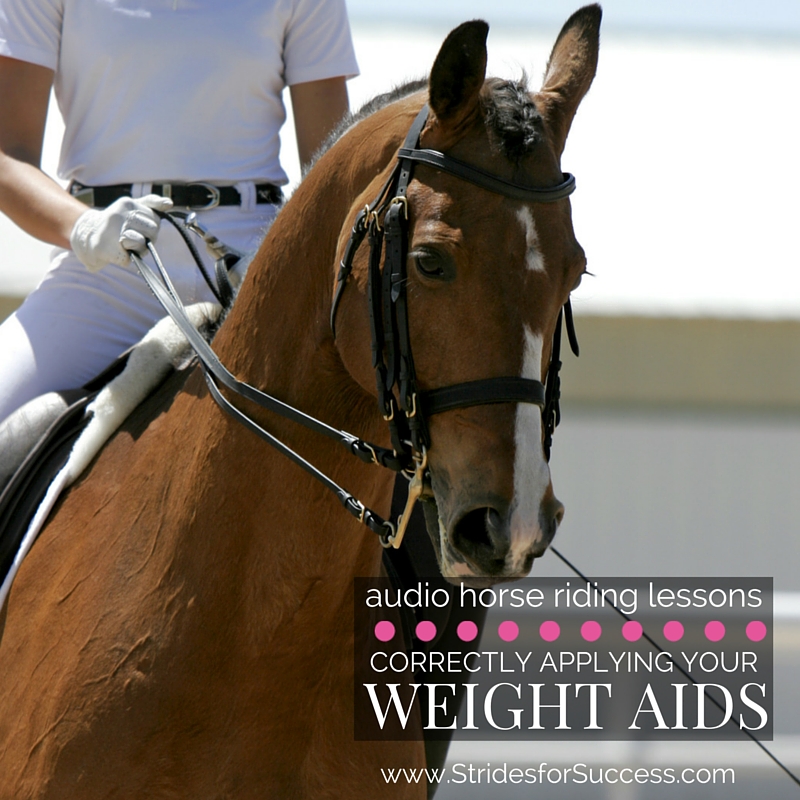
    When we begin riding, we are generally told about this almost magical ability that we have to communicate with our horse, known as the weight aids.   However, it soon becomes apparent that we have to master many other aspects of riding before we can hope to use our weight to communicate with our horse…

    Unfortunately for many of us, this takes too much time to achieve, so instead we begin happily throwing our weight around in the saddle and then getting upset when our horse does something completely different to what we ‘asked’.

    [smart_track_player url=”https://op3.dev/e/traffic.libsyn.com/dailystridespodcast/516-Learning-to-Correctly-Apply-Your-Weight-Aids.mp3 Feedback” title=”Learning to Correctly Apply Your Weight Aids” social_linkedin=”true” social_pinterest=”true” social_email=”true” tweet_text=”Learning to Correctly Apply Your Weight Aids in the Saddle” hashtag=”horseriding #equestrian” twitter_username=”strides_success” ]

    So first and foremost, what are your weight aids?  The term ‘weight aids’ refers to where and how you are using your core to distribute your weight in the saddle.  Your weight aids are controlled with subtle movements which shift the pressure and weight of the seat bones in a way that communicates a certain instruction to your horse.

    You use your weight aids in all aspects of riding, from slowing down or stopping, to asking for more energy or moving forward.  Weight aids are an important part of transitions, bending, turning and even just riding a straight line.  Learning how to control your weight aid is a vital and essential part of good riding.

    It is only when we learn to develop a truly independent seat that those aids really can become useful to both us and our horse

    An independent seat is when you can move your legs or other parts of your body without affecting your overall balance & position in the saddle.  An independent seat is also something that is really earned by spending consistent time in the saddle, riding correctly and practicing correct movements and sound techniques.   A rider also needs a certain level of fitness and body awareness, so as to be able to use their muscles, and therefore shift their weight, as desired or required.

    If we do not first cultivate that independent seat, our weight aids can often work against us and our horse.  They can also when applied incorrectly, whether due to lack of knowledge or lack of control, contradict the other aids being applied which leads to our horse not performing as we think he should.

    Applying Your Weight Aids

    Many riders think that they are applying their weight aids correctly, however something as simple as not sitting straight in the saddle is enough to change the application and meaning of a particular movement.  Often riders will sit to one side, or favour one side of their body, when in the saddle and the problem then begins to compound when they begin shifting their weight around, giving a total different feeling to their horse than what the rider thinks they are asking

    Another way that the weight aids can begin to work against the rider if not correctly understood and applied is that often riders get a little ‘over enthusiastic’ in the application of the aid.  So rather than that subtle shift we mentioned in the beginning, they either begin ‘shoving’ or ‘pushing’ their horse, or they begin leaning…  Never Lean!  We can also incorrectly apply the weight aids, particularly when turning, by lifting our outside seatbone off the saddle…

    Keep in mind that both seat bones must remain seated if you want to give a correct and easily understood weight aid!

    The final issue I want to warn you of before we carry on is incorrect timing of the aid.  As with all things riding related, the weight aid being given will only be as good as the preparation leading up to it and the timing of it.  No matter how well-balanced, or finely tuned your seat may be, if you apply the aid at a moment when your horse physically cannot respond to it, the aid will never get anywhere near the result you desire.

    It is when you can combine a true independent seat with correctly applied subtle weight aids & a perfect sense of timing you will begin to master what we call ‘feel’ in the saddle

    To get an idea of just how subtle your weight aids and the ways you affect them are, I suggest beginning off your horse.  Find a firm surface you can sit on, and gently put a hand under each of your seat bones.  Feel how just applying a little more tension to the different muscles in your core, affects the distribution of the weight applied by your seat bones on your hands.

    Move your body as you would when in the saddle performing a half halt; feel how your seat bones would ‘block’ a river of energy that would flow underneath you through your horse’s back when you are in the saddle.  However, then begin to see how, my making slight adjustments,  you can soften that aid or smooth it out.

    Once you can begin feeling these subtle differences, try it with how you would move when you ask your horse to move forward, whether it be to transition up a gait, or within a gait.  Again, imagine the river of energy flowing underneath you and how, when applied correctly, your weight aids will ‘open’ and allow that energy to flow a little more.

    Of course, when you apply your weight aids you are not necessarily ‘blocking’ or ‘allowing’, just rather suggesting this to your horse, who with time, will understand and make adjustments as required

    Once you have a good feeling and understanding of the ’cause and effect’ of your body movements out of the saddle, then you can begin experimenting in the saddle.  Unfortunately however, many riders will experience that their horse is not all that attentive to their weight aids initially.  This is usually due to the fact that the rider has been guilty of literally ‘throwing their weight about’ in the saddle!

    However, all is not lost and you can begin to re-school or retrain your horse to your newly acquired subtle weight aids.  To do this you will have to be consistent and mindful of where you are sitting in the saddle and also that each movement or change is set in motion by applying the correct, subtle, weight aid first.   Your horse will, given time, begin to associate that particular weight aid with that instruction and soon, begin responding to the weight aid when it is applied.

    Really effective communication with your horse through your weight aids will take time and patience, however is really worthwhile in the end.

    Happy Riding

    Lorna

    Applying Your Weight Aids