Tag: Equestrian

  • Not Feeling Like a Typical Equestrian?

    Not Feeling Like a Typical Equestrian?

    [fusebox_track_player url=”https://op3.dev/e/traffic.libsyn.com/dailystridespodcast/1324_Not_Feeling_Like_a_Typical_Equestrian-Lets-Change_That.mp3″ title=”Not Feeling Like a ‘Typical Equestrian’?” social_linkedin=”true” social_pinterest=”true” social_email=”true” ]

    What does the typical equestrian look like? Apparently not like a lot of the typical equestrians that I know!  Let me explain; recently I asked riders to let me know what challenges they were having in their riding, in the hopes I could potentially help.  And I received so many replies from riders all over the world. Great right?

    Except for the line of text that so many of those emails contained…  “I’m not a typical equestrian”. And because of this, the rider feeling unworthy of having their question answered… 

    Now, there were of course different versions of this; “I’m not your average rider” or “I’m much older than other riders”.  And it was the tone of all of these similar statements that really got my attention.  To me, it seemed as though because they didn’t see themselves as a ‘typical equestrian’, their question was not worthy of being answered.  Why is it that so many riders feel like this?

    Not a Typical Equestrian…

    I think many riders simply feel like they don’t ‘belong’. Or that they’re not ‘horsey enough’, as though there was some standard measure for this.   Perhaps of who we continue to see represent a typical equestrian in advertizing.

    If I take myself, for example, I’m definitely over 28.  I am not extremely wealthy. And I certainly don’t board at an exclusive barn! My ‘Riding Outfit Of The Day’ is not always colour-coded, never mind matching or complimenting the colours my horse is wearing! And, quite honestly, I don’t spend an hour each morning getting my make-up on, my hair set, and my outfit ‘just right’ to go and do what has to be done at the yard with the horses…

    For the most part, I clean a good deal of my own stables and tack – which is something many equestrians I know do as well  (and I know quite a few…)  

    Equestrian’s I Know Are…

    And I think that there is an issue.  The ‘typical equestrians’ that we are being fed so much of in mainstream media do NONE of these things.  They don’t mix and make their horses feed, they don’t ‘hay’ their horse.  Honestly, have you ever seen an equestrian ‘influencer’ covered in horse sh*t or hay? No, not ever! This brings me to my final point, they rarely ever seem to muck out, skip out, or clean up…  In fact, it’s only done if they are promoting a special gizmo or gadget for that day… #ad :)

    I think the feeling of being unworthy to take up ‘equestrian space’ with their questions, thoughts, and opinions that so many riders feel is due to ‘us’ still not being represented in print and online. 

    Why don’t we see more vertically challenged (like myself) equestrians? Or riders with multicolored, grey, braided, brassy blonde (darn sun!), dark, or curly hair…?  There are the equestrians that I know and love who have generous waists and thighs and are proud of their bodies.  Many have strong hands with maybe a callous or 5 (hands up here again!).  Skin that is many shades darker than pale lily-white. Or skin that maybe once was lily-white, but has seen a lot of sun.  Most of it while either on the back of a horse or fixing a fence…

    But let’s ask the question; what is an equestrian?  It’s a person who enjoys building a relationship with a horse, or lot’s of horses – period. 

    Whether that’s on the ground or in the saddle if you love the idea of going deeper with your horse, congratulations!  You’re an equestrian :)

    Your Questions & Thoughts are Valid

    I would love to see a change in riders regarding how ‘worthy’ their questions, thoughts, and opinions are.  It seems to me that there are so many riders out there that are choosing to stay quiet.  And they do this because they don’t feel like their schedules, riding style, or lifestyle ‘matches’ what a typical equestrian ‘should’ look like.

    If you love horses and you’re interested in improving the clarity of the communication between you and your horse (or horses in general), your questions, thoughts, and opinions are needed in the equestrian world.

    It’s through diversity of thought, different (sometimes difficult) conversations, and a level of open-mindedness that equestrian sports and lifestyles can grow and expand. 

    So if right now you don’t feel comfortable ‘taking up space’ inside of those conversations, you have important mindset work to begin doing for both yourself, your horse, and all of the legions of other not-so-typical equestrians who have not even begun their journey yet.

    Start ‘Feeling’ Like a Typical Equestrian

    I think the key to making lasting change for all riders is to recognize and celebrate that if you are interested in horses and want to develop your relationship with a horse… You’re a typical equestrian! And because I know this is you, congratulations! I say this tongue-in-cheek because we both know that, deep down, you already are fully aware of this. So own it.

    Equestrians care about the relationship between themselves and their horse. They look for ways to better that bond and develop their skills. Even if they are in mismatched clothes and smell like a manure pile!

    The key is the desire to improve how you show up for you and your horse. Having that desire and then taking actions that align with that desire is the key to ‘being’ an equestrian.  And the good news is that there countless ways you can do this…

          • Educate yourself more about your riding
          • Understand more about your horse and how he does things
          • Be intentional with each interaction
          • Set some ‘do-able’ goals and a plan to work towards them
          • Realize that you and your horse are a team – meaning training is 50:50

    Immerse Yourself in ‘Being’ an Equestrian

    So, you are now 100% certain that you are a bonafide equestrian.  However, ‘knowing’ something and ‘being’ something are often two different things. And this is where I encourage you to start your immersion into how you can begin feeling more like a ‘typical equestrian’.

    My first suggestion for you is to spend a little intentional time each day learning, or doing something ‘equestrian related’.  Read a book or listen to a podcast – I highly recommend the Daily Strides Podcast for Equestrians ;).   Brush your horse’s tail or clean some of your tack – both while listening to a podcast ;).

    Do what feels good for you and really become intentional about yourself and your feelings. By immersing yourself more and more each day in ‘horsey things’ you are going to begin to feel more ‘horsey’.  It is a simple truth.

          1. Sign up for the 2024 all-new Equestrian Fitness Challenge (it’s based on walking not workouts)
          2. Request to join the Daily Strides Podcast Online Community and join in the chats
          3. Do one thing every day that grows your knowledge as an equestrian
          4. Spend 15 minutes every day doing something ‘horse’ related

    Trust me, after a couple of weeks of surrounding yourself with intentional ‘horsey’ input, you will begin to feel like what we already know to be true; that you are a 100% typical equestrian.

    And then, practice voicing your questions, your opinions, your thoughts, and getting involved in our sport.  Your input is greatly needed and might just change the trajectory of someone else’s ‘horsey’ journey.

    Happy Riding
    Lorna

    Equestrian Fitness Challenge ’24

    Let’s walk together for 21 days and have a chat about how you can do much more than you think you can as a rider and an equestrian… I am so excited to bring you along on this journey for the 100% FREE 2024 Equestrian Fitness Challenge
    There will be a daily walk, a 10 minute daily yoga practice, and lots of tips, ideas, exercises, and ways to improve so that you can show up as the best version of you – for you and your horse.
    Sign up today and let’s transform your riding – one stride at a time! 100% FREE 2024 Equestrian Fitness Challenge

    More Help for Riders:-

    Connect with Lorna online:-

    Get Going in Your Riding:-

    Daily Strides Premium is back! You can use the first and original audio horse riding lessons to improve your riding, train your horse, keep things interesting, and have fun… Even if you don’t have a trainer or coach

  • Day 12 ~ SfS 12 Days of Christmas Equestrian Challenge

    Day 12 ~ SfS 12 Days of Christmas Equestrian Challenge

    Strides for Success 12 Days of Christmas Equestrian Challenge Day 12

    The final day of our challenge – and today I want you to turn your attention back to yourself and your horse.  We are so close to the end of the year I want you to have a think about where you are right now.  Is this where you thought you would be 12 months ago?  Did you reach your goals?  Keep your resolutions?

    Where would you like to be this day next year?  More specifically, I want you to think about your riding and your horse.  When you get to this day next year, what do you want to be able to have written about 2017?

    What do you want your word for 2017 to be?

    Today  for the final day of the SfS 12 Days of Christmas Equestrian Challenge, Day 12, I want you to set your number 1 equestrian related goal for 2017.

    Will it be to do with your riding?  Perhaps it will be based on your horse, or where your horse lives.  Maybe it will have something to do with equipment or tack.  It might relate to competitions or qualifications…

    Whatever goal you choose, please make sure it is ‘do-able’ for you.  That your current circumstances support and will allow you to pursue this goal.  Time and finances are two of the biggest factors when considering if it is the right goal for you.  Also your family and work.

    Once you have chosen your goal, post it online making sure you use the hashtags for us to follow along. 

    And finally, because this challenge is about what you can do to help others, I urge you to take a look around and see who you can help achieve their goal.  

    Is there someone at the barn that you can support?  Perhaps there is someone you can mentor?  Maybe there is a rider who needs someone to video them?  Or who could ride an extra day a week of someone tacked their horse up for them…

    When you have identified a rider you feel you can assist, approach them and offer your services.  If they take you up on it, fantastic!  If they don’t, well no hard feelings!

    As with the previous days, here are the hashtags you can use when posting your goal…

    #Sfs12DaysOfChristmas #12DayChristmasEquestrianChallenge #MakeEveryRideGreat #30DayRiderFitnessChallenge #EquestrianChristmas #PayingItForward #FitforRiding #RidingforWellness #EquestrianLifestyle #ChristmasChallenge #SfSChristmasChallengeDay1

    Thank you so much for taking part in the challenge… If you have been following along via email, look out for an email from me on Tuesday 27th of December…

    I hope you and your loved ones have a peaceful, blessed and happy Christmas
    Keep well
    Lorna

    The Strides for Success 12 Days of Christmas Equestrian Challenge is an opportunity for equestrians throughout the world to give their favourite equestrian businesses, bloggers and horse people in general a big virtual shout out & “Thank You” throughout the 2016 build up to Christmas!

    To join in the fun, simply CLICK HERE and help spread the love & gratitude throughout the horsey world.  

    Day 1, Day 2, Day 3, Day 4, Day 5, Day 6, Day 7, Day 8, Day 9, Day 10, Day 11, Day 12

    And help us to spread the Christmas goodwill all over the equestrian world by sharing the challenge with your friends and fellow riders.  Thank You!

  • Increasing Your Horses Suppleness

    Increasing Your Horses Suppleness

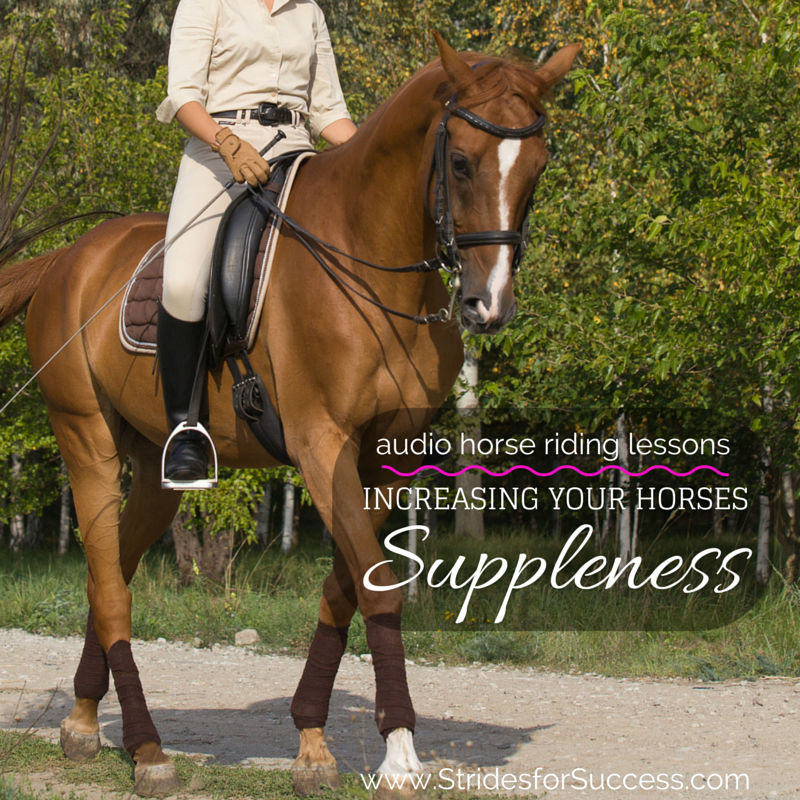
    Have you ever ridden a horse and they feel so wonderfully loose and pliable underneath you?  Perhaps you can remember how your horse was able to really and truly use his body and how the suppleness made it feel like he was performing movements in the best possible way that his body, fitness and confirmation allowed?

    [smart_track_player url=”https://op3.dev/e/traffic.libsyn.com/dailystridespodcast/SFA431-Increasing-Your-Horses-Suppleness.mp3″ title=”Increasing Your Horses Suppleness” social_linkedin=”true” social_pinterest=”true” social_email=”true” tweet_text=”Loosey Goosey… That feeling you get when your horse is warmed up, ‘bendy’ and ready to go… ” hashtag=”Supple #TrainingScale #Equestrian” twitter_username=”strides_success” ]

    True suppleness allows your horse to bend without stiffness and work freely without excess tension or stiffness throughout his back and muscles.   This enables him to perform smoother movements and transitions with greater balance which leads to building strength, development of muscles and growing confidence in both horse and rider.

    Increasing Your Horses Suppleness

    As riders, we are seeking true flexibility or suppleness in our horses, and should always work towards trying to establish, and then allow, elasticity throughout the horse, particularly the jaw, poll, back shoulders, knees, hips and hocks.

    However this is often difficult to understand due to the simple fact that we will not achieve suppleness by ‘fixing’, ‘forcing’ or ‘restricting’ our horses in any way.  Rather than forcing your horse into unnatural frames or positions trying to promote this relaxation and flexibility, think of asking your horse to stretch himself in a natural way, little by little in slight increments, to grow the natural pliability of his muscles and joints.

    Also, when he is flexing or bending, if you are ‘fixing’ him or holding him there, he is not truly supple himself.  When riding , ask your horse for a small about of flexion or bend and then allow him to carry on with the movement himself for a period of strides or seconds.

    As his strength grows, he will become more flexible and his ability to carry himself for longer periods will also increase.

    Suppleness can be thought of in both a forward movement capacity and a sideways or lateral capacity. It is important to ride exercises that boost the development of both. Your horse will not achieve true suppleness if only using his body a certain way. In fact over-development of one will  often result in stiffness in the other.

    Another advantage of working to increase relaxation and suppleness is that it can have a positive effect on your horse mentally and emotionally as well. Often we try to ‘relax’ our horses by speaking to them in a soothing manner, however, if we think about life, feelings follow actions (it is rarely the other way around), so by relaxing the body, we can often dissipate anxiety and stress in the mind and put that energy to better use elsewhere.

    In riding, we are thought to think from the back of the horse to the front of the horse.  Energy created in the hind quarters and then sending it to the front of the horse.  However, we should think of loosening or relaxing our horses the other way around, from front to back.

    There are many horses that are flexible, pliable and supple through their backs and limbs, however they are ‘stuck’ at the poll or jaw which causes that flow of energy to also become stuck or blocked and makes true connection  impossible.

    When working on increasing your horses suppleness, I suggest starting with the poll and jaw.  Place two poles parallel to each other across the center line about 1 meter apart.  In walk, bring your horse between the poles and ask for halt. Try to keep him straight, using the poles for guidance and reference. Then, remembering to keep his neck straight, as him to flex his poll, first one way and then the other.  Use your inside hand and turn your wrist slightly so as the underside is more on top and your thumb is about 45 past the vertical to the outside. Gently squeeze with your ring finger.

    When asking for the movement, keep in mind it is very slight flexion in the poll, not bending though the neck. Ask to the right and then back to center, and then back to the left. You can repeat this quite a few times, all the while noticing any resistance or stiffness. If this shows up, rather invest more time over the coming weeks and months, slowly asking for the flexion and then working it out.

    Don’t force it! Suppleness does not happen overnight, it takes time for your horse to soften, relax and become flexible

    Once you have mastered this in halt and your horse understands, you can begin to incorporate it into walk, trot and eventually, canter.  Use the center line, and if necessary, place some parallel ground poles to work between school to help keep you ‘straight’ and on target for where you want to go.  Remember, you are only flexing your horses poll, not bending the neck.  In walk, ride up the center line and begin asking you horse to flex left then back to straight and then left.

    Pay attention that his shoulders are not ‘swinging’ where you are flexing to which will give your horse the appearance of being slightly inebriated!  Also, focus on keeping him straight through his back, not allowing the hind quarters to fall in or out

    As mentioned, it is important to work all parts of your horses body, so I recommend beginning to incorporating some large circles into your work.  how well your horse can maintain the bend in their body on the circle, will depend on how supple your horse is.  the smaller the circle, the more difficult it will be for your horse, so stick to large circles initially in walk or trot.

    Increasing Your Horses Suppleness

    When riding the circle, Establish and maintain a consistent bend to the inside, all the way from neck to tail. The degree of the bend will depend on the size of the circle as you will follow the arc of the circle.

    Notice if your horse is falling in or out through this shoulders.  Often, when we ask for the horse to bend to the inside, he will begin to literally fall in towards the center of your circle, rather than maintaining the ‘line’ of the circle and his back replicating the arc of the circle.  If this is the case, use your inside leg to encourage him to stay ‘out’ on the circle, however once he is there, he must learn to balance himself so you are not all the time supporting him on the circle or bend.

    There is nothing more exhausting that riding a horse which you have to hold up with your legs

    Again, start your circles in walk and once he understands and has a nice equal bend through his body, go forward to trot and later canter.  Work on both directions and pay attention to any stiffness, tension or lack of balance on one side more than the other.

    If you do notice any problems, see working in it as a long-term project that will be successful if you consistently work little by little at stretching and loosening up your horse

    You can also begin to incorporate some serpentines into your schooling.  Obviously work on your bend while riding the loops, but also focus on your straightness as you cross the center line.  Transition in and out of the two by beginning to ask for some flexion through the poll for 2 to 3 strides before and after the center line.  As you round your ‘loop’ again, straighten the body with just the poll flexed and as you cross the center line, straighten your horse, so you can then change the flexion in order to ride the next loop.  Work the serpentines from both sides, again walk, trot and then canter if necessary.

    You can also incorporate some halts into the serpentine, as you cross the center line, and spend the time in halt flexing the poll again in order to flex the poll and reinforce the principle, in both your head and your horses!

    Finally, you can begin to add some counter bend to your circles.  Ride a large 20 meter circle in walk and once you have established bend to the inside, see if you can ‘change’ the flexion to the outside, paying close attention that the shoulders do not come off the track of the circle.

    The flexion to the outside will be very slight at first, and not held for long periods.   Work on a quarter circle to the outside, then change to a half circle to the inside and then returning to a quarter circle to the outside.  Slowly, your horse will begin to increase his suppleness and flexibility throughout his body and from there, you can begin to make the circle smaller or begin working in trot and, again, later canter

    Suppleness is something that must be continuously and consistently worked on in order to maintain and improve with your horse

    Just like us, if our horses become restricted and only use their body in a certain fixed movement, over time they will lose their ability to bend and be pliable..

    It will take time to build true suppleness, and it will have to become an integral part of your training program to maintain it

    Happy Riding
    Lorna

    [wp-tiles post_type=”post” orderby=”date” order=”DESC” grids=”Simple”]

  • Slow Down Over Fences

    Slow Down Over Fences

    [fusebox_track_player url=”https://op3.dev/e/traffic.libsyn.com/dailystridespodcast/SFA396-Learning-to-Slow-Down-Over-Fences.mp3″ title=”Learning to Slow Down Over Fences” social_linkedin=”true” social_pinterest=”true” social_email=”true” ]

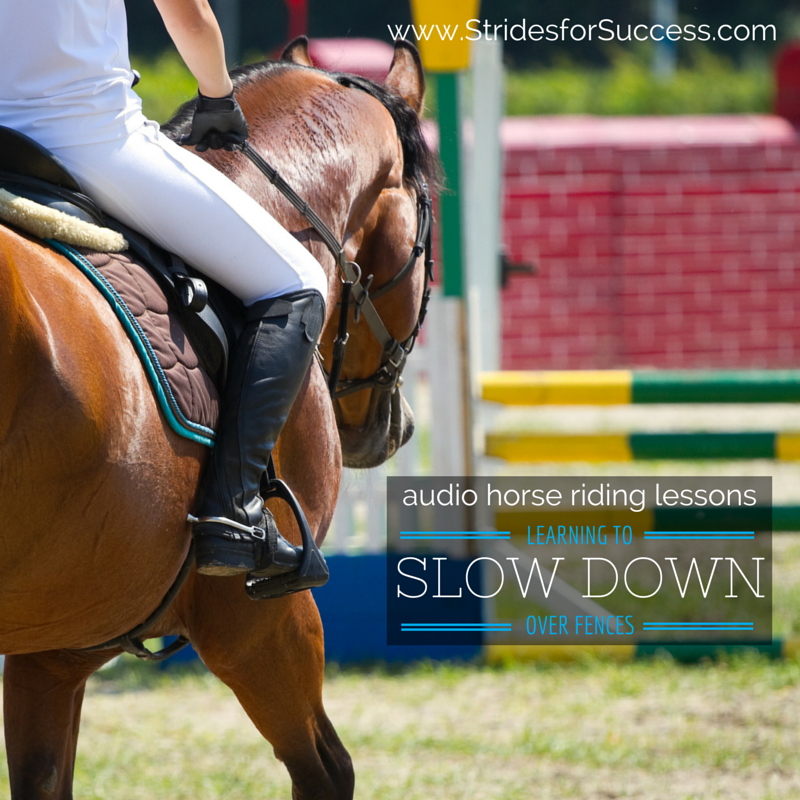
    Does your normally relaxed, sane, and rhythmic horse turn into his version of a racehorse each time he rounds a corner and spots anything that resembles a jump when you are riding?  Your quiet calm ride turns into a flat-out gallop, resembling the rush for the finish post on the final furlong of Aintree…  (minus the cheering crowds!)

    Unfortunately, horses rushing or racing over fences is a common problem for riders. And one that, once all pain or discomfort has been ruled out as the cause, only patience, time, and consistent correct schooling can help remedy and slow down your jumping experience.

    Why Do Horses Rush?

    Rushing over jumps may begin to become a habit because of lots of varied triggers for different horses and riders.  One of the more common ways is due to a lot of riders becoming anxious over fences. This is also true for the horses. They pick up on this anxiety and become a little tenser themselves.

    This feeds the rider’s anxiety, which in turn feeds the horses. A vicious cycle is created between horse and rider every time a fence appears on the horizon

    Alternatively, many horses when jumping need a lot of practice to maintain the same speed around a course of fences.  Most horses enjoy jumping. And they become naturally more excited and ‘goey’ as they progress through the course.

    Learning to Slow Down over Fence

    Why You Need to Slow Down

    The downside to this is that instead of getting their back end underneath them, the horse flattens out. This causes them to pull forward with the front end. It also allows the energy to literally fall out through the front door.

    When the horse does not slow down it can have a real negative effect on the outcome. As reaches the fence, he cannot get sufficient height with his heavy front end.  He also cannot use his back correctly over the fence. This leads to knocking rails or worse.

    Anxiety in the Rider

    Rushing fences also leads to even more anxiety in the rider, who will generally do one of two things…

    Firstly, they lean back, behind the movement and haul on the reins with all their might.  

    While the horse will usually lift its head, it will also hollow its back. This, again makes it impossible to use its back correctly.  Also, when they do get to the fence, the rider is so focused on slowing the horse, that they usually end up being left behind over the fence. This causes discomfort and a loss of balance for both horse and rider.

    The other way I see riders react to a horse that runs at fences is to lean forward, hamster style, and just hold on.  

    They become completely ineffective as a rider. They are no longer supporting or carrying themselves. And all the while, the horse is getting faster and faster. Becoming heavier and heavier on the forehand.  Hamster style and hiding, the rider fails to do anything!

    This particular situation generally ends in one of two ways. The horse runs out of the fence with the rider coming off over the dropped shoulder. Or the rider stays on for the jump but hits the deck at the inevitable next turn after the fence.  Both, for obvious reasons, only increase the rider’s anxiety levels.

    Engaging the Hind Quarters

    As I mentioned before, in order for your horse to correctly use himself over the fence, the power must come from his hindquarters.  If you can just imagine a cat preparing to jump up onto a windowsill…  He first ‘rocks’ back onto his ‘hocks’, placing his back legs squarely underneath his body. Then, from that position, springs up by pushing off with his back legs, up onto the windowsill.

    Now, I do realize that a horse is built a bit differently from a cat, but the same principles apply.  His hocks must come more underneath his body in order to propel him cleanly over the fence.

    Learning to Slow Down over Fences

    Not only that, if the rider has collapsed their upper body, or gone into their jumping position too early which often happens with nervous and anxious riders, all their weight is now sitting squarely on the horses front end, making it even more difficult to lift the and shoulders and front legs out of the way of the fence.

    This is often why the horse will run out… It just becomes physically impossible for them to safely get from A to B over the fence.

    Starting with Reschooling The Rider

    All of these scenarios only lead to further issues for both horse and rider.  I believe when teaching a seasoned rusher to slow down over the fences, the training has to first begin with the rider’s mindset and control of their body and aids.  Only when this has been improved or changed can the horse can be worked on.

    A secure and correct jumping position is vital when working over bigger fences, but it is also necessary when working with a horse that rushes its jumps.

    Being able to direct the horse, while keeping out of his way over the actual fence is an essential element to riding clear rounds.

    One of the most important habits we can cultivate as a rider is to be able to ride through and focus on the end goal, regardless of what distractions or invitations crop up while getting there.

    What I mean by this, is to keep the focus on your aids.  Pay attention that you are correctly asking for what you are desiring your horse to do, at all times.  Don’t allow your body to shut down, and just become a passenger.  It is your responsibility as a rider to keep your sights set firmly on whatever goal you have set for you and your horse.

    Riding Individual Lines

    However, often the goal is simply just too big, so rather break it down; instead of looking to ride a course of fences, see the course as a series of individual lines that are merely joined together.  Rather ride each individual line, stride for stride, and when you have successfully completed one, then move onto the next line, again stride for stride.

    This is easier said than done. But in order to slow things down physically, you must condition yourself to slow them down mentally first.

    Begin with riding a straight line, on the quarter line of your arena. Place a single pole on this line. Ride over it in the canter. Focus on riding that line as straight as you possibly can. Also, halt while still on the line before the corner or bend.  Notice how, when you are thinking about halting before that corner, you are preparing for that all along… Not only focusing on the pole anymore.  I

    n fact, the pole is merely an obstacle to overcome before you get to what you are truly doing, which is the halt.

    The Importance of Straightness…

    It is important to note here that the line must be straight.  In order to successfully navigate a course of connected fences, your horse must be able to jump in a straight line.  This is not only essential to getting over a single fence, but also related distances, lead changes, and riding correctly through the corners as well.

    You will often see that many horses that rush fences, will tend to drift to one side or the other. This becomes even more noticeable through combinations.  Of course, straightness is also the key to preventing run outs.

    Work on establishing straightness as the rule early in your horse’s training, so as to minimize problems later as the fences get higher.

    Working Over Small Fences

    Once you and your horse are comfortable able to this on both reins, build a small fence where the pole is.  SMALL… 18 inches or so.  I want the fence to be so inconsequential that, again, it is merely a small obstacle between you and that lovely straight halt.

    If you find that, once the fence has been added to the exercise, your horse is beginning to rush, I want you to take things back again…

    Are you riding each stride with purpose or are you simply reacting to your horses rushing and riding defensively or not at all?

    If indeed your horse is rushing, place a ground pole about 9′ on either side of the fence.  Again, try to ride the fence with the same controlled, rhythmic canter that you achieved when there was only a pole there and aim for that straight halt afterward

    ReTraining Takes Time

    This may take weeks to achieve; horses develop habits, just like us, and unfortunately rushing is a habit that will take time to reprogram in your horse’s head.  All the while as you are working through the exercise, continuously check that you are indeed riding the actual line and not just reacting to the situation.

    Stride for stride… Keeping straight all the way through and asking your horse to follow your lead and do the same.

    As you and your horse learn to wait for the fence to arrive, I would then suggest moving the two ground poles further away from the fence.  However, this depends on the length of your arena.  If possible, moving them 5 strides on either side of the fence.  And then, working through the same exercise, balanced, rhythmic strides to the fence and away from the fence.  The aim is to ride, again, a straight halt before the corner or end of the line.

    Happy Riding
    Lorna

    Additional Resources to Help with This Topic


  • A Smooth Sitting Trot

    A Smooth Sitting Trot

    [fusebox_track_player url=”https://op3.dev/e/traffic.libsyn.com/dailystridespodcast/SFA381-Mastering-a-Smooth-Sitting-Trot.mp3″ title=”Riding a Smooth Sitting Trot” social_linkedin=”true” social_pinterest=”true” social_email=”true” ]

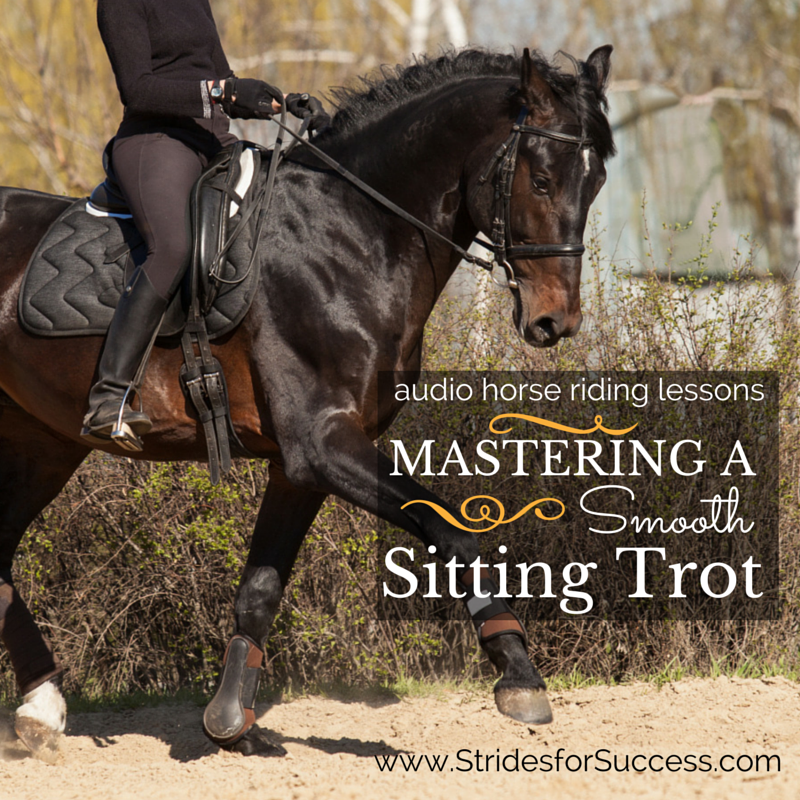
    Does the thought of any sort of prolonged periods of sitting trot fill both you, your bum, and your horse’s back with a sense of dread?!  Perhaps the find the more you try not to bounce; the higher you appear to go?!

    Sitting trot is probably one of the most confounding things to master when you first begin riding. And often enough time is not invested at the beginning of your training to understanding the sitting trot. This leaves riders to their own devices, of which there are many, in trying to stay in the saddle and not bounce around like a gummy bear!

    Ideally, the sitting trot should be thought before the rising or posting to the trot, however, because sitting trot has gotten a bad name over the past few years, this is rarely the case.

    This leads most novice riders to think of it as difficult or hard, which does not have to be the case.

    Challenges with the Sitting Trot

    Riding a good sitting trot involves staying in the saddle and moving with your horse.  No bouncing and no daylight between your backside and your horse’s back.  However, this is often easier said than done.  What happens is when your horse’s back moves up on the first stride of the trot, you move up with it.

    However as your horse’s back moves back down, you are not quite quick enough to move with your horse and your ‘coming down’ is now a fraction of a second behind your horse’s movement.  

    This can be due to a number of reasons and the problems begin to present themselves when your horse’s back moves up again, while you are still on your way down.  The saddle or your horse’s back will ‘bump’ you and this causes the bounce, of which two or three in a row is usually enough to put most riders off balance and results in them clinging on by any means possible!

    The Trampoline Effect

    The same effect is experienced when on a trampoline with another person. If they touch down on the trampoline before you do… Their bounce coming back up meets your legs coming down… And results in a huge bounce, knocking you completely off balance and sometimes off the trampoline itself!

    When the bouncing begins, so do all reactive actions that riders take to try make the bouncing stop, all of which only make the bouncing worse and get the rider further and further away from their correct position, which is essential to correctly move with the horse and stop the cycle.

    What Not to Do…

    Common faults include gripping with upper thighs to stay in the saddle or using your reins to balance yourself.  Collapsing your upper body and rolling into an almost fetal position is also popular!

    Gripping with knees and/or holding the arch at the pommel of the saddle is another common occurrence. And, of course, flapping the legs. I have even seen riders hanging on around their horses neck!!  Not good folks, not good!!!

    Sitting Trot; the Right Way…

    A smooth sitting trot begins with being relaxed enough to move with your horse.  

    However many riders confuse a relaxed body with a floppy body.  Relaxed means that while you are still carrying yourself.  You have simply released all the excess tension from your muscles.  There is the right amout of tension there.  This allows you to be pliable and flexible enough to allow that movement.

    Your hips and pelvis will certainly move up and down in the sitting trot.  However, there is also a slight backward and forwards movement happening as well.

    Becoming Like Jelly…

    The strange thing about initially riding a sitting trot is that often the best way to learn how to actually begin moving with your horse is to ride a little incorrectly.  This is just so you can begin to really feel what is happening under you.

    You can then begin ‘polishing’ things up and holding a correct position for longer each time.

    Firstly, make sure your legs are long and not gripping upwards.  Focus on keeping your toes up, which for some reason seems easier to think of than weight into the heel in this particular situation.  Also, keep your knee off the saddle.

    By ‘off’ I mean no gripping or squeezing, just a very relaxed knee laying gently against the saddle.

    Next, look at opening your pelvis.  Do this by allowing your thighs to relax and open up.  Again, no gripping, or pressing…  Just gently draped down over your saddle and relaxed all the time.  As you ‘open your pelvis’, allow your body to sink down, so you are no longer really carrying yourself in the saddle and are actually becoming heavy.

    Again, I have to stress, this is not the correct way to ride, however often when riders are stiff or tense, ‘over relaxing’ is the key to allowing them to feel for the first time, what it is like to move with their horse instead of tensing against each stride.

    Move With Your Horse

    Once you have relaxed everything, you will probably feel almost like you are leaning back a little and are quite low in the saddle.  Don’t hold this position for too long and it is uncomfortable for your horse, not to mention bad for your back. However, while there try to notice how your horse’s back is moving underneath you.  I

    f you feel confident, you can try a few strides of a very slow trot and see how, in this ‘jelly-like’ position, you stay on the saddle, not bouncing off it.

    Self Carriage for the Rider

    Once you can master the sitting trot in a completely relaxed position, you can begin to carry yourself again.  Do this by engaging your core muscles, in particular your abdominal muscles.  Notice how, when you engage the muscles in your tummy, you lift your body up.  You are still relaxed, however now you are beginning to carry yourself.

    Again, ask for slow, short trots, making sure not to spend too long in the gait as, until you can master carrying yourself and allowing your pelvis to follow. Otherwise you will feel very heavy on your horses back and may cause him discomfort.

    As you use your core to carry yourself, pay attention to how you are sitting up through your body. Almost as though you don’t want your rib-cage to squash the organs underneath.  Work on keeping your chest open. The points of your shoulders opened out and no ‘creases’ on the front of your tummy.   Try not to arch your back or pull your shoulders back, as this will only cause you to tense your lower back again. This will lead to straight back to bouncing.  You must carry your upper body so your pelvis, hips, and seat can indeed move with your horse

    Sitting Trot is Like Dancing…

    Sometimes we hear that we must try and absorb the energy. However, this is often difficult to visualize or understand for many riders.  If this is the case for you, rather think of moving with your horse. Like a dancing partner.

    Each of you is responsible for carrying and supporting your own body and all the while, you move together.

    Another exercise you can try is to put both reins into one hand and, bending your elbow, place your other arm behind you with your hand flat on your back.  This works in two ways; you can feel what is happening with your back as you ride, but also, your elbow is now slightly behind your shoulder, which will help keep your upper body and chest area open.

    Lastly, remember to keep on relaxing through your legs so you do not grip up.  A ground pointing toe is often the result of gripping up with the legs, so pay attention that legs are hanging down, with the weight going into your heel.

    Start with a Few Strides of Trot

    Again, begin by trotting 5 to 10 strides and then back to walk.  Repeat until you can really begin to understand what is happening to your body as your horse trots. But, also, that you don’t have to concentrate on not gripping or curling forward.

    If you do run into trouble and feel like you are about to fall off at any time, lean back, push your heels down, and bring your lower leg forward.  Once you have regained your balance, begin working on ‘fixing’ your position again.

    As I mentioned earlier allowing yourself to become heavy and completely relaxed in the saddle is not correct. However sometimes as riders, we make such an issue out of our bouncing in the sitting trot, that we train ourselves to tense up in order to try to prevent it.

    Often the easiest way to untrain this is to feel what the movement is actually like with a totally relaxed body. Then begin to control your core so that it can support you and, most importantly, can move with your horse in the trot.

    Once you have mastered carrying yourself and not bouncing for the shorter, slower periods of trot, you can then begin to ride longer pieces of sitting trot as you are now moving with your horse, not against him.

    And, trust me, when this happens both you and him will be happier for it!

    Happy Riding
    Lorna

    Additional Resources for Equestrians

    Mastering a Smooth Sitting Trot

  • Moving Off Your Leg

    Moving Off Your Leg

    [smart_track_player url=”https://op3.dev/e/traffic.libsyn.com/dailystridespodcast/SFA331-Getting-Your-Lazy-Horse-To-Move-Off-Your-Leg.mp3″ title=”Moving Forward off Your Leg” social_linkedin=”true” social_pinterest=”true” social_email=”true” tweet_text=”Struggling with a horse who ignores your leg? ” hashtag=”Equestrian #Horseriding #deadtotheleg” twitter_username=”strides_success” ]

    Is there a more frustrating and exhausting experience when riding to match that of being on a horse that is not paying you a blind bit of notice?!  You are on board kicking and pumping away.  And all the while your horse is just meandering along.  Ignoring you completely and acting as though he is on a relaxing Sunday outing.

    Training your horse to move off your leg will help you overcome the inertia.  It will also actively improve responsiveness in your horse.  Starting the very next time you ride. 

    Why Is He Ignoring Your Leg?

    It is always a good idea to first take a good, in-depth look at your horse’s health.  Rule out the possibility of there being something physically wrong that may be causing him to be so nonchalant and laid back.   Question whether or not the environment or weather could be contributing factors.  Or perhaps his fitness levels, or lack thereof?  Also, things like tack fit and confidence working on a particular type of surface or ground.

    Moving Forward off your Leg
    Once you have confirmed that he is fit and healthy and able for the level of work you are asking for, you can then begin to look at other factors.

        • Has he been trained to ignore the rider’s questions?
        • Is his rider asking correctly and then allowing him to go forward?

    Inconsistent Riding Aids

    Let’s first look at the fact that he may just be ignoring your aids.  Some horses will only do what is absolutely necessary for them to do. Surprise, surprise!  In a lot of instances, if they are not motivated sufficiently to go the extra mile, they won’t. Simple as!

    As riders, often we ride to enjoy ourselves and relax.  Unfortunately, during these rides, we can be a little ‘too relaxed’.  This is in both our communication and our instance of doing things the correct way.  

    The problem arises when we ask for ‘more’ and then get upset when our horse doesn’t want to actually do ‘more’ for us.  This is a direct result of our inconsistent riding and disciplining!  If this is the case, your horse is simply reacting to how he has been conditioned or trained by you, the rider.

    Nagging Riding Aids

    On the other side of this incorrect training are novice riders who, whether knowingly or not, consistently do too much in the saddle.  Whether it’s due to a lack of awareness, balance, or control over their seat and limbs, the result is the same.  Riders become the ‘dripping tap’ on their horse’s sides… Nag, Nag, Nag.

    Unfortunately, like the dripping tap, your horse will soon learn to completely ignore the leg aids.  ALL OF THE TIME!  So when you actually put your leg on to go forward, he just sees it as another ‘Nag’ and ignores it.

    One of the most important skills we can cultivate with regard to our riding is mindfulness.  Knowing what we are doing, when we are doing it, and why. 

    I also think it is worth mentioning that you must carry yourself, and your horse must carry himself while riding. This will help you to be more effective with your leg aids.  And your horse to become more responsive.  Both are necessary when moving off your leg is what you want to improve in your riding.

    Conflicting Riding Aids

    The last part of the equation is the fact that the rider may be giving conflicting instructions to the horse.  Using their leg while at the same time, using the hand for balance.  This is often due to a lack of independence in their seat.

    It is a common sight in arenas, the knee jerk reaction of the hand moving when the leg is used.

    Alternatively, instead of actually applying the leg when and where you should, riders often ‘polish’.  This is when, to ask a question, the rider allows their leg to swing back along the horse’s side.  It never actually does anything constructive except to shine a 6″ stripe on both sides of the horse’s body!

    The rider gets frustrated.  And their horse becomes confused. Luckily, being the kind soul he is, decides that if in doubt, rather don’t go or move anywhere! This is definitely not moving off your leg!

    In fact, he is now ignoring your leg at all costs… Which is the exact opposite of what the rider actually wanted in the first place! 

    Improving ‘Moving Off Your Leg’

    I have other resources on this topic, which have more detail on how to more effectively use your legs when riding.

    Choose one of the topics, go deeper and see what you can achieve in your riding.

    Happy Riding
    Lorna

    Additional Resources:-