Tag: Equestrian

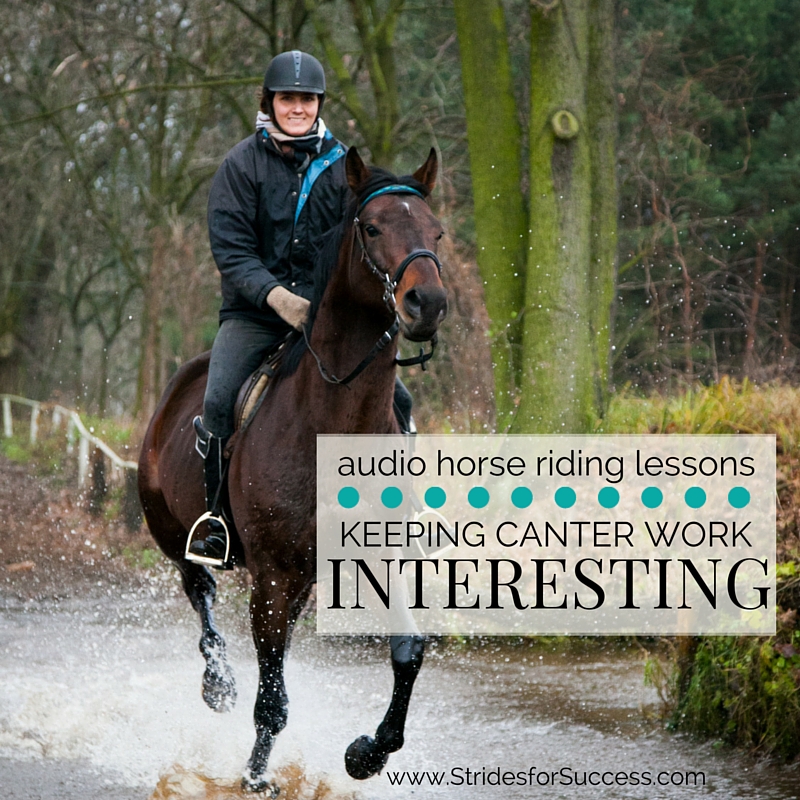
  • Keeping Canter Work Interesting

    Keeping Canter Work Interesting

    [fusebox_track_player url=”https://op3.dev/e/traffic.libsyn.com/dailystridespodcast/SFA316-Keeping-Canter-Work-Interesting.mp3″ title=”Keeping Canter Work Interesting” social_linkedin=”true” social_pinterest=”true” social_email=”true” ]

    I’ve often wondered what it is about the canter that makes riders almost seem to ignore it when schooling in the arena.  I see riders put so much time, care, and attention into the trot and to a lesser degree, the walk…

    But the canter is more often than not relegated to a few ‘laps’ of the arena and then back to more of the same with walking and trotting…

    In this week’s episode of the Daily Strides Podcast, we are focusing on some ways you can incorporate more canter work into your schooling sessions…

    Lateral Movement; Leg Yielding | Audio Horse Riding Lessons

    Canter work can require some serious work from both you and your horse.  It is easy to become tired while we are cantering and with tiredness comes a sense of complacency with the quality of the gait.   During this episode, we are covering four main points that will help keep you on track with your cantering and allow you and your horse to perform at your best.


    1. Establish Rhythm in Your Canter

    When you begin cantering initially I strongly suggest focusing on establishing a rhythm.  From here begin to notice when that rhythm and, later, tempo change and what may be causing this to happen.

    Pay particular attention to when ‘changes’ happen, such as a corner, a pole, or a jump.

    Being able to keep a consistent rhythm and tempo is vital to  good quality canter work.

    Ride a Rectangle or Square (not an oval)

    The second point we cover is when you initially begin canter work, rather than riding a large oval shape around the arena, ride a rectangle. This is obviously when you are going large.

    By making a dedicated effort to ride a rectangle (or whatever shape your arena is), you will use your corners and straight lines on the ‘long and short sides’.  

    This will give you the opportunity to use your half-halt before each ‘corner’.  And also work on your aids to help your horse remain balanced around each bend.

    3. Pay Attention to Your Body Riding Canter Work

    The third focus point is what your body is doing while your horse is cantering.  The fact of the matter is that the bounding feeling that we can get while we canter invites us to get slightly ahead of the movement…

    And as always, we cannot ride our horse while sitting on the neck.  

    So make a consistent effort to keep your position while you are working in the canter.

    4. Your Posture when Cantering

    The final point that we touch on today and to take into consideration is the position of your shoulders, seat bones, and legs while your horse is working in the canter.

    This is particularly important when you are beginning to feel tired…  

    This is when our lower legs can begin to swing backward and forwards.  It is also when we are more prone to collapsing our bodies and becoming ‘heavy’ in the saddle.

    I have included links to other more detailed blog posts and Daily Strides Podcast episodes to help you in your canter. You can also download a FREE EXERCISE to use with your horse HERE

    Happy Riding

    Lorna

    Additional Resources to Help with This Topic

  • Trotting Without Running

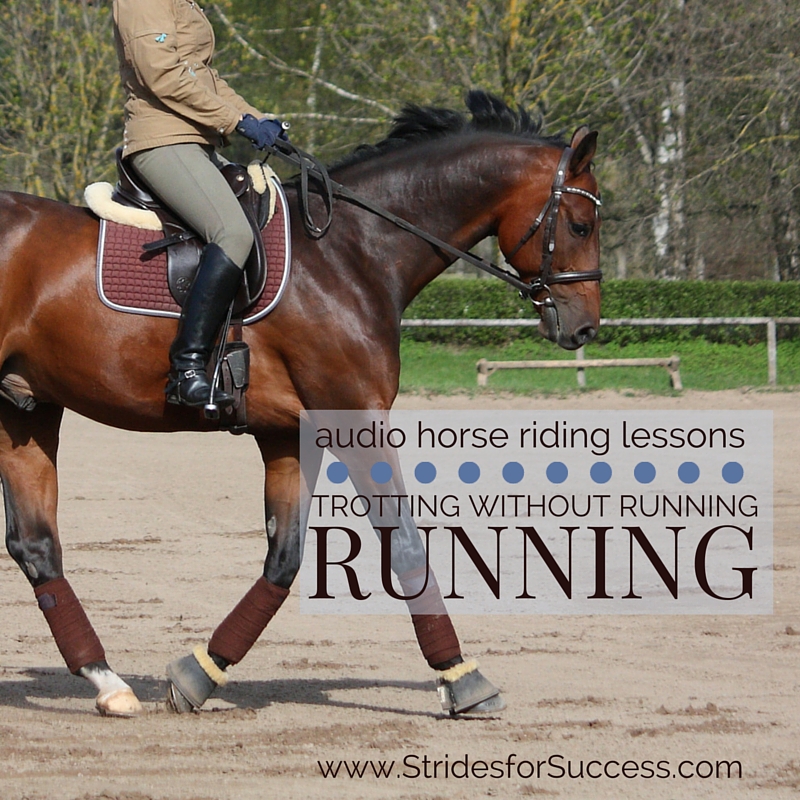
    Trotting Without Running


    Do you find that when you ask your horse for a more expressive trot, he just seems to begin running onto his forehand with you, becoming heavier and heavier with each stride? You’re not alone!

    Many riders set out looking to achieve an active, working trot… But due to lots of different factors, this can end up just ‘running’ around the arena. The horse resembling an arrow of sorts!

    The front end getting lower and lower with each passing stride, while the back end is getting completely left behind!

    Unfortunately, what usually happens next is the one thing that exasperates this ‘effect’ even further and that is hauling on the reins; dropping an anchor if you will.

    The reason this just makes the whole situation worse is by doing this, you and your horse begin to engage in a ‘tug of war’ of sorts. And, quite frankly, being involved in such a game with a 600 kg animal is an exhausting endeavor!

    Trotting Without Running | Audio Horse Riding Lessons


    Speed Versus Impulsion

    Often, as riders, we can confuse speed with impulsion…  We think that by asking for the trot to go 100 mph around the arena, we are really working our horses… Pushing forward with each passing stride.  The truth however is that while we may be creating energy, we are letting it all ‘fall’ out the front end of our horse, never contained and put to use in any form conductive ‘good’ work.

    The first part of mastering trotting without running is imagining in your mind that your horse’s back end is coming more and more underneath him… While his front end is becoming slightly higher and more elevated, as well as light in your hand.

    This is the picture you should work towards continually as you ride.  What is important to remember with this picture, is the ‘lightness in the hand’ part.  This cannot be achieved by hauling on the reins in the eternal tug of war.

    I challenge you to not only change how you think of working trot but also what you are physically doing with your body to ask your horse to begin using himself more.

    Happy Riding
    Lorna

    Additional Links to Help You:-

  • Everything Takes Time and Persistence

    Everything Takes Time and Persistence

    The following text is an excerpt from a business coaching resource I created for equestrian business owners. Time and persistence, when coulpled in the right way, will help entrepreneurs overcome most challenges.   If you would like help with your business, you can reach out to me privately on Instagram, @lornaleeson.

    “The important thing to remember here is that everything takes time.  EVERYTHING!  Looking at any situation as a monumental leap from here to there will often seem impossible. However, breaking it down into smaller pieces, makes it seem much more manageable. Perhaps dividing it into two years, and then again chunking it down into even smaller pieces, quarters.  From here, breaking it down into months, weeks and lastly days…  Well, now anything can become possible!

    Big Desires & Goals

    Let’s look at this situation another way.  As I write this I am sitting on my farm in South Africa.  Let’s say I have a goal or desire to get back to Ireland (my home country) for a visit.  I can have a look on a map and see the vast distance between S.A and Ireland. Paying attention to all the land and sea (mostly land) between here and there!

    In doing so, I could easily decide that it is far too vast a distance for me to ever cover. And so, never even start the journey. 

    And looking at it like that, taking action and stepping outside my front door here on the farm seems a little useless.  Just imagining Ireland, from my perceived reality right now; yes, it is a MASSIVE distance.

    Leverage What You Have

    However, I have options.  Depending on how I decide to go about getting ‘home’, I could start today. And within 24 hours or 6 months, I can be there (all going to plan!).

    The quickest way to achieve that is by having the necessary cash on hand to purchase a plane ticket.  Yes, I will still have to drive the hour to the nearest airport.  From there, catch the first flight, transfer at another airport, catch the second flight. And then transfer again at a third airport. Then, after catching the final flight, I will depart that third plane in Ireland! All in less than 24 hours than when I began my trip.  In this case I can leverage money.

    No Money? Leverage Time & Effort…

    For many entrepreneurs, a lack of money is the perceived thing holding them back.  However, there are other things you can use if funds are not available. Time and persistence will help you leverage these things.  Let’s go back to my initial goal of going to Ireland, but this time without available cash for a plane ticket.  I could if I wanted, set out on foot tomorrow morning.  Plotting a trail up through Africa, crossing the Mediterranean Sea into Europe. And, after crossing Europe, catch a ferry to Ireland.

    It would take me longer.  And it is riskier journey and path to follow.  There will probably be the odd twist and turn, some leading me in a direction away from my desired destination…

    But after 6 to 8 months, a very exhausted, but far more learned and experienced me, would arrive in Ireland.   It is the longer route.  And it is a far riskier way.  Definitely not for the faint-hearted!  Most importantly it would involve me using all my resources, contacts, skills, and knowledge.  However, it is doable.

    Time and Persistence

    This is how you should look at your journey from where you are with your business to where you want to get your business to.

    If you have money available to spend, you can use it to ‘buy a plane ticket’ . This will move you faster from A to B.  But, if you don’t, you can also use what you have right now.  You will achieve the same results, but with a little more time and energy.

    Chunk it down.   Break it into smaller ‘stages’.  Divide those into smaller pieces. And finally, you will be left with the ‘steps you can take.  One by one.  Use both time and persistance to get you to your desired destination.

    Happy Riding
    Lorna

    Additional Resources for Equestrians

  • Paying It Forward

    Paying It Forward

    . As equestrians, I believe we have an important role to play in encouraging new riders into the world of horses; paying it forward so to speak.  “Today I spoke with one of the Moms at the yard and she passed an observation that has stayed with me…  “You are great to have all these children around all the time and to spend so much time, care, and attention on each of them.”

    It reminded me of when I was young and overflowing with enthusiasm for anything horse-related. I spent every waking extra hour at the barn, stables, yard.  If there was a pony there, I was there! I distinctly remember the feeling of rushing home from school and, with all thoughts of homework cast aside, scrambling into my ‘riding gear’ and setting off to the riding yard on my trusty bicycle.  Every pedal action fueling the thoughts in my mind of eventual cross-country or showjumping glory.

    Later, I upgraded my mode of transportation to my trusty pony Shadow who, to my dismay, my trainer very honestly and I think with no hard feelings, truthfully, labeled useless…  As a show-jumper; yes.  As a young girl’s first love…  Ah, she remains my favorite and most loved :-)

    Instilling Values

    Either way and regardless of the mode of transportation, I lived for the stables.  The smell, the work, the feeling of utter joy at achieving a perfect stable.  This was after painstakingly clearing every piece of droppings from the bed.  My trainer was a strict lady and if I was not personally willing to lie in the bed, how DARE I even suggest her horses would!

    It not only made me feel alive, the riding, training, and interacting with horses. But also it, daily, willed me to do my best and, often, reach well beyond what I thought I could achieve.

    Yes, It was hard work, no doubt about it.  It was a HUGE responsibility.  And yet, it also taught me so many lessons which, if I was not exposed to such circumstances, I am sure would make the present ‘Me’ a far lesser person.   I am now a person who will very verbally tell the children at her yard that leaving the tack/equipment/horse unattended when tired/unsure/wanting to go home was just unacceptable.  A person that won’t accept anything but your best effort in the arena.  And a person that expects a basic use of initiative at all times from all in her company, and a person who demands an unwavering allegiance to the pony or horse’s best interest from all her ‘little people’ and ‘big people’.

    Coming Full Circle

    Bringing me full circle to above mentioned Mother’s comments….  I do this, not because of some sadistic sense of satisfaction from ‘young labor’, but rather in the hope that the values of initiative, self-belief, and responsibility that were embedded in me twenty years ago (yes, do the maths!) will be transferred into an impressionable and open few who, God willing, will go on and in another twenty years, pay it forward again…

    But with more experience, knowledge, and confidence than I could ever hope to instill in them….

    Paying it Forward

    So today, when at the barn or yard…  Look at those little earnest faces.  View them as little vessels waiting to be filled with the most wonderful of all that is horses. From this place, ask yourself the question, “What life lessons and skills served me best?” and in your answer, there is the beginning to paying it forward.

    We would love to hear your experience of paying it forward.  Whether it be someone who bestowed this gift on you?  Or how you try to incorporate it into your life now, as a gift for future generations.

    Happy Teaching!

    Additional Resources for Equestrians