Tag: position

  • 5 Reasons You’re Struggling with Lunging – Part 1

    Hands up if, at some point in your riding journey, you’ve been guilty of thinking that lunging was a simple matter of your horse going in circles. Don’t feel bad, I’ve been there too. Most riders have, and so many still are!

    Lunging is so much more than just running in circles. It is an amazing way to connect with your horse and compliment or continue with your training when riding. 

    Like most worthwhile things, it takes time, practice, and improving your skills to get the most from lunging. It’s not something that just magically ‘happens’. Between getting tangled in the lines to missed communication between you and your horse, lunging is an art. It’s like riding. So when you approach it that way, you can begin to improve :)

    In this episode and post, I will focus on 10 common challenges that riders have when it comes to lunging. Now, Obviously, I say riders; I mean ‘lungers’, as in you on the ground in the circle with your horse trying to lunge :)

     1. No Plan or Purpose for the Session

    Ah, the old ‘no plan’. Just like riding, if you are hoping to use lunging as a tool to improve your work with your horse or your horse’s training, you need a plan! It’s when you show up in the arena with no clear intention or focus for the session, that it can very quickly become ‘running in circles.

    Just like your riding, if lunging is to benefit your work with your horse, you need to take the time to create a plan that connects to your goals or vision for your horse’s training and your riding. 

     2. Getting All Tangled Up!

    Is there anything as frustrating as trying to explain something to your horse, while also trying to get ‘untangled’ from the lunging line?!  If you are going to use lunging as a tool to help you and your horse improve, you must learn how to use the lunging equipment! And it’s not just the lunge line. This extends to the whip, cavesson or bridle, boots, bandages, and all of the other things you can use to make the experience better and safer for you and your horse. ,

    If you feel awkward and overwhelmed about using the lunge line, it will transfer to your horse through ineffective, stiff, and muffled communication.

     3. Wrong Position & ‘Cues’

    Your position as it relates to your horse when lunging is as important as your seat when riding. It is the foundation for everything. And it is also one of the biggest struggles riders have when lunging! They find themselves blocking the horse by being too far forward, or driving the horse when too far back.

    And because your horse is in almost constant motion when lunging, your position in relation to your horse must be constantly adjusted to reflect what you want to communicate to your horse. One wrong move and you are having an entirely different conversation! 

     4. Struggling with the Whip…

    Before we begin, I STRONGLY believe this artificial aid has the wrong name. It should be called a pointer. Or an ‘extender’. Because that’s what it does. It ‘points’ to areas that you would like your horse to focus on, or it ‘extends’ your aids (which is its primary role when lunging). Unfortunately, there are so many riders who do not know how to lunge correctly and, therefore, rely far too much on the whip or use it incorrectly. And you don’t necessarily need to ‘whip’ the horse to do either of those things…

    Incorrect or overuse of the whip is never a good thing and, however well intended, will usually result in excessive tension, anxiety, or confusion for the horse. It’s an aid that must be used with your other aids for positive results

     5. No Link between Lunging & Riding Goals

    And finally, it all comes back to planning and becoming clear on your vision.  If you want to really strengthen your training and your partnership with your horse, you have to begin seeing everything you do together holistically – instead of lunging being a completely separate activity.

    Almost everything you can work on or work towards while in the saddle can be worked on in some way while on teh ground. And so often, it is the different perspective that really cements the concept for both you and your horse…

    Stop Struggling with Lunging!

    I can go on and on about the things that riders struggle with when it comes to lunging. These are just a few of the ones I hear about from riders on a weekly basis. And the sad part is that these challenges, which can make lunging feel frustrating or unproductive, can all be easily remedied or changed.

    With some clear guidance, you can really transform your lunging experience into something special for you and your horse. I have created a free 3 Days to Successful Lunging audio program you can use today to start you on your journey. Get it for free by CLICKING HERE
    .

    Happy Riding
    Lorna

    More on this Topic:-

    Online Training to Help Your Riding

    Connect with Lorna online:-

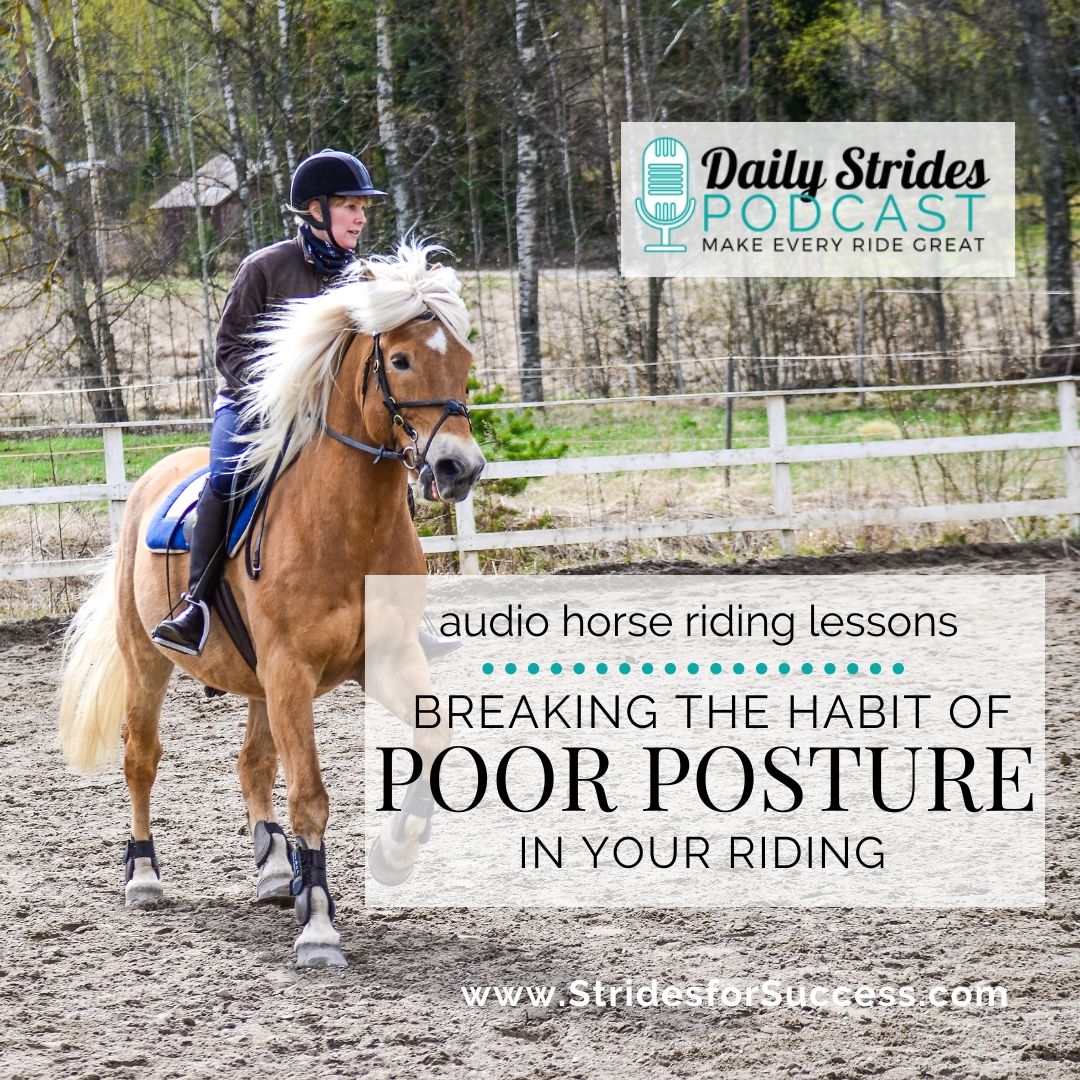
  • Breaking the Habit of Poor Posture in Your Riding

    Breaking the Habit of Poor Posture in Your Riding

    [fusebox_track_player url=”https://op3.dev/e/traffic.libsyn.com/dailystridespodcast/1320_Breaking_the_Habit_of_Poor_Posture_in_Your_Riding.mp3″ title=”Breaking the Habit of Poor Posture in Your Riding” social_linkedin=”true” social_pinterest=”true” social_email=”true” ]

    Whether you realize it or not, incorrect or bad posture is hurting your riding. And your horse’s way of going. And this habit will usually continue unchecked for sometimes years.  I don’t believe that riders ever initially set out to ride in a way that will negatively impact things. Usually what happens is that riding a certain way either produces a certain outcome or solves a particular challenge at some point… And then turns into a habit!

    But, what happens if you get stuck there?  Stuck with thinking the thoughts that cause you to use or carry your body a certain way…  Usually never good things!

    There are lots of reasons why you might have developed less than great posture when in the saddle.  Luckily, there are also lots of ways you can begin to both identify what’s going on – and how to begin remedying it in your riding.

    Symptoms of Poor Posture in Riding

    If you have started to ‘slip’ a little where posture is concerned in your riding, there will be signs!  Definite and obvious signs.  This is good because when you know what to look for, it makes it easier to begin to make those small tweaks that can make all the difference for you and your horse.

    Lack of Balance in the Saddle:

    It stands to reason that if you are struggling to carry yourself in the saddle, your balance will be affected.  You may feel yourself tipping or tilting.  This can be to the front, so tipping forward… Or it can be tipping backward, which then feels like you are being left behind.  You may also notice this around bends, corners, or circles as a sideways tilt or collapse.

    Whatever way you are tipping or tilting, you will also most likely notice that your horse will struggle with this as well.  Your lack of balance can really negatively impact your horses own balance. 

    He may speed up (especially through transitions or bends/corners).  Or he may slow down.  He can also fall in or fall out to try and compensate for your tilting to the side.  Finally, if you are regularly tilting back, he may being to hollow through his back to avoid any associated discomfort…

    Tension and Stiffness

    Poor posture will inevitably create issues with tension, and maybe stiffness in certain areas of your body.  And of course, your horse’s body if allowed to go uncorrected for any length of time. Many riders notice this in their shoulders, lower back, or hips.  However, this can also show up across your chest, your elbows, knees, and even calves.

    Last week I spoke about ‘opening up’ and practicing expansion as a rider.  This can really be helpful for this, especially if you focus on your posture as well. And, keep in mind that incorrect tension can go both ways; excessive tension OR a lack of tension… Both can lead to poor posture in your riding and block or prevent your horse from moving and working forward.

    Closed Down or Shut Down Position

    Otherwise known as the hamster effect we least expect…! This is the reason I actually wanted to really address this topic today; too many riders are resembling hamsters while in the saddle! So what do I mean by this?   Well, if you are crumpled, contracted, hunched over, closing your shoulders and chest, riding with your hands touching each other, gripping with your knees, and overall ‘rolled up’, you are riding like a hamster!

    Often this starts as a defense mechanism – although it only makes things worse, so it’s incredibly ineffective!  Maybe there was a time when you felt fear or anxiety when riding.

    The natural thing to do is ‘play small’, roll into a ball, and wait it out.  Except, when we are riding, this is ineffective – and often downright dangerous.  Again, I am going to point you to last week’s episode on Opening Up and Practicing Expansion in the Saddle.

    Ineffective Aids and Communication

    If poor posture is something you’ve been struggling with, you are also most likely having communication issues with your horse.  Responsiveness, or the lack thereof, is something that is most likely showing up.  Coupled with your horse understanding your aids. Unfortunately, this often then increases the initial problem of poor posture and tension issues as the rider ‘doubles down’ on ‘making’ their horse do whatever it is they are trying to communicate… Frustration can run high; for both horse and rider… Not an ideal situation.

    Back and Muscle Discomfort

    Did you realize that your lack of posture can actually be contributing to muscle fatigue in your riding?  When you are not setting your body up to use itself in the best way, it gets tired – very quickly!  And then continual poor posture can even result in back pain or injuries over time. This will 100% take away from how much you enjoy your time in the saddle – and can even cause you to eventually stop riding!

    Unable to Effectively Use Your Core

    We all know how important your core is when it comes to riding.  It really does impact EVERYTHING.  Good and correct posture requires core strength and engagement. And, without this, you will find it difficult to be independent through your seat and aids.  This can lead to confusion between you and your horse – and can actually set you up for a fall or an accident in the long run.

    Improving Your Poor Posture

    Okay, so there are so many ways this can show up and none of them are beneficial when it comes to improving your skills as a rider or training and developing your horse. So, let’s work on actually improving your posture in the saddle.  Investing time here will both enhance your riding experience and help you more effectively train your horse.

    Body Awareness

    Again, we chatted about this last week HERE.  When you begin to become more aware of your body’s alignment and position while riding, you will begin to feel and notice when things are not ‘right’. This is also where practicing exercises off the horse can help.  Especially those that promote body awareness, such as yoga or Pilates.  And they have the added bonus of strengthening your core muscles and improving your flexibility.

    The 100% FREE 2024 Equestrian Fitness Challenge will help you with this.  This year’s challenge includes a daily yoga practice from Emma-Jane Leeson (yep, my sister), a qualified yoga teacher.  And an equestrian just like you :) Make sure you get signed up for the 2024 Equestrian Fitness Challenge HERE

    Riding Lessons with Focus on Posture

    Get help when you need it most by investing in lessons with a proven instructor or trainer who can assess your posture and provide corrective feedback. I realize that this can be a challenge for many riders, especially when time/schedules and location are an issue.  If this is the case, think about video reviews or live virtual online lessons.  Both of these are available for riders inside of Connection; My Online Membership for Equestrians.

    Regular riding lessons with a focus on proper alignment in the moment and balance can significantly improve your posture over time.

    Using Mirrors or Video

    I know, in an ideal world, we would all have mirrors strategically placed around the arena.  If you do have, make use of them by paying attention to your posture and alignment.  If you don’t; use video.  You can either invest in something like a PIVO – use THIS LINK to get $20 off your purchase (this is an affiliate link and we will receive a commission on your purchase but it won’t affect how much you pay).

    Being able to watch back over your work will allow you to begin to see where things are falling out of alignment, and where you can make improvements. 

    Of course, you can also use the PIVO (affiliate link) to have virtual lessons in real-time online with a coach or trainer (again, this is part of the Connection Membership with me)

    Increasing Fitness & Stamina

    Do you walk? Walking is one of the easiest and most effective ways of moving your body and improving your overall well-being and fitness.  I LOVE walking.  Whether it’s on the road, on the trail, hiking, or just out to the fields to collect or turn out the horses. It helps to keep my body toned, and move my hips, and it is hands down amazing for my mental health and well-being.

    If you would like to walk a little more and see where it takes you and your riding; the 2024 Equestrian Fitness Challenge is ALL about walking.  Join me for 21 days as we take a daily walk together and chat about all things riding and training horses related :) It’s 100% free and it has the potential to transform your riding. CLICK HERE
    to sign up


    Mindfulness & Connection Techniques

    Recently, I ran an in-person program on my farm here in South Africa all about connection and energy techniques on the ground with your horse.  The results were amazing.  The difference then in the rider’s and horses’ performance when being ridden afterward was mindblowing.

    Just a simple practice of grounding before working with your horse can be transformational for both of you.  Couple this with the power of intention…

    I have packaged up this full program into a short email course that you can use with your horse.  The Connection Partnership Program Mini-Course lays out all of the techniques in step-by-step audio episodes.  And all delivered via your email.  You can get more details HERE

    Improving Your Poor Posture

    Phew, that was a lot.  I would love for you to take just one of these resources this week and begin working on it to help change any habits you may have in the saddle.  Remember, improving your overall posture and alignment in the saddle will not only help you but also have a positive impact on your horse as well.

    And, over time, improving your posture will result in better communication, clearer aids, and increased understanding between you and your horse when working together.

    Happy Riding
    Lorna

    List of Resources for This Episode:-

    Connect with Lorna online:-

    Get Going in Your Riding:-

    Daily Strides Premium is back! You can use the first and original audio horse riding lessons to improve your riding, train your horse, keep things interesting, and have fun… Even if you don’t have a trainer or coach

  • Opening Up as a Rider – Practicing Expansion

    Opening Up as a Rider – Practicing Expansion

    [fusebox_track_player url=”https://op3.dev/e/traffic.libsyn.com/dailystridespodcast/1319_Opening_Up_as_a_Rider.mp3″ title=”Opening Up as a Rider – Practicing Expansion” social_linkedin=”true” social_pinterest=”true” social_email=”true” ]

    Have you ever considered how different it could all be if you could open up more as a rider? Specifically around how, physically in the saddle, if you could expand yourself a little bit more, the difference it could have on your riding. And your mindset. Even your horse’s way of going… Over the past few months, I have been running an in-person program on my farm South Africa based on Connection and Groundwork.  It has been such an amazing experience working with all these different riders

    We focused specifically on energy work, and becoming more aware of how we can intentionally use this to connect with our horses. 

    It was so much fun.  And, it got me thinking about riding and how so many riders are blocking the kind of flow with the energy in their riding, especially with their physical body.   So, in this week’s episode of the Daily Strides Podcast, I would love to walk you through a few simple exercises you can do, from the saddle, to begin to identify where you are, potentially, contracting as a rider.

    Noticing What You’re Doing…

    So, you will probably agree with me that, as a rider, once you notice something that you’re doing in the saddle, you can’t ‘unnotice’ it. I mean, you can try to ignore it… However, once it’s out in the open, it’s out in the open!  So today, I would love to help you begin to notice where, potentially, you are contracting through your body, rather than expanding. Where you are blocking rather than allowing ease and flow to happen inside of your conversation with your horse.

    When you are contracting, you are shutting down; making things smaller.  This will usually have a detrimental effect on your riding because it affects your position and posture.

    It will also negatively impact what your horse is doing, especially how well he is working and understanding your communication. And, of course, it impacts the trust and the partnership element of the combination as well. Sometimes, you may begin to notice the tension or contraction because there will be other symptoms or ‘clues’ that show up.  The key is to notice them, and then begin to take steps to dissipate, change, or replace the ‘contraction’ with openness and expansiveness through your body.

    Starting In Walk

    I suggest starting this work while in the walk in the arena with your horse. Now, as I mentioned, we were initially doing this work on the ground.  However, I successfully crossed this over to being ‘in the saddle’ inside of Connection this month, so that is what I want to do today for you. So, as your horse is walking, begin to assess your body and notice where you may be holding any excessive tension.

    Keep in mind that there are the more obvious places, such as lower back or elbows.  And there are also those less obvious places in your body that can hold excessive tension.  Your jaw for example.

    I used to hold a lot of tension in my jaw and I clenched my teeth.  As I’ve mentioned, once I became aware of this unconscious tension, it became something I could consciously begin to ‘undo’ in my riding.  You may notice ‘tightness or ‘squeezing closed’ through your knees. This is a common one, and most riders don’t realize it is happening until it’s pointed out.

    The key is to really bring your awareness down into your own body and feel how it feels to be in the saddle, Notice what your body is telling you… 

    Triggering Words or Thoughts

    So, after a while of simply walking and being aware of your body, you can begin to ask bigger questions.  What I found really interesting when working with riders was the response to the word ‘prepare’. Especially when it was used before any changes or transitions.  As soon as I would tell riders to ‘prepare’ for something ‘new’, a lot of riders began to physically ‘contract’.

    So my second exercise for you to begin working on is to ‘prepare’ to introduce and ride a circle.  Notice how your body changes as you ‘prepare’ to go from straight to circle…

    Maybe it’s a tendency to unnecessarily fiddle with or gather up the reins. It could be a tendency to grip up with the inside leg.  Do you tilt your body? Or shift weight your weight around in the saddle, maybe to the inside? Perhaps your inside shoulder ‘ducks’ or lowers slightly…  The key thing to look out for is where the ‘ease and flow’ gets lost or blocked due to excessive tension and ‘contraction’ becoming a part of your physical body.

    If you can notice or catch yourself making big changes to your body to accommodate or ‘prepare’ the circle, begin to question why… Is it necessary? Or is this a learned habit?

    I suggest continuing to work on this for a day or two.  Stay here until you can feel that your ‘preparation’ is not as contracted as it was before and one movement can simply flow into the next…  Another idea worth mentioning here is how once we notice and begin to shift the ‘blockage’ or contraction in one area of our body, it just might show up again somewhere else!  So spend time practicing…

    Stepping Up a Gear…

    Now, from here, I want you to begin thinking about stepping up a gear into the trot.  Both the trot itself and your transitions in and out of it as well.  With the trot, you might find that all is good when you and your horse are slowly sauntering along.  You will feel open and expansive in your riding.  However, as soon as the energy levels increase a little, the contraction begins…

    Often, as soon as you are aware of ‘more’ in the trot riders can begin to ‘crumple up’ in the saddle. They round their backs, bring their hands closer together, change their lower leg, and tip forwards onto their fork.

    None of these things are very ‘expansive’ and they 100% have the potential to block the ‘ease and flow’ we spoke about for the walk.  Another unfortunate side effect of ‘crumpling’ is that your aids can often agitate or even frighten your horse, which compounds the tension!

    Just like in the walk, begin to notice where you are creating or holding onto any excess tension in your body when trotting.  Start in rising trot, and later work in sitting trot.  Also, use your transitions in and out of the trot as a way to examine this in your riding.  Any place where your body feels ‘smaller’ or tighter, is worth looking at a little more carefully…

    Expansion in the Canter

    When we think of ‘expansion’ and ‘canter’, our minds can (and often do) jump to the conclusion of ‘explosion’! This is, obviously, not what I am referring to here!  One of the most common areas I see the ‘contraction’ coming into the rider’s body when it comes to canter, is the transition to get to canter!  Instead of the rider being in ‘self-carriage’ and allowing the horse the space to canter, a lot of riders ‘collapse and ‘chase’ the horse into the canter… Nope and nope!

    And with the canter, because there is more energy involved, it can often highlight any areas of the body where excessive tension and contraction are showing up for the rider…

    The canter, by its very nature, is ‘upward’ in its trajectory. Therefore it is so important that you remain open, in self-carriage, and ready to allow the ‘ease and flow’ through your body. As you ask for and then ride the canter, allow your awareness to scan your body for excessive tension. What are your hands doing? Are your elbows straight?

    Once you begin to open up you will then find it easier to move your body in a way that feels good and that also allows the energy to flow.

    Applying This When Jumping

    Finally, this concept is not just for flatwork or dressage.  I think that working on creating a consistent state of expansion in your body is important for all disciplines and activities with horses.  When the energy is flowing, there is a good chance that communication is also flowing between you and your horse.

    When jumping, the ‘contraction’ begins around three strides before the jump. It’s important to focus on training yourself to remain ‘open’ all the way to the jump, especially through your chest, shoulders, and upper body. 

    Curling up into a ball and doing your best hamster impression, whether before, over, or after the jump stops you from balancing yourself.  This, in turn, prevents your horse from using himself to the best of his ability over the jump as well.  Start over poles on the ground and work through your body from there.

    Allowing & Letting Go

    Very often, the reason we begin to ‘contract’ or tighten our bodies is due to a response to something.  This can be something that happens in the moment (such as our horse spooking), or it can be something that we have learned to do… A memory or a repeating pattern.

    The key to changing this in your riding is to notice it, and then simply choose to let it go.  Practice opening up and feeling your energy grow

    This expansion is how you can begin to connect with your horse in a whole new way and on a whole new level in your riding. I have linked to similar posts on this topic below.

    Happy Riding
    Lorna

    Similar Posts to Support You:-

    Connect with Lorna online:-

    Get Going in Your Riding:-

    Daily Strides Premium is back! You can use the first and original audio horse riding lessons to improve your riding, train your horse, keep things interesting, and have fun… Even if you don’t have a trainer or coach

  • Self Assessment and Your Riding – Your Comeback to Riding

    Self Assessment and Your Riding – Your Comeback to Riding

    [fusebox_track_player url=”https://op3.dev/e/traffic.libsyn.com/dailystridespodcast/1317_Self-Assessment_as_a_Rider_Your_Riding_Comeback_to_Riding.mp3″ title=”Self Assessment and Your Riding – Your Comeback to Riding” social_linkedin=”true” social_pinterest=”true” social_email=”true” ]

    So you’re back in the saddle. It feels amazing and you love how each ride is jam-packed with learning new things and rediscovering little things you’d forgotten. However, once the initial excitement begins to wear off, you’ll probably start thinking about how to improve your skills.

    Self-assessment is a skill all riders can practice and improve. And it is essential if you want to improve your riding – and your horse’s overall way of going.

    The challenge can be knowing what to look for.  Being able to identify the root cause of an issue from a symptom of something else. This takes practice. Here’s a few things to look out for in those initial rides to create a solid foundation for your comeback to riding.

    Your Posture and Position

    It all starts here. If you are sitting correctly in the saddle, the chances of everything else working as they should increase dramatically.  From allowing the horse to move, to remaining balanced through transitions.  From your aids and overall communication to being able to help your horse to use it’s body better.

    Start with checking your ‘lines’; ‘head shoulder hip heel’ and ‘elbow, wrist, thumb, rein, bit’. Pay special attention to your shoulders being above your hips – not in front of or behind. 

    From here, think about your posture. Are you modeling ‘self-carriage’ for your horse? Are you creating ‘space’ between your ribs and your hips?  Doing this will allow your seat to open up and more easily communicate with your horse.

    Weight Distribution

    Once you feel like you’re in a good space position wise, think about how you are distributing your weight while in the saddle.  Ideally, you want an equal amount of you on the left as on the right. And then, as you work with your horse, you can begin to notice how your weight might shift and change.

    A great exercise to help with this part of your self assessment is to make sure both of your seat bones are equal distance from an imaginary line from cantle to pommel on your saddle. 

    You will probably find that while this is pretty simple to achieve and maintain in walk, your weight might start shifting in trot and canter. Especially when riding through corners and bends. Spend time in each of your riding sessions working on this.  And then test yourself regularly with how long you can maintain the ‘balance’.

    You can also play with riding without stirrups and notice if this changes your position, posture, and how you distribute your weight…

    Tension and Gripping

    For many riders, there is something strange that often happens when trying to improve riding skills; excessive tension through the body.  This is especially true when a rider, after running through a quick self-assessment, begins trying to either try to ‘hold’ a better position or posture! Relaxation and suppleness are essential for both you and your horse!  This is why I recommend practicing in the walk first and then building slowly from there.

    Remember, if you need to use excessive tension or ‘gripping’ to keep things correct and aligned when riding your horse, those things are NOT correct to begin with! 

    One of the most basic foundational elements of training when it comes to horses is relaxation. In order for this principle to really be present, both horse and rider must embrace and work into it. Excessive tension, such as gripping, being rigid, holding on to the reins, and bracing through the body all work against true relaxation. And this will, over time begin to show up in your horse’s way of going as well.

    Responsiveness

    Finally, I would suggest working on improving the overall responsiveness between you and your horse. This is definitely a trained behaviour.  This means that if your horse is not as responsive as you would like, someone has probably trained him that way, either intentionally or not!

    When working on improving responsiveness, the key is to recognise and put into practice what your role is in the dynamic… You ‘ASK’ and then your horse “RESPONDS’.

    It is not. your job to move the horse or to make the horse move or do anything.  Your job is to make sure you are in the right place (your position), with the correct level of tension through your body (your posture and relaxation), so that when you apply your aids correctly, your horse can respond to those aids. That’s it.  Okay, and I realize this is easier said than done.

    Self Assessment by Asking Questions

    When you begin to ‘ask’ questions and then pay close attention to your horse’s response, you have a baseline that you can now begin working with.  You can now tell where you are both at in your riding so that you can start to identify what needs to stop happening, change, or improve.

    Often, your self assessment will show you that changes are needed for both yourself and your horse; my advice is to focus on what you can control first – YOU!

    Get your basics under more control.  Understand how what you are doing is impacting the overall conversation and how you can begin making those small changes that will create a huge transformation. The basics are essential.  Your position, posture, basic aids, and moving with the horse. When you can start improving these things, the whole ride will begin to improve – you and your horse.

    Happy Riding
    Lorna

    Your Riding Comeback

    Your journey back to riding is as unique as you are. While you can draw inspiration from various plans and advice, remember to tailor them to fit your individual path and circumstances.

    If you’re seeking assistance with your riding comeback, consider our program ‘Returning to Riding.‘ In just 9 weeks, we’ll help you solidify your basics and transition from passenger to confident rider alongside your horse.

    With private 1 to 1 coaching, easy-to-follow audio lessons, and personalized weekly reviews, you’ll see yourself progress from feeling unbalanced to mastering clear communication and improving your horse’s performance.

    Through 9 weeks of private coaching sessions, we’ll provide the support you need via secure video, voice, and text. Plus, our proven program can be revisited with your horse anytime to refine both your skills.

    Explore Returning to Riding today for more details and start your journey back to the saddle!

    Get Going Again in Your Riding:-

    Daily Strides Premium is back! The first and original audio horse riding lessons you can use to improve your riding, train your horse, keep things interesting, have fun… Even if you don’t have a trainer or coach

    Connect with Lorna online:-

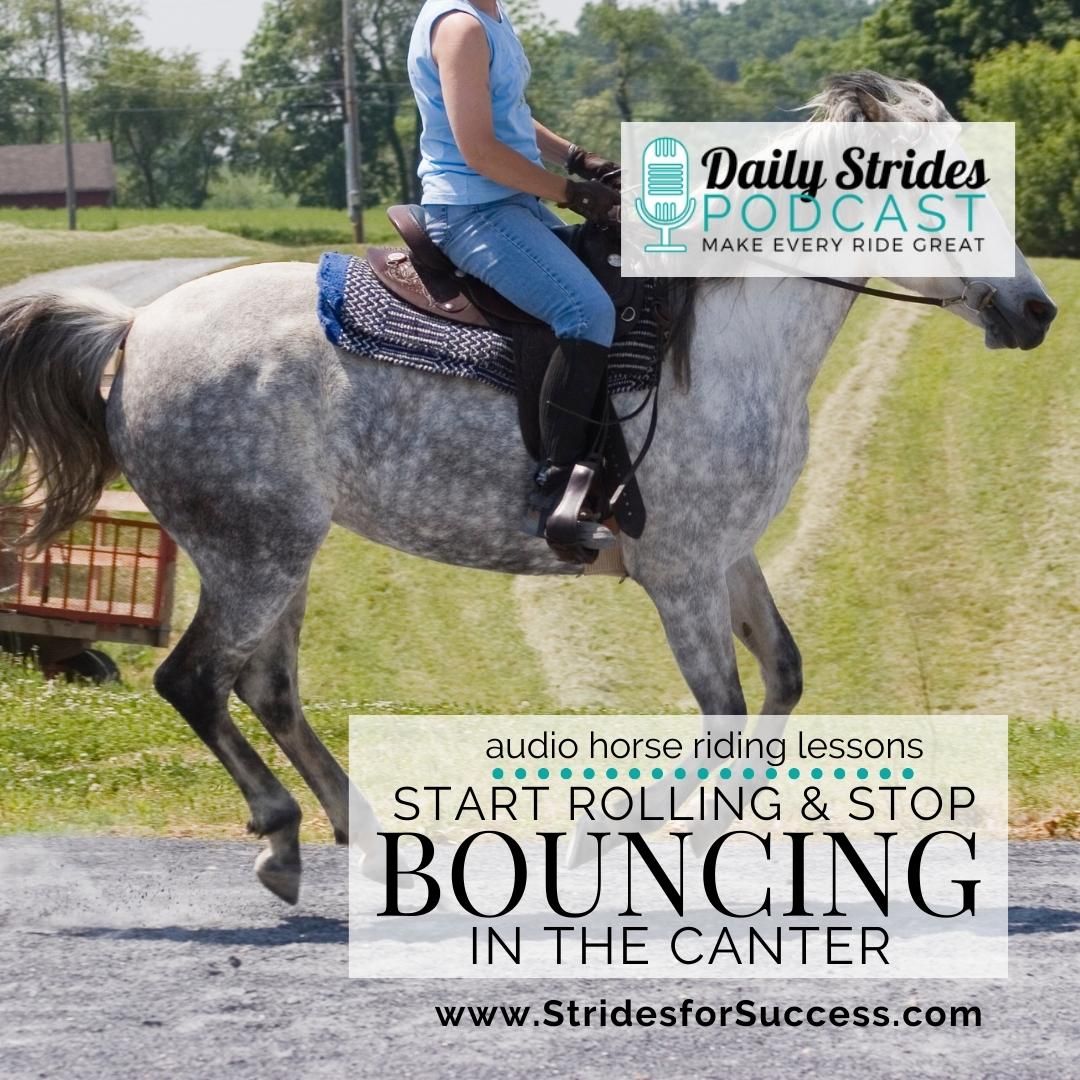
  • Start Rolling & Stop Bouncing in the Canter

    Start Rolling & Stop Bouncing in the Canter

    [fusebox_track_player url=”https://op3.dev/e/traffic.libsyn.com/dailystridespodcast/1285_Start_Rolling_Stop_Bouncing_in_the_Canter.mp3″ title=”Start Rolling and Stop Bouncing in the Canter” social_linkedin=”true” social_pinterest=”true” social_email=”true” ]

    One of the fun things about canter is the ‘moment of suspension’.  Except when this ‘moment’ applies to the rider, not just the horse!  Yes, there is a moment when the horse will be ‘off’ the ground; suspended in midair.  However, we definitely don’t want you to experience this bouncing in the canter.

    Becoming airborne whenever your horse strides in the canter is no fun!  And the ‘land’ when you connect with the saddle again brings little relief.  Instead of being a safe and reassuring place to ‘come back to earth’; it can feel like the saddle is trying to push you back into ‘thin air’ again.  Never a good feeling!

    In order to truly stop bouncing in the canter, I think you first have to understand the canter. And what your body needs to do in order to stay moving with the horse, rather than against it. 

     1. Start in Walk

    I think the walk is the perfect place to really begin moving your body in a way that will help your canter.  Allow the movement of the walk to move your body. Focus on how loose and supple your lower torso and seat can be.  Once your body has begun moving, you can really go deeper with what is actually happening.

    Instead of just thinking ‘backward and forward’ with your seat, notice the ‘higher and lower’ that goes with it.  Down and forward, up and back, down and forward, up and back…

    The ‘roll’ that we want to use to continue to move with our horse while cantering is just a more ‘advanced’ version of the roll you experience while in the walk. But so many riders are unconscious of this.  They fail to notice all of the little nuances. Spend time in the walk.  Know it with your eyes shut. And then practice some more.  This will truly help you when you canter.

     2. Understand the Canter

    Most of us understand that there is a moment of suspension in the canter.  And it is that moment of suspension that can cause so many hassles for riders! In order for you to really ride a smooth canter, every stride, it’s important to realize what is happening during the moment.

    In canter, you have 1,2,3, roll.  Then it repeats.  The ‘roll’ part, while not an actual beat, is really a silent beat.  It is where the horse resets.  Meaning your horse’s body and the legs pass over the inside front leg (the 3 in the canter stride sequence).  To do this, everything comes ‘up’.  It lifts.

    So, the down and forward happens during the 1,2,3.  And the up and back happen during the ‘roll’. Like a slightly wonky-shaped circle.  Down and forwards, up and back. 1,2,3, roll. 

     3. Self Carriage

    So once you know what is happening and you’ve begun to get to grips with your seat and how it’s moving, the next part is to really carry yourself.  Self-carriage is not just for horses. In fact, as riders, we should ideally be modeling this for our horses.

    One of the easiest ways to really begin carrying yourself while riding is to think about your posture and your position, When you work on your posture, you will naturally engage your core – and begin carrying yourself. 

    And this carrying yourself is key to being able to move with your horse, rather than working against him.  bouncing in the canter happens when we are moving against our horse.  It’s not pleasant for horse or rider, so working on your physical strength, fitness, posture, and position will help both you and your horse in the canter.

     4. Your Seat is a Pendulum

    Now, while I say ‘swing your seat’, I really mean allow your seat to be swung! As you get better at moving with the canter, yes, you can definitely use your seat to influence the canter. But for the start, just to get you out of the ‘bouncing mode’, you must learn to allow your seat to move with your horse.

    One of the easiest ways to think of this is that your seat is like a pendulum.  It is moving backward and forwards, underneath a certain point. And that point is pretty consistent.  In your case, the ‘point’ is your shoulders and upper body.  Your seat is your pendulum.

    Unfortunately, many riders are operating their pendulum upside down!  Their shoulders and upper body is doing all the movement. While the seat is stiff, stuck, and blocking. 

    Being able to move with your horse in the canter will require your body to be supple, elastic, and loose enough to move with your horse through each stride of the canter. And not just the forward and back, but also the down and up.  This truly creates the roll.

     5. Practicing, Correcting, & Practicing

    When you properly understand what is happening and can move your body, in walk, in preparation for ‘greater things’, then it is time to canter. Remember, bouncing in the canter happens on the roll.  So really start to become aware of the 1,2,3,roll. When you know what your body is supposed to be doing at which point in the stride, you can make adjustments.

    If you feel like you are losing rhythm and suppleness, reengage your core and carry yourself again. This will give your seat space to move with your horse.

    Cantering is not easy.  The more energy that is being created by the horse will always cause any weaknesses in the riders to be amplified.  In this case, it’s often a lack of posture, position, and suppleness. However, these can also all be worked on by becoming intentional when you ride.

    Happy Riding
    Lorna

    More on This Topic:-

    Training For Riders:-

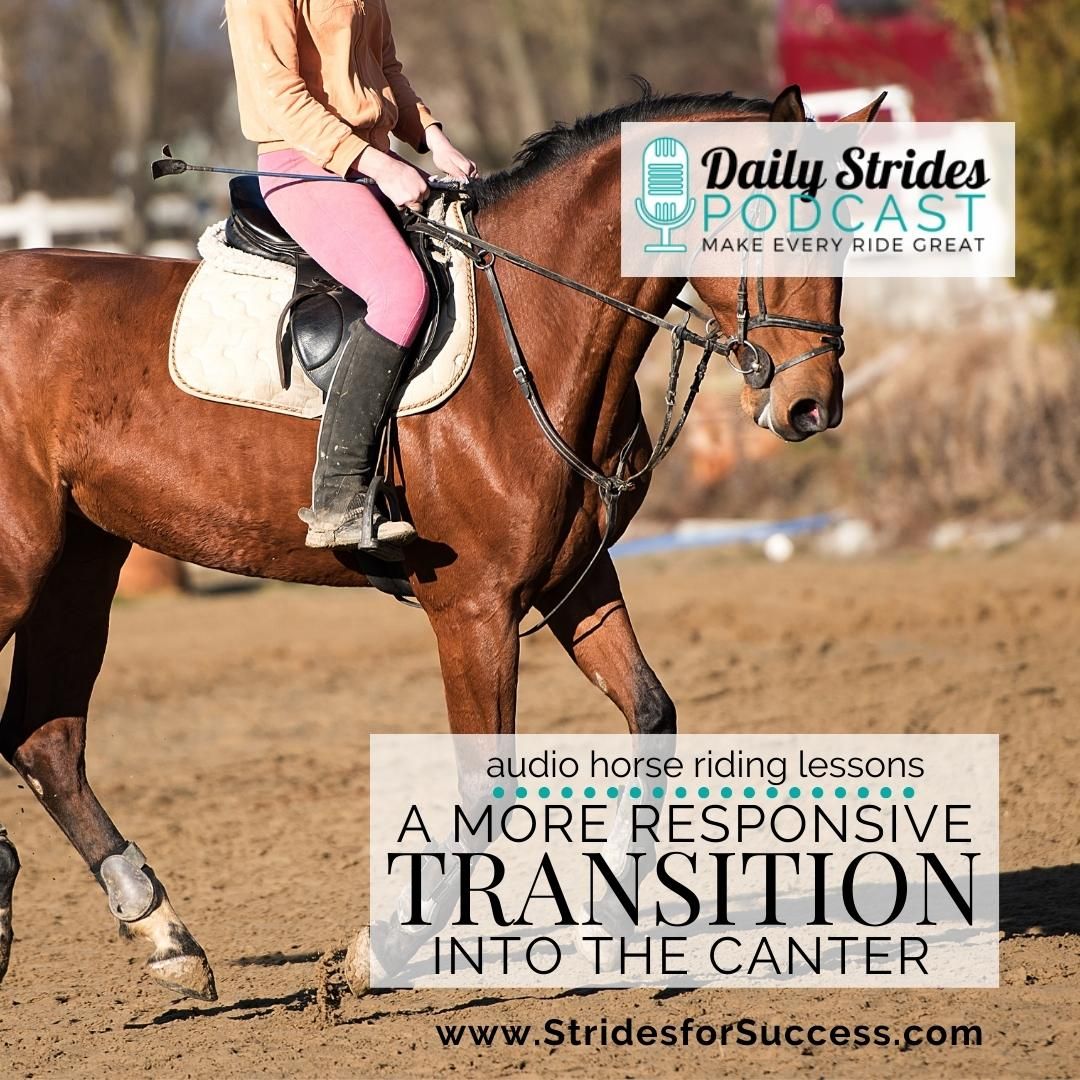
  • Creating a More Responsive Transition into the Canter

    Creating a More Responsive Transition into the Canter

    [fusebox_track_player url=”https://op3.dev/e/traffic.libsyn.com/dailystridespodcast/1284_More_Responsive_Transitions_into_the_Canter.mp3″ title=”Creating a More Responsive Transition into the Canter” social_linkedin=”true” social_pinterest=”true” social_email=”true” ]

    Getting into the canter can be a challenge! For so many riders the transition into the canter can be a truly bumpy, hair-raising, rushed, and flat experience.  There is none of the upward, poised, clean, and intentional 1 that leads to the 2, 3 for the canter stride. It is just a matter of creating enough momentum with a flat, running trot to finally, eventually, fall into the canter. Not good!  But all is not lost…

    I believe that by working on a few key elements in your riding and your training with your horse, you can literally transform your canter transition in a VERY short period of time.

    The key to doing this is to first be very honest with yourself.  Honest about both your abilities and what you are doing.  And also, your horse’s abilities. Is he actually  ‘able’ to simply step from a trot into a canter, carrying you, at this level in his training?  That there is a really good question and one that’s worth getting clear on today.

     1. Check All External Influences

    We have all heard of the horse who, once the feeding program was changed went from being a Lazy Daisy to an Arkle… And yet, so many riders simply fail to consider calories, protein, fats, vitamins, and minerals when it comes to their horse’s energy levels. I am not an equine nutritionist.

    However, I have seen (and personally experienced) how a simple tweak to the diet or supplements can have a massive impact on performance and concentration.

    This is always something to consider when your horse is struggling with energy levels during training. And the same can be said for tack and equipment.  How many horses ‘inherit’ a saddle and bridle?  I was guilty of this for years with my own ponies.  There’s a bridle with a certain bit in the tack room that is not being used.  Great – let’s shove it into ‘Shadow’s’ mouth.  Hmmmm…. We know our horses are individuals.  So it makes sense that their tack should be selected for them – individually.

    Make sure that all of the equipment, especially saddles, is allowing your horse the freedom of movement through his back and shoulders so that he can actually do what you ask him to do :) 

     2. How’s Your Responsiveness?

    So you ask a question.  Great.  What response do you get?  This past week I’ve worked with 3 different riders who want to ‘fix’ big things.  And yet, I sent them all home to work on their responsiveness.  You see, I believe that responsiveness is a rider issue…

    Responsiveness comes down to what expectations you set and what boundaries you are willing to communicate and enforce. 

    So many riders are ‘wishy-washy’ about things.  A simple pushover on the ground.  An unwillingness to walk ‘shoulder to shoulder’ (if you’re Irish you’re singing) as you lead from the ground.  Responsiveness matters.  And it all comes down to being clear on what you want – and how you ask for it.

     3. Understanding the Canter

    So the canter is lovely because there is this natural ‘moment of suspension’ involved in it.  We meet it every single stride.  Which also includes the very first stride.  And if we, as riders, are hoping for suspension… Well, it stands to reason that we are doing all we can to help that happen.

    If we are collapsed on our horse’s shoulders and withers as the transition happens… How can we expect our horse to elevate and ‘step up into’ the canter? We need to allow space for the transition to happen.  So for the 1 to happen – the first step of the 3 beat stride – there must be space for the 2 and the 3.

    It’s the upward trajectory of the canter that creates the momentum many riders can’t ‘sit’ or ‘handle’.  And this is a simple lack of self-carriage and suppleness through their own bodies that causes this issue. 

     4. Your Seat is a Pendulum

    A great way to begin improving your ability to ‘follow’ and ‘stay with’ your horse in the canter is to imagine your seat as a pendulum.  It is swinging from your shoulders or upper rib cage. Meaning that they should remain relatively consistent, while the seat is doing the movement.

    So many riders are riding the canter the wrong way around… Their shoulders are doing the ‘swinging’ while their seat is stiff, hunkered down, and blocking the natural flow. 

    I go into more detail on this in THIS ARTICLE. However, for now, just keep the idea in mind that your shoulders and upper body must remain in self-carriage.  This will allow your seat to literally go with your horse into the canter itself.

     5. Gain Clarity On Your Aids

    The final piece when improving your transition into the canter is to become really clear on your aids. And the fact that the word aids is plural is really important here!  There is no ‘one aid’ that will get you into the canter.  It is a combination of good preparation meeting an accurate and effective combination of aids.

    So many riders seem to think that their outside leg is a magic wand.  One swish of it and ‘voila’ your horse will be cantering!  Not so, not so…

    Your half halt is so important to really prepare both yourself and your horse.  It helps rebalance and refocus you both on working together to achieve something.  From there, your aids will then, if positioned and timed correctly, ask the question.  Which then leaves your horse the space to answer the question.

    Improve Your Transition into the Canter

    The canter is a big topic for riders. There can be so much pleasure and joy found there. And, often, an equal amount of bumps, flatness, and non-starts! If you are keen on improving your canter in just 4 weeks, make sure you take a look at my program Improve Your Canter.

    You will learn what is happening and how you can best time your aids so that your canter will go from being hit-and-miss to smooth and connected.

    With audio horse riding lessons to listen to 4 days a week while you ride, all filled with different exercises for you to practice, Improve your Canter will help you finally ride the canter the way you want.  Every single time.

    Happy Riding
    Lorna

    More on This Topic:-

    Training For Riders:-